A surveillance fight moving from the street to the courtroom
Four protesters have sued the Department of Homeland Security and the Federal Bureau of Investigation over the collection and retention of their DNA after arrests tied to protests against Immigration and Customs Enforcement activity. The lawsuit, filed in federal district court in Illinois, argues that the government has exceeded its authority by seizing genetic material from people arrested while peacefully protesting and then storing that information in federal systems.
The case is significant because it links a familiar flashpoint in U.S. politics, protest policing, to a more consequential and less visible one: the expansion of biometric surveillance. According to the supplied reporting, the plaintiffs are asking the court to stop what they describe as wrongful arrests, DNA collection, profile uploads to government databases, and permanent storage of DNA samples in federal labs.
The plaintiffs’ argument
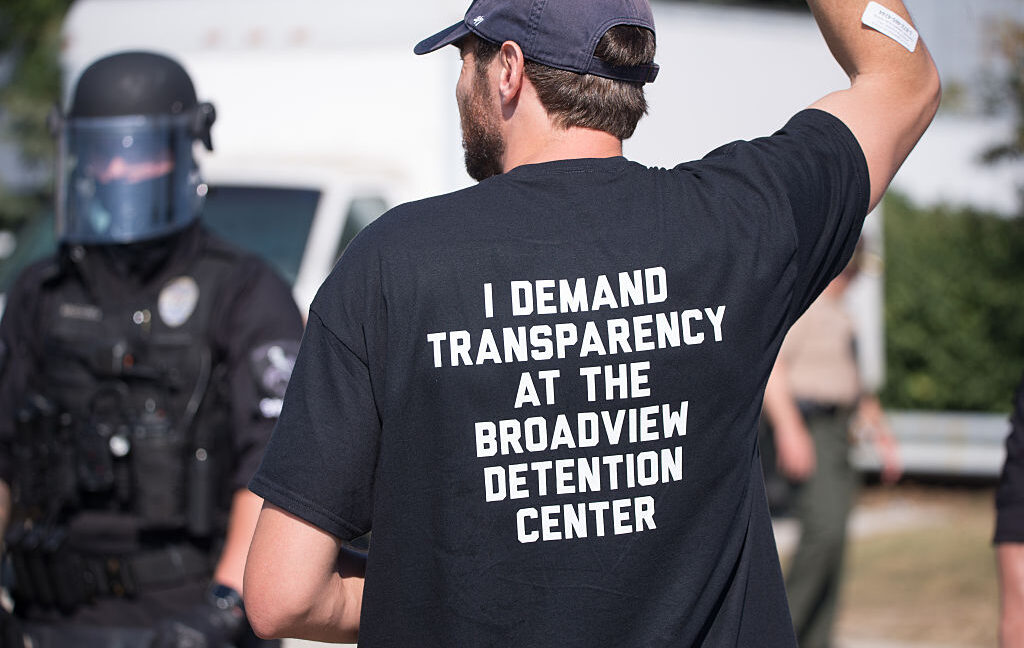
The source text says the lawsuit alleges violations of the First and Fourth Amendments as well as the Administrative Procedure Act. The protesters were arrested during what the report calls “Operation Midway Blitz,” when thousands of federal agents flooded Chicago. The arrests took place at the Broadview ICE facility.
The plaintiffs argue that the government is using authority intended for more serious circumstances to justify broad DNA collection from people who were either not charged, quickly saw minor charges dropped, or in one case pleaded guilty to a matter unrelated to the protests themselves. Out of 92 non-immigration arrests at Broadview, the report says, only one protester was convicted, and that conviction had nothing to do with the protest conduct at issue.
That statistic is central to the legal narrative. It supports the plaintiffs’ broader claim that the government collected deeply personal biometric information from people who were not established to be dangerous offenders and, in several cases, were not ultimately found culpable of protest-related wrongdoing at all.
The constitutional question
The lawsuit appears to turn heavily on how far existing precedent can be stretched. The source text references a 2013 Supreme Court case in which authorities were allowed to collect DNA under a specific set of circumstances: when a person has been validly arrested with probable cause for a serious offense and that arrest has been confirmed by a judicial officer. The reporting also says the resulting DNA use in that context is limited to identification purposes.
The plaintiffs say none of those conditions existed when their DNA was collected. That is the legal hinge of the case. If the court agrees that the government treated low-level protest arrests as grounds for a collection regime meant for more serious and clearly validated criminal circumstances, the implications could reach well beyond this one protest episode.
This is why the case is more than a dispute about booking procedures. DNA is not just another identifier. It is uniquely sensitive biological information, and the source text emphasizes that the plaintiffs fear it being folded into a wider surveillance system tied to ICE enforcement and protest monitoring.
Why this case has broader stakes
The supplied reporting frames the dispute in stark terms, accusing DHS of trying to build a vast DNA database that could be used to track critics of ICE. Whether a court ultimately accepts that characterization in full, the lawsuit spotlights a deeper concern: once collected, genetic data can persist in government systems long after the immediate arrest context has faded.
That creates a one-way ratchet problem. Temporary arrests can lead to long-term data retention. Minor accusations can generate permanent biometric records. Protest activity, even when peaceful, can become an entry point into a surveillance infrastructure that is much harder to challenge after the fact.
For civil-liberties observers, that is the real significance of the case. It forces the judiciary to confront whether protest-related arrests are being leveraged to normalize an aggressive form of biological data collection. For federal agencies, the case could test how far arrest-based DNA authority extends when the underlying conduct is politically charged, constitutionally protected at its core, and often only loosely connected to criminal prosecution outcomes.
What is established now
The lawsuit has been filed, the constitutional claims are on the record, and the reporting provides a concrete factual frame: four protesters are asking a court to stop DHS and the FBI from collecting, storing, and uploading DNA taken after ICE-related protest arrests. The government’s authority to do that is now under direct challenge.
The final outcome will depend on the courts. But the immediate development is already substantial. A fight over immigration protest enforcement has become a test case about the limits of biometric power in domestic policing, and about whether the government can transform short-lived arrests into permanent entries in a genetic surveillance system.
This article is based on reporting by Ars Technica. Read the original article.
Originally published on arstechnica.com