A major reuse milestone arrived with an asterisk
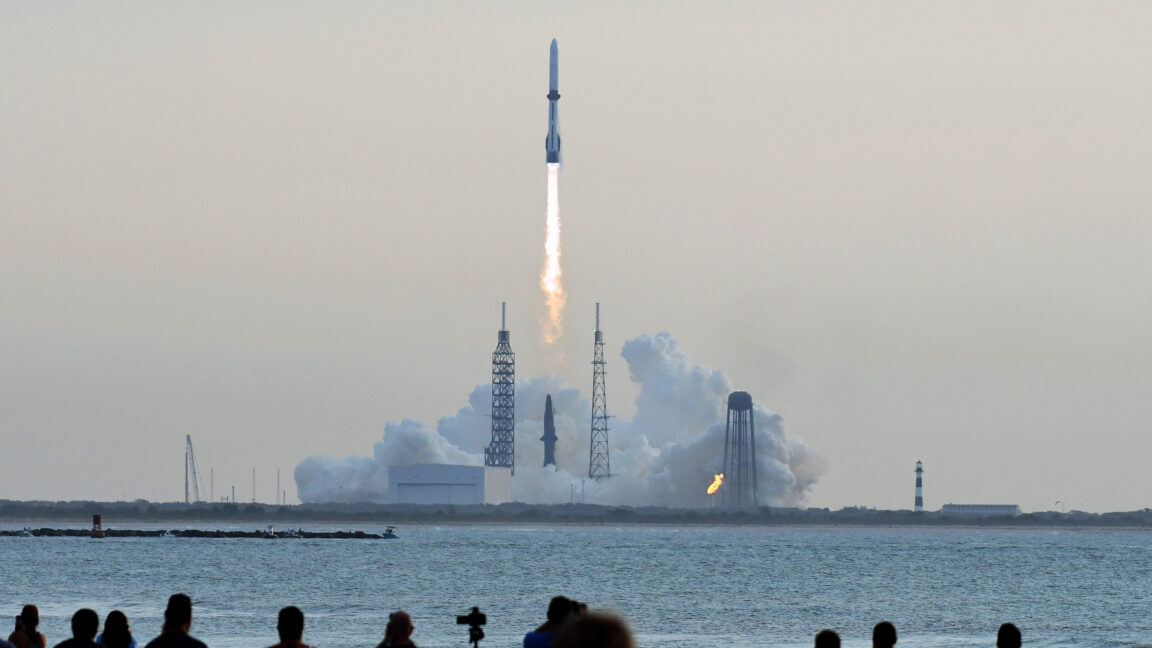
Blue Origin reached an important benchmark on April 19 when it successfully reflown and recovered a New Glenn first-stage booster for the first time. The company’s heavy-lift rocket lifted off from Cape Canaveral Space Force Station in Florida at 7:25 a.m. Eastern, with the booster completing a downrange landing on Blue Origin’s recovery platform in the Atlantic less than 10 minutes later.
That recovery mattered. New Glenn is Blue Origin’s flagship orbital launcher and a central part of the company’s bid to compete more directly in the commercial launch market while supporting high-profile government work, including roles connected to NASA’s Artemis program. Reusing a booster at this scale is a harder technical problem than recovering the smaller New Shepard vehicle Blue Origin has already flown multiple times.
But the success did not extend through the entire mission. According to Ars Technica’s report, New Glenn’s upper stage failed to complete its job, turning what might have been an unambiguous breakthrough into a mixed result. The flight demonstrated that Blue Origin can bring a large orbital booster back for another trip, but also showed that full mission reliability remains a work in progress.
Why the booster landing matters
New Glenn stands 321 feet tall and launches with seven methane-fueled BE-4 engines on its first stage. On this third flight, the booster separated roughly three minutes into the mission and followed a controlled trajectory back toward Blue Origin’s landing platform. After two braking burns, it touched down on target.
The recovered booster, named Never Tell Me The Odds, had already flown once before on a previous New Glenn mission in November. This second use marked Blue Origin’s first successful reflight of an orbital-class booster, a capability now widely viewed as essential to lowering launch costs and increasing cadence.
Blue Origin CEO Dave Limp said technicians installed new engines on the reused booster for this mission, while the company intends to eventually reuse engines from earlier flights as well. That detail is important because true operational reusability is not only about recovering hardware, but about minimizing how much refurbishment or replacement is required between missions.
SpaceX has set a demanding benchmark in this area, repeatedly reflown Falcon 9 boosters on short turnarounds and at high flight rates. Blue Origin is still earlier in that curve. Even so, demonstrating that a New Glenn booster can survive a mission, return to a ship, and fly again is a notable systems-level validation.

The setback in the upper stage
The mission’s upper stage was powered by two BE-3U engines burning liquid hydrogen and liquid oxygen. That stage was supposed to carry the rest of the mission after separation, but the flight reportedly ended with an off-nominal upper stage performance. The source text does not provide a full technical root cause, and Blue Origin’s post-flight path will likely depend on data review and anomaly investigation.
That distinction matters because launch customers and government partners ultimately buy complete mission success, not just an impressive first-stage recovery. A reliable upper stage is especially important for missions beyond low-Earth orbit and for any role in cislunar logistics or deep-space architecture.
In practical terms, the April 19 mission can be read two ways at once. It strengthened confidence in Blue Origin’s booster reuse strategy, while raising fresh questions about how quickly the company can mature the rest of the vehicle. Both are true.
What this means for Blue Origin’s position
New Glenn is one of the most closely watched rockets outside SpaceX because it sits at the intersection of national space policy, commercial launch competition, and the long-running effort to build an alternative US heavy-lift provider. For Blue Origin, each flight is not just a technical exercise but a credibility test.
The company needed a visible reusability win, and it got one. That helps show customers and policymakers that Blue Origin is moving beyond demonstration toward reusable operations at orbital scale. At the same time, the upper stage issue means the company leaves this launch with both a success story and a debugging agenda.
That is common in rocket development, but it also compresses schedules. Heavy-lift launch vehicles gain trust slowly. Every flight can shift perceptions about readiness, especially when competitors already offer proven alternatives.
For now, Blue Origin can point to a genuine first: an orbital-class New Glenn booster flew twice and landed successfully after its second mission. That is a serious achievement. The harder part is still ahead: turning isolated milestones into repeatable mission performance across the full stack.

What to watch next
- Blue Origin’s explanation of what went wrong on the upper stage.
- How much refurbishment the reflown booster will require before another mission.
- Whether the company can begin reusing engines from prior flights, not just the booster structure.
- How quickly New Glenn can build a consistent launch record after this mixed outcome.
April 19 did not deliver a clean victory lap. It did, however, show that Blue Origin has crossed one threshold in reusable heavy launch. The company now has to prove it can carry that progress through the rest of the vehicle and the full mission profile.
This article is based on reporting by Ars Technica. Read the original article.
Originally published on arstechnica.com


