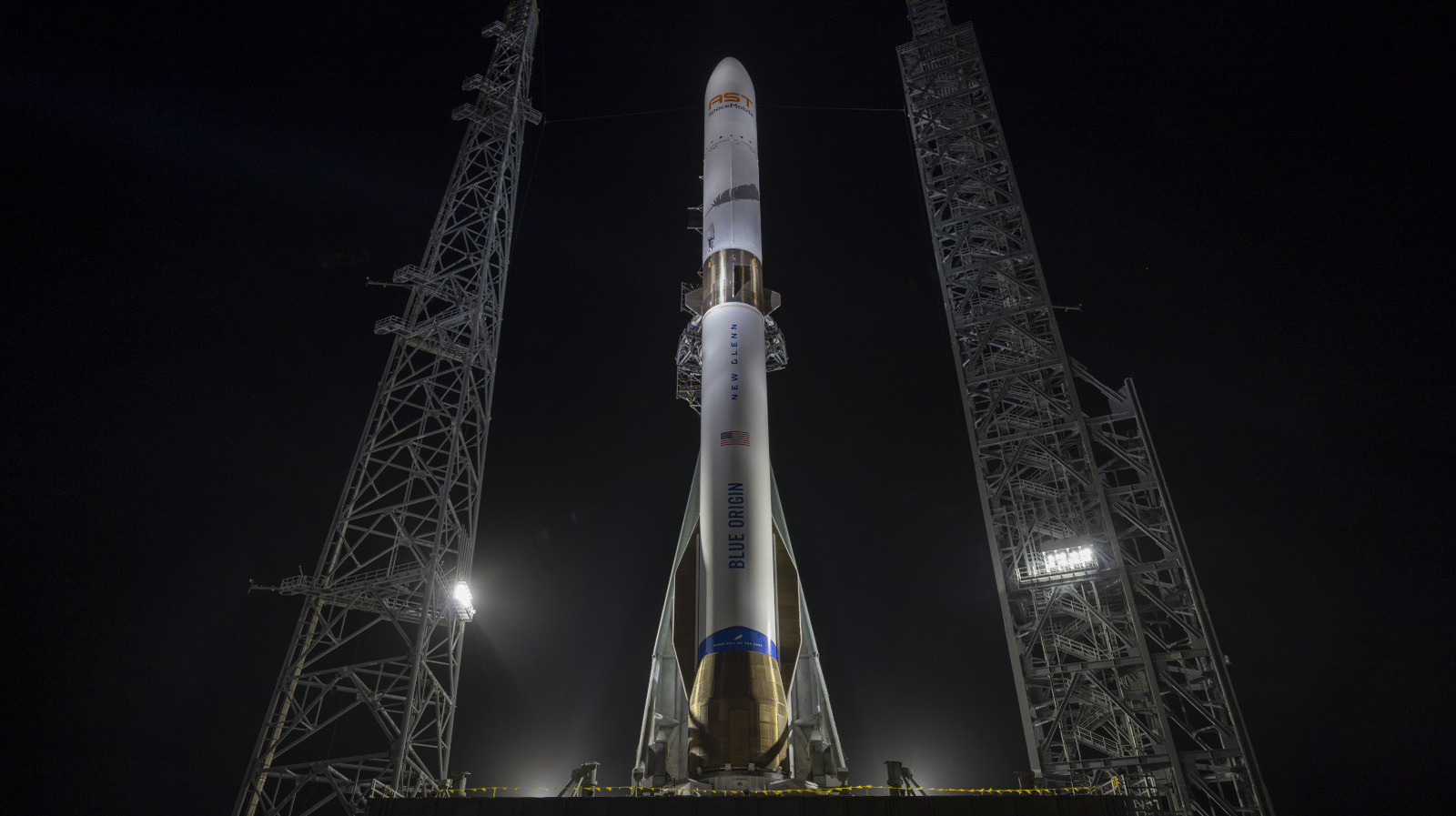
A major setback hit Blue Origin before New Glenn’s next mission could begin
Blue Origin’s New Glenn program suffered a serious blow when the company’s heavy-lift rocket exploded on the launchpad during ground testing at Cape Canaveral Space Force Station. The company said it experienced an anomaly during a hot-fire test and that an investigation is under way. Jeff Bezos later said all personnel were safe and accounted for.
The immediate facts point to a severe hardware loss. Reporting cited in the source text says the fully stacked rocket was effectively obliterated along with nearby equipment, and New Atlas described visible damage to surrounding infrastructure, including the apparent loss of a lightning tower. More importantly for Blue Origin’s schedule, this was the company’s only launchpad for New Glenn.
That detail changes the event from a vehicle failure into a program disruption. Rockets can be rebuilt, sometimes faster than launch complexes can be repaired. When the damaged site is the sole operational pad for a heavy-lift system, every mission linked to it is exposed to delay.
Why the timing is especially painful
The explosion came as Blue Origin was preparing for New Glenn’s next mission after already working through regulatory and technical setbacks. According to the supplied source text, the Federal Aviation Administration had only recently cleared the rocket to return to flight following an earlier mission failure in which the payload was not placed into orbit. The agency’s investigation attributed that prior incident to a cryogenic leak that froze a hydraulic line and caused a thrust anomaly during second-stage engine burn.
In other words, New Glenn was already in recovery mode. The program was trying to return to operational momentum after a difficult stretch, and the hot-fire test was part of that climb back. Instead, the test itself became the next major failure event.
That matters because heavy-lift credibility is built on repetition. Operators need to demonstrate not just that a rocket can fly, but that it can return to flight, absorb failure, and sustain cadence. A destroyed vehicle and damaged pad interrupt all three.

NASA consequences are now in view
The broader implications extend beyond Blue Origin’s internal schedule. The source material says New Glenn is central to the company’s role in NASA’s Artemis and Moon Base programs, including lunar lander work for cargo and crew missions. NASA Administrator Jared Isaacman said the agency was aware of the anomaly and would work with partners to support a full investigation, assess near-term mission impacts and provide further information as it becomes available.
NASA’s response was measured, but the message was clear: mission consequences are possible, and they are not yet fully known. Space agencies expect launch setbacks, especially in heavy-lift development, but dependencies still matter. If a program rests on a single rocket family and that family loses both a vehicle and launch infrastructure, contingency planning becomes unavoidable.
The source text also notes that NASA had chosen Blue Origin over SpaceX for the Moon Base I mission it hoped to launch this fall. Even without drawing conclusions beyond the supplied material, the implication is straightforward. Any major interruption to New Glenn readiness forces a reassessment of timeline confidence for the missions that need it.
The harder lesson for launch companies
Spaceflight failures are often discussed in terms of engineering difficulty, and that is true here. Isaacman described heavy-lift launch development as extraordinarily hard, and that is a fair summary. But this accident also underscores a more operational lesson: single-point infrastructure dependencies are strategic vulnerabilities.
Blue Origin may still be able to recover with enough capital, time and engineering discipline. Bezos signaled exactly that, saying the company would rebuild whatever needed rebuilding and return to flight. The question is not whether Blue Origin intends to continue. The question is how long recovery takes when the damaged asset is not just a rocket, but the ground system required to launch the next one.
For competitors, the incident reinforces the advantage of mature launch operations with more than one proven workflow. For customers, it is a reminder that booking capacity on a developing launch system carries schedule risk even after regulators restore flight approval. For Blue Origin, it is one of the harshest forms of reset a space company can face: a failure on the ground that can still reach forward into future missions.
New Glenn was supposed to be the vehicle that expanded Blue Origin’s role in commercial, national-security and civil spaceflight. It still may. But after this explosion, that future will depend less on the original mission plan than on the speed and quality of the recovery now underway.
This article is based on reporting by Engadget. Read the original article.

Originally published on engadget.com


