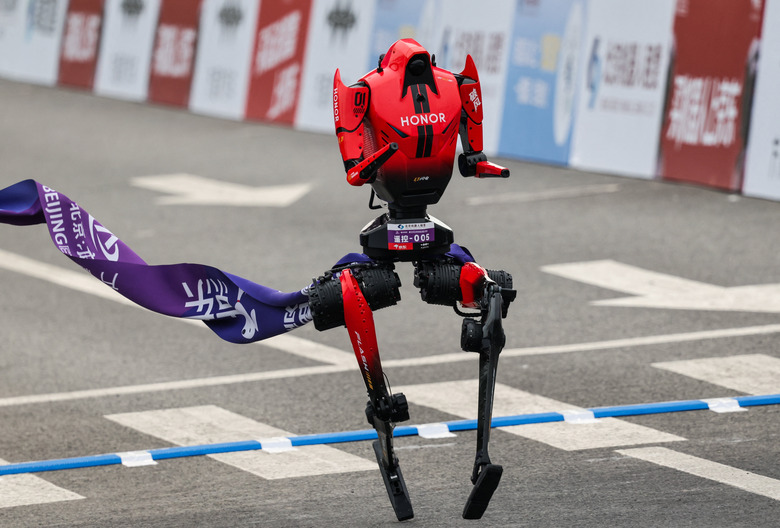
Beijing’s second robot half-marathon looked much more like a technology demonstration than a spectacle of failure
Beijing has staged its humanoid robot half-marathon for a second year, and the contrast with the inaugural event is striking. The 2026 race featured more than 100 competitors, according to the supplied source text, and the headline result was a winning time of 50 minutes and 26 seconds from Honor’s robot, Lightning. That is a major improvement from the first edition of the race, when the fastest robot reportedly needed two hours and 40 minutes to finish and many machines required close human assistance.
The event matters because it offers a public stress test for a class of machines that is often shown only in tightly controlled demos. A 13-mile course exposes problems in balance, endurance, locomotion, sensing and decision-making all at once. In that sense, the improvement from last year to this year suggests more than better race preparation. It indicates that at least some humanoid systems are beginning to handle longer, more demanding real-world tasks with greater consistency.
Honor’s performance stood out, but autonomy remains the bigger benchmark
Honor, better known for smartphones, took first place and also swept the podium, according to the source material. State broadcaster CCTV said the company’s top finishers navigated the course autonomously, which is the most significant claim in the report. Raw speed is useful, but autonomy is the more meaningful measure because it reflects how much sensing, control and route handling the robots can manage without continuous human direction.
That said, autonomy was not universal across the field. The BBC, as cited in the source text, reported that roughly 40 percent of the robots competed autonomously, while the remainder were remote-controlled. That split is important. It shows the field is improving, but it also shows the technology is still transitional. Some builders are comfortable letting their machines operate largely on their own in a public endurance event. Many others are not there yet.
The winning time itself is eye-catching, especially because the Engadget report notes it was several minutes faster than the recently set human half-marathon record by Uganda’s Jacob Kiplimo. But the comparison should be treated as symbolic rather than literal. The more useful takeaway is not that robots have overtaken elite human runners in a meaningful athletic sense. It is that a humanoid robot can now cover a long course at a pace that would have seemed improbable in the context of last year’s race.

From comic failures to credible engineering progress
The first edition of Beijing’s robot half-marathon was memorable largely because of its mishaps. The supplied text recalls falls at the starting line and widespread operator support, creating the impression that the event had outrun the technology. This year, crashes still happened, including incidents involving Honor’s robots, but they did not dominate the story in the same way.
That distinction matters because robotics progress is often nonlinear. A system can look awkward and fragile in one public outing, then appear far more competent after improvements in gait control, battery management, perception software and recovery behavior. Endurance events are especially useful because they expose not only peak capability but also failure rates. If a robot can stay upright, maintain speed and complete a course over 13 miles, that says something more durable than a short choreographed clip.
The event also highlights a broader pattern in Chinese robotics: companies are willing to put prototypes into visible, competitive public settings. That creates embarrassment when systems fail, but it also creates a clearer baseline for measuring progress. This year’s results suggest that developers learned quickly from the shortcomings of the first race.
Why the race matters beyond sport
A robot half-marathon is not a direct proxy for warehouse work, factory labor or home assistance. Still, the underlying capabilities overlap. Humanoid machines intended for real environments need stable bipedal movement, energy efficiency, route handling and the ability to keep functioning over time without constant intervention. A long race compresses many of those demands into a single public test.
The field’s mixed results also underscore how early the sector still is. If only around 40 percent of entrants were autonomous, then reliability and control remain major bottlenecks. Crashes, even among top performers, show that the winning systems are not yet polished products. But that is exactly why the improvements matter. The gap between “can perform a demo” and “can repeat a demanding task” is where much of robotics development succeeds or fails.

The real story is the rate of improvement
The strongest signal from Beijing is not the spectacle of robots racing humans. It is the compression of progress into a single year. Moving from a competition remembered for stumbles and operator support to one with more than 100 entrants, significantly faster completion times and a meaningful share of autonomous runs suggests a sector evolving quickly.
That does not mean humanoid robots are suddenly ready for broad deployment. The source text makes clear that remote control remains common and failures still occur. But it does suggest that long-distance, semi-structured physical tasks are becoming more manageable for some platforms. For an industry trying to prove that humanoids can do more than short demos, that is a meaningful milestone.
This article is based on reporting by Engadget. Read the original article.
Originally published on engadget.com


