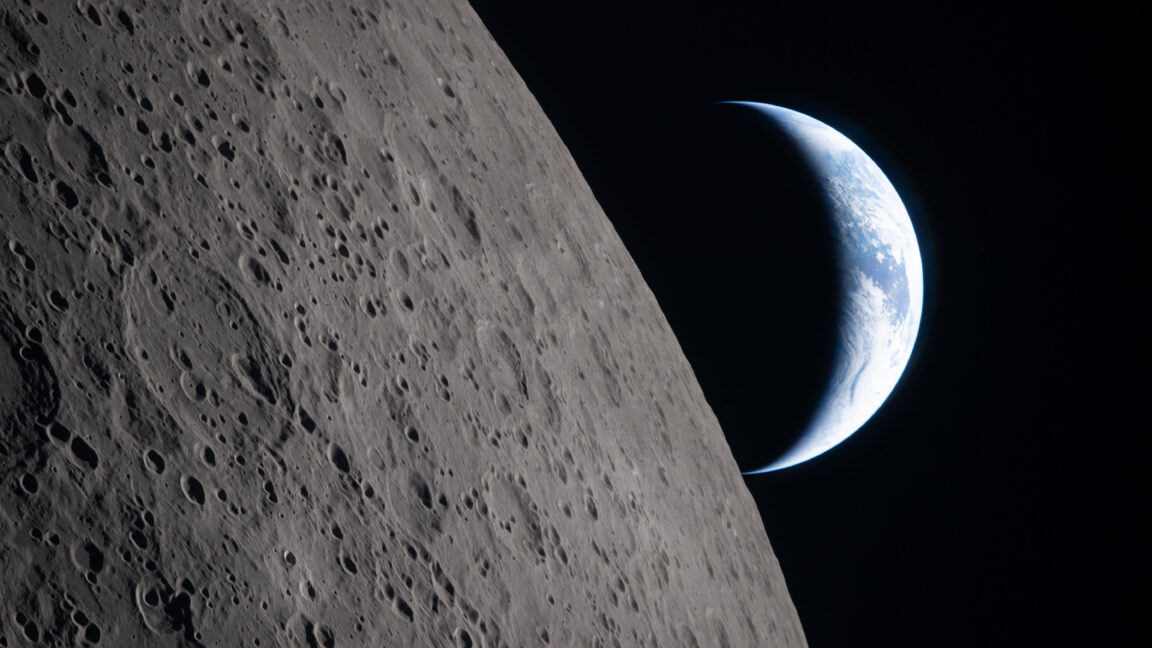
Artemis II reaches a new deep-space milestone
NASA’s Artemis II mission set a new distance record for human spaceflight as its Orion spacecraft passed behind the Moon and moved farther from Earth than any crewed mission before it. According to the supplied report, the spacecraft reached 252,756 miles, or 406,771 kilometers, from Earth shortly after its closest approach to the lunar surface. The mission also passed within 4,067 miles, or 6,545 kilometers, of the Moon.
The achievement is significant not only because it breaks a historical record, but because it marks the first time in more than 53 years that humans have returned to the vicinity of the Moon. Artemis II is not a landing mission. Its value lies in proving that NASA’s Space Launch System rocket, Orion spacecraft, mission operations, and crew procedures can support a future return to the lunar surface.
A crewed test of NASA’s Moon architecture
The four-person crew includes Reid Wiseman, Victor Glover, Christina Koch, and Jeremy Hansen. Their flight serves as the first human mission on NASA’s Space Launch System rocket and Orion capsule. The supplied source describes the spacecraft, named Integrity, as performing well after launch and through its lunar flyby phase.
That matters because Artemis II is doing more than recreating Apollo-era symbolism. It is testing the hardware and human systems that NASA wants to rely on for a sustained lunar campaign. In the supplied account, the astronauts spent three years training to pilot Orion, respond to emergencies, and prepare for the risks of the first crewed flight of this system. NASA also trained them in geology and photography so they could document lunar features during the flyby.
Those preparations point to one of the mission’s broader goals: turning a lunar pass into a field exercise for future exploration. Even without landing, the crew is practicing observation, documentation, and operations in deep space, where delays, limited bandwidth, and periods without contact with Earth all become part of the job.

The Moon comes back into focus as a destination
The supplied report emphasizes the astronauts’ reaction as the Moon filled Orion’s windows. Live images showed the lunar surface growing larger during final approach, while exterior cameras sent low-resolution video back to Earth. Higher-resolution telephoto imagery was expected to be downlinked later.
That visual record is more than public outreach. Artemis is meant to reposition the Moon from a historic achievement into an active exploration target. The astronauts’ training in geology and surface photography reflects that shift. NASA wants crews not just to visit lunar space, but to study it in ways that support later missions.
In that sense, the Artemis II flyby is a bridge mission. Apollo demonstrated that humans could reach the Moon. Artemis is trying to show that lunar exploration can become a repeatable program with modern systems, new crews, and a broader scientific agenda.
Deep-space operations remain central to the test
The most operationally demanding part of the mission came as Orion moved behind the Moon, temporarily cutting the crew off from mission controllers in Houston. The supplied source notes that the distance record and closest approach both occurred while the spacecraft was out of contact with Earth.
That blackout is a reminder that deep-space human missions still require crews to operate with substantial autonomy. Even on a carefully planned lunar flyby, communication gaps and bandwidth limits shape what astronauts can do and how quickly ground teams can respond. Artemis II is therefore testing not just engines and navigation, but decision-making and resilience in a more isolated environment than low Earth orbit.
The report also indicates that NASA’s preparation paid off. Orion was said to have performed well since launch, suggesting that the spacecraft’s systems remained stable through one of the mission’s most watched phases.

Why the record matters
Records alone do not guarantee long-term success, and Artemis II’s importance will ultimately be judged by what it enables next. Still, the milestone has practical and political weight. It demonstrates that NASA can once again send astronauts into deep space, a capability absent since the Apollo era. It also gives the Artemis program a concrete achievement tied to a crewed mission rather than a future promise.
For NASA, that matters because Artemis is both a technical program and a strategic one. It is intended to support future lunar surface missions, reinforce U.S. leadership in space exploration, and establish the operational foundation for more ambitious expeditions later on. A crew safely reaching record distance and rounding the Moon strengthens the case that the architecture is progressing beyond paper plans.
The mission also reframes the Moon itself. The supplied source describes the crew as observing the near side and far side with a sense of awe that is difficult to put into words. That reaction has always been part of lunar exploration, but Artemis is trying to convert it into continuity: repeated missions, better documentation, and preparation for later human activity around and on the Moon.
What Artemis II signals next
Artemis II is still a test flight, and its success depends on safe completion as much as headline moments. But the distance record, the close lunar pass, and the crew’s successful operations behind the Moon all show a system being exercised in the environment it was built for.
If NASA can close out the mission cleanly, Artemis II will stand as more than a ceremonial return to cislunar space. It will be an operational proof point that crewed exploration beyond low Earth orbit is active again. After five decades without humans near the Moon, that is the real development: the lunar frontier is no longer just historical memory. It is once again being flown.
This article is based on reporting by Ars Technica. Read the original article.

Originally published on arstechnica.com


