Ankara makes its case in a shifting security order
Turkey is pushing for a larger place in Europe’s defense architecture as the United States reassesses its security guarantees on the continent, according to Defense News. The message from Ankara is direct: excluding Turkey from European defense initiatives would damage Europe’s security and resilience more than a reduction of U.S. forces in Europe.
The argument was laid out by Turkish Defense Minister Yaşar Güler at a conference marking the 74th anniversary of Turkey’s entry into NATO. In remarks reported by Defense News, Güler criticized the European Union’s reluctance to fully open its defense structures to Ankara, despite Turkey’s longstanding role inside NATO.
This is not just a diplomatic complaint. It is a strategic positioning effort at a moment when the foundations of transatlantic security appear less settled than they have for years.
Turkey says it is no longer a flank state
One of the clearest lines in the Defense News report is Güler’s claim that Turkey is no longer simply a southeastern flank country on NATO’s periphery. He described it instead as a central ally capable of generating security across the European theater. That framing matters because it reflects how Ankara wants to be seen: not as a difficult partner outside the EU club, but as an indispensable military actor whose role has outgrown older geographic assumptions.
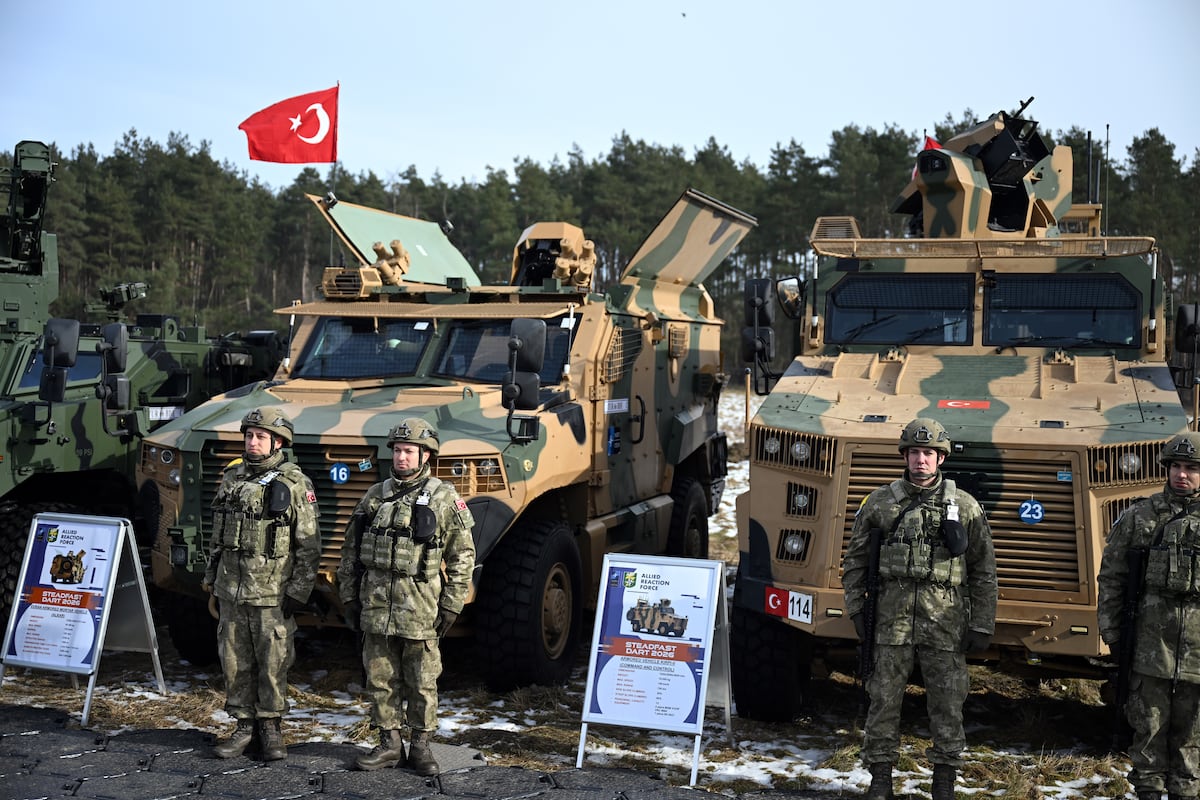
The case rests on several assets Turkey says it can bring to Europe. Defense News notes Ankara’s emphasis on its large standing military, combat experience, strategic geography between Europe and the Middle East, and an industrial base able to produce drones, munitions, armored vehicles, and naval platforms at speed.
That industrial dimension is particularly relevant at a time when European governments are increasingly focused on production capacity as much as on doctrine or force posture. A partner able to manufacture at scale can matter as much as one able to deploy forces.
The U.S. factor is driving urgency
The timing of Turkey’s push is closely tied to uncertainty over Washington’s future role. Defense News frames Ankara’s argument against the backdrop of President Donald Trump questioning U.S. commitments to Europe. If the American security umbrella becomes less reliable, then the value of capable regional allies rises.
That is where Turkey sees an opening. By presenting itself as a central security provider rather than a peripheral one, Ankara is trying to convert geopolitical anxiety into institutional influence. The warning is that European defense planning cannot afford to sideline one of NATO’s most militarily substantial members simply because it sits outside the EU.
There is also a self-protective element here. The article notes that Turkey faces an increasingly complex threat environment of its own. In Ankara’s view, a weakened NATO or fragmented European defense posture would not just hurt Europe generally. It would leave Turkey more exposed amid regional instability.
NATO command and political leverage
Defense News reports that Turkey will assume command of NATO’s Allied Reaction Force from 2028 to 2030. That is more than a ceremonial detail. It gives Ankara a concrete example of alliance trust and operational relevance at a time when it is arguing for greater inclusion elsewhere.
Experts cited in the article reinforce the point. Serhat Güvenç of Kadir Has University said Turkey has become one of the few NATO allies able to contribute across multiple operational domains with meaningful scale. The report adds that countries on NATO’s eastern flank, including Poland, Romania, the Baltic states, and Nordic allies, increasingly recognize Turkey’s value as Europe tries to strengthen deterrence against Russia while managing instability to its south.
That does not erase the political obstacles between Turkey and EU institutions. But it does show why Ankara believes the strategic case for inclusion is getting stronger even if the formal barriers remain.
Europe’s defense debate is broadening
The larger significance of the story is that Europe’s defense conversation is no longer only about budgets or procurement. It is also about membership, alignment, and which countries are treated as core contributors in a more autonomous security order.
Turkey wants that order to be built in a way that recognizes military capability and strategic geography, not just EU status. Whether Europe agrees will shape more than Ankara’s diplomatic standing. It could influence how effectively the continent can organize deterrence and force generation in a period of widening instability.
At minimum, the Defense News report makes one point clear: Turkey is no longer content to be treated as adjacent to Europe’s defense future. It wants to be inside it.
This article is based on reporting by Defense News. Read the original article.
Originally published on defensenews.com