The Pentagon Has Asked for Far More Missiles Than Industry Can Immediately Produce
The Pentagon’s fiscal 2027 budget request calls for a dramatic increase in missile procurement, putting a hard number on a concern U.S. defense planners have been signaling for years: the country does not believe its current stockpiles are adequate for a more dangerous era. According to budget documents cited by Breaking Defense, the plan includes roughly $70.5 billion for missiles and related line items across the Army, Navy, and Air Force, a 188 percent increase over the amount approved for fiscal 2026.
That figure is striking not just because of its size, but because experts quoted in the report agree the defense industrial base cannot simply turn on enough production capacity to absorb such a jump in one year. The likely result is a budgeting and contracting strategy designed to stretch spending over multiple years while signaling to manufacturers that demand for munitions is not temporary.
A budget shaped by stockpile anxiety
The Pentagon’s broader FY27 defense proposal totals $1.5 trillion, including $1.15 trillion in the base budget and another $350 billion expected from a reconciliation bill. Inside that framework, the missile-related request breaks down to about $36.6 billion for the Army, $22.6 billion for Navy weapons, and $11.3 billion for the Air Force.
For comparison, the combined munitions figures for those three services were just under $20 billion in FY25 and $24.4 billion in FY26. The step change now being proposed makes the underlying message unmistakable. U.S. planners believe the country needs much deeper reserves of higher-end munitions than it currently has.
Becca Wasser of Bloomberg Economics described the request as a “generational budget,” arguing that it is intended to overcome longstanding challenges and reposition the United States for the future. That interpretation fits with the long-running concerns about a potential conflict with China and the observed rate at which modern wars can consume expensive precision weapons. It also reflects the reality that replenishment has become more urgent as U.S. forces draw from existing inventories in current operations.
Why current operations matter
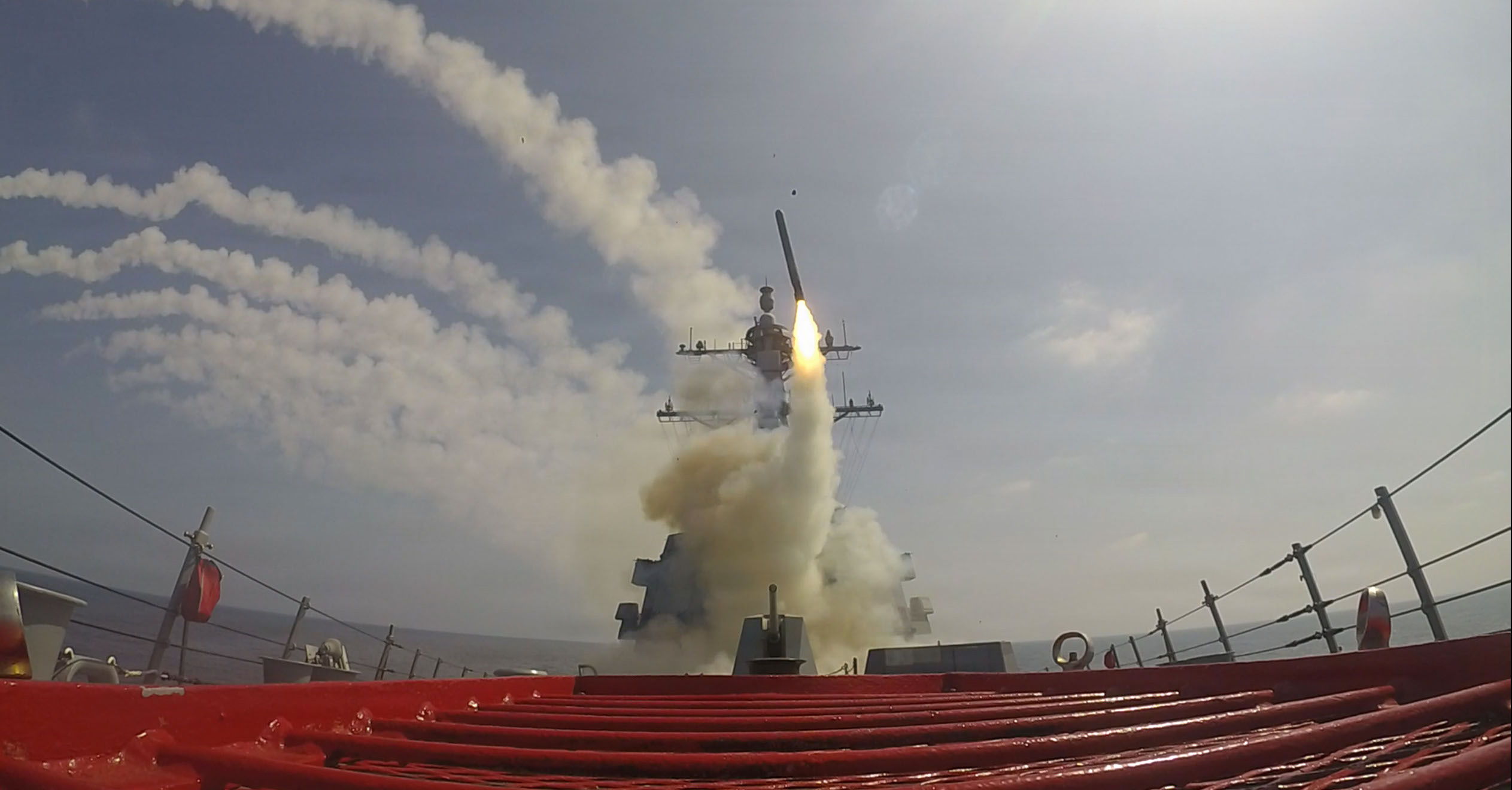
Breaking Defense notes that the pressure has intensified as American forces have drawn deeply into stockpiles of key weapons such as Tomahawk cruise missiles and PAC-3 interceptors for Operation Epic Fury against Iranian forces. That operational drawdown adds immediacy to an issue that might otherwise have remained framed as a future contingency problem. Stockpiles are not just theoretical reserves for a later crisis. They are being consumed now.
That matters for congressional politics as well. It is easier to argue for sustained investment when lawmakers can point both to near-term operational use and to strategic competition with China. The Pentagon appears to be using the FY27 request to show Congress exactly how seriously it now takes munitions readiness and to challenge lawmakers to match rhetoric with appropriations.
As Wasser put it, the request puts the onus on Congress. In effect, the Pentagon is saying it is willing to pursue steadier procurement, but legislators must fund it.
Industry cannot ramp overnight
The most important practical constraint is manufacturing capacity. A 188 percent increase in requested missile procurement does not mean factories can deliver 188 percent more product on demand. Production lines for advanced weapons depend on specialized suppliers, long-lead components, skilled labor, and often regulatory and contracting stability that only emerges when companies believe demand will persist for years.
That is why analysts in the report expect the Pentagon and Congress to structure spending in a way that allows fiscal 2027 funds to be used over several years. The point is not simply to place a one-year shopping list. It is to underwrite a durable expansion in capacity by telling industry that this is a sustained strategic priority.
That approach would also help smooth the mismatch between appropriated dollars and deliverable output. It is one thing for the government to budget for more missiles. It is another for primes and suppliers to add tooling, expand facilities, and secure the inputs necessary to produce them at scale. Multi-year visibility is often the bridge between policy ambition and industrial reality.
A signal about the defense era ahead
The proposal is therefore important as both a procurement plan and a strategic signal. It tells allies, adversaries, Congress, and manufacturers that Washington sees munitions depth as central to military credibility. It also acknowledges that the United States is trying to correct a deficit that has been exposed by both real-world operations and the projected demands of high-end conflict.
None of this guarantees the request will survive unchanged. Congress could alter funding levels, sequencing, or contract authorities. The industrial base could also struggle more than expected, even with policy support. But the scale of the request suggests that the debate has already shifted. The Pentagon is no longer asking whether to make a major stockpile effort. It is asking how quickly the country can do it.
That distinction matters. For years, U.S. officials warned about munitions shortages in analytical terms. The FY27 request translates those warnings into a budgetary test. If lawmakers support it and industry responds, the United States may begin a multi-year rebuilding cycle for critical missile inventories. If not, the gap between strategic demands and available stockpiles will remain a defining weakness.
The immediate lesson is simple: money alone does not create munitions at speed. But large, credible demand signals can begin to reshape the industrial base. That seems to be what the Pentagon is trying to do now.
This article is based on reporting by Breaking Defense. Read the original article.
Originally published on breakingdefense.com