XGIMI targets one of projection’s oldest weaknesses
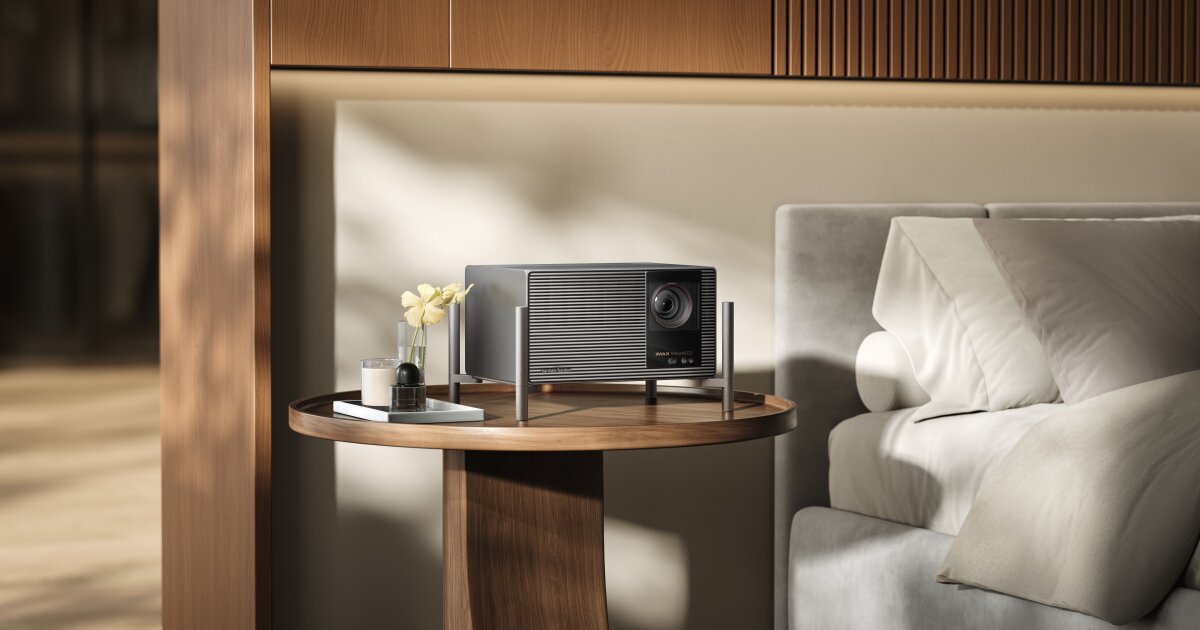
XGIMI’s new Titan Noir series is built around a simple argument: brightness alone is not enough to make home projection feel cinematic. The company says its new line uses a dual mechanical iris system to improve one of the category’s most persistent limitations, the tendency for dark scenes to turn gray rather than truly black. If that claim holds up in real-world use, the Titan Noir launch could matter less as another incremental hardware refresh and more as a targeted attempt to fix a core image-quality complaint.
The series was introduced through a Kickstarter campaign and includes three models. The top-end Titan Noir Max is rated at up to 7,000 ISO lumens, the Pro at 6,000, and the base model at 4,800. But the central innovation is not the brightness spec. It is what XGIMI calls the Dual Intelligent Iris System: two physical iris modules that continuously adjust based on scene content.
Why the iris approach is notable
According to the supplied source text, the dual irises act directly on the light path before it reaches the lens. That differs from digital dimming, which simply darkens the whole image in software. XGIMI is borrowing a principle long used in commercial cinema projectors and applying it to the home market. The company says the result is a native contrast ratio of 10,000:1 on the top model.
That figure does not put projection on the same level as an OLED television for black control; the source explicitly says it still falls short of pixel-level OLED performance. Even so, the distinction matters. Projectors compete on screen size and immersion, but they often lose on contrast and shadow detail in typical living-room conditions. A hardware-based attempt to improve black levels goes directly at that weakness rather than trying to out-market it with ever larger lumen counts.

What the Titan Noir lineup includes
All three models share a triple-laser RGB engine that XGIMI says covers 110% of the BT.2020 color space. The lineup also supports Dolby Vision, HDR10+, and IMAX Enhanced. These are familiar premium-video markers, but paired with the contrast-focused iris system they suggest that XGIMI wants the Titan Noir range to be judged as serious home-theater equipment rather than lifestyle tech.
The optical system is another part of that pitch. The source says a 15-element lens can store up to five focus positions, making it possible to switch quickly between 16:9 widescreen and 2.35:1 cinemascope without manual readjustment. XGIMI has also added Anti-RBE technology to reduce the “rainbow effect,” the brief color flickers that can affect some single-chip DLP projectors.
Connectivity is broad rather than experimental: three HDMI ports including eARC, two USB 3.0 ports, Gigabit Ethernet, and Wi‑Fi 6. That specification will not define the product on its own, but it rounds out the picture of a platform meant to fit into a more dedicated home-cinema setup.
A product launch that speaks to category pressure
The projector market has spent years competing against increasingly large, increasingly capable televisions. That makes XGIMI’s emphasis on black levels strategically interesting. Consumers who pay premium prices for projection are not usually looking only for brightness. They are looking for a theater-like image that can justify the tradeoffs projectors still make on contrast, convenience, and room control.
By focusing on the “gray-black problem,” XGIMI is effectively acknowledging that the category’s next step cannot just be more lumens. It has to address image depth, perceived realism, and scene-to-scene consistency. The Titan Noir series is therefore a technological bet on quality of darkness, not just quantity of light.
The Kickstarter factor
The launch arrives via Kickstarter, and the source says the campaign suggests thousands of home-cinema enthusiasts are willing to back the concept. That support gives the announcement a level of market validation, but it also places it in a slightly different category than a standard retail rollout. Enthusiasm on crowdfunding platforms can signal real demand, though it is not the same thing as long-term mainstream adoption.
Still, the campaign format fits the nature of the pitch. This is not a commodity projector play. It is a proposition for enthusiasts who know what native contrast, color gamut, and lens memory mean, and who are willing to fund a hardware approach that promises a more cinema-like result.
What to watch next
The Titan Noir series will ultimately rise or fall on whether the dual mechanical iris system produces visibly better dark-scene performance without introducing distracting side effects. The source provides XGIMI’s claims and key hardware details, but not independent testing. That leaves the most important question unanswered: how much of the promised theater-level experience survives outside a product page and into actual living rooms.
Even without that answer yet, the launch is noteworthy. XGIMI has chosen to compete on a problem many projector makers quietly live with. If the company’s dual-iris approach works as advertised, Titan Noir could stand out not because it is brighter than everything else, but because it tries to make projection look better where it has traditionally looked weakest.
This article is based on reporting by New Atlas. Read the original article.

Originally published on newatlas.com