A Small Satellite With a Big Deployment Trick
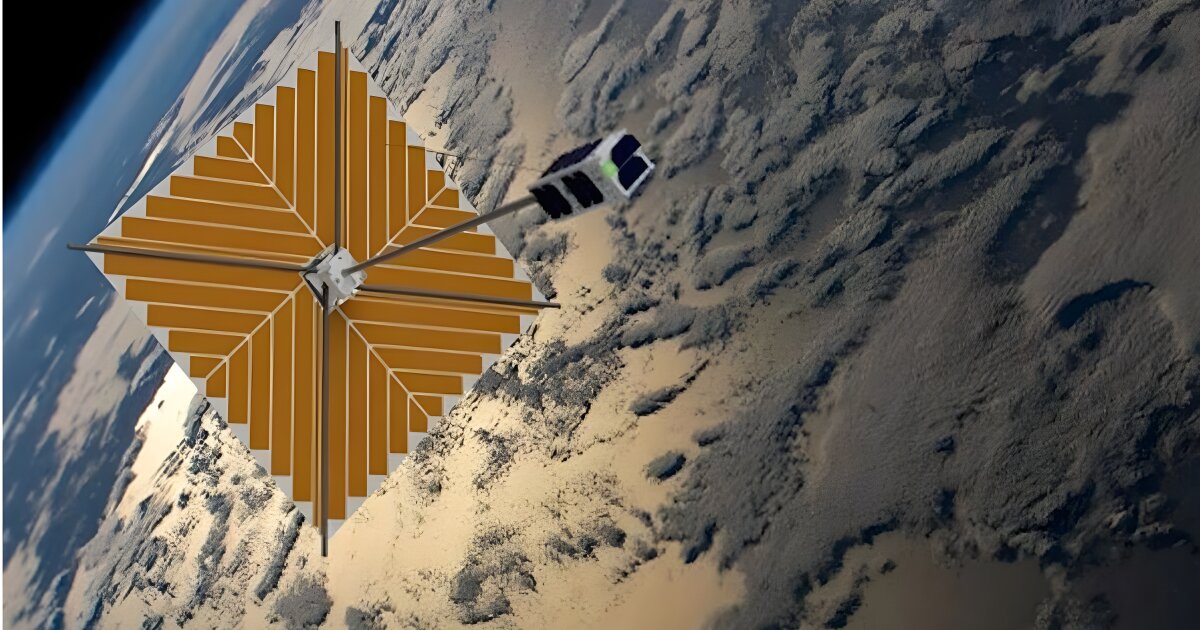
Japan’s space program has sent another origami-inspired spacecraft into orbit, this time in the form of a 10-centimeter CubeSat designed to unfurl a reflectarray antenna to around 25 times its folded size.
The satellite, OrigamiSat-2, was launched April 23 as part of the Japan Aerospace Exploration Agency’s Innovative Satellite Technology Demonstration Program. Roughly 53 minutes after liftoff from New Zealand, the Kakushin Rising mission deployed eight small satellites into a sun-synchronous orbit about 540 kilometers above Earth.
That broader mission is carrying a mix of experimental payloads linked to earthquake detection, ocean monitoring, multispectral imaging, and other goals. But OrigamiSat-2 stands out because it tackles one of spaceflight’s oldest engineering constraints: how to fit a large functional structure inside a tiny launch volume.
Why Origami Keeps Returning to Space Engineering
The promise of origami in space is not aesthetic. It is economic and mechanical. Launch is expensive, volume is scarce, and hardware that can pack flat and deploy reliably after reaching orbit has obvious advantages. CubeSats, in particular, force engineers to make every cubic centimeter count.
JAXA’s latest demonstrator builds on a long lineage of folding concepts in Japanese engineering. The source article points to the Miura fold, developed by Dr. Miura Koryo in 1970 during research into deployable space structures. The pattern later flew on Japan’s Space Flyer Unit in the 1990s, where stowed solar panels unfolded in orbit.
That heritage matters because the basic problem has not changed. Satellites need larger antennas, sails, panels, and sensing surfaces than launch fairings conveniently allow. Folding strategies offer a way to transport compact payloads that can later become much larger working systems.

What OrigamiSat-2 Is Testing
OrigamiSat-2 uses a two-layer membrane that is folded for launch and deployed after reaching orbit. In its stowed form, the spacecraft measures just 10 centimeters across, roughly the size associated with a single CubeSat unit. Once deployed, its reflectarray antenna expands dramatically.
The use of a reflectarray antenna is significant because communications and sensing performance often improve with larger apertures. For small satellites, that creates a constant tradeoff between spacecraft size and mission capability. A deployable antenna helps relax that tradeoff.
JAXA is effectively testing whether a very small, low-cost platform can carry hardware that behaves more like a much larger spacecraft once in space. If successful, the approach could inform future designs for communications payloads and other deployable systems where launch compactness and on-orbit scale both matter.
Part of a Broader Japanese Design Tradition
The article places OrigamiSat-2 in the context of other Japanese folding-space technologies, including the IKAROS solar sail mission launched in 2010. IKAROS used an origami-folded sail and traveled toward Venus using solar radiation pressure rather than conventional fuel-driven propulsion.
That example highlights the range of applications for folding structures in space. The same broad design philosophy can support power generation, antennas, observation platforms, and propulsion concepts. In each case, the engineering value comes from compact launch packaging followed by large deployed geometry.
For small satellites, the stakes are especially high. CubeSats have made access to orbit cheaper and more flexible, but their size limits often constrain ambition. Folding systems offer a way to push those limits without abandoning the low-mass, low-cost appeal of the format.

Why This Launch Matters
Space agencies and commercial operators both want spacecraft that are cheaper to launch and more capable once they arrive. OrigamiSat-2 sits directly at that intersection. It is not merely a novelty demonstration of paper-inspired mechanics. It is a test of whether deployable design can multiply the usefulness of very small satellites.
The mission also reflects a broader pattern in orbital technology development. Instead of waiting for giant step changes, agencies are increasingly running targeted demonstrations that validate one critical subsystem at a time. In this case, the subsystem is deployable geometry.
If such systems prove robust, they could influence future constellations that need more capable antennas without accepting larger buses and higher launch costs. That logic applies to civil missions, research platforms, and potentially commercial networks that depend on compact spacecraft working beyond their apparent physical scale.
The Engineering Bet
The real question now is reliability. Folded systems only become transformative if they deploy consistently in orbit. Launch vibration, thermal extremes, vacuum conditions, and mechanical tolerances all make that difficult. JAXA’s program is designed precisely to test those assumptions under real flight conditions.
Even at demonstration scale, OrigamiSat-2 is a useful marker for where satellite design is heading. The pressure to miniaturize spacecraft is not going away, but neither is the demand for larger functional surfaces. Foldable architectures are one of the clearest ways to satisfy both pressures at once.
That makes this launch more than a clever experiment. It is a compact expression of a bigger industry direction: spacecraft that launch small, then become something larger and more capable once they reach orbit.
This article is based on reporting by New Atlas. Read the original article.

Originally published on newatlas.com