One product review points to a larger indoor-air trend
A hands-on New Atlas evaluation of PuroAir's HVAC filter and standalone room purifier is, on its face, a consumer product test. But it also reflects a wider shift in how home air quality is being marketed and managed: not as a single-device problem, but as a layered system that combines central HVAC filtration with room-level purification.
The review tested two separate products from the same brand: a so-called Mega Filter for central HVAC use and the PuroAir 240 room purifier. They were not evaluated side by side at the same time. According to the source, the HVAC filter was used first and the purifier arrived roughly three months later, meaning the products were assessed separately rather than as a synchronized whole-home setup.
That distinction matters because it keeps the article from claiming a controlled comparison that did not happen. What the test does provide is a real-world snapshot of how two common air-cleaning strategies perform in a dusty, pollen-heavy household environment, and why manufacturers increasingly sell them as complementary rather than competing tools.
Whole-house filtering versus room-specific cleaning
The HVAC product uses a three-layer setup built around MERV 13 filtration, activated carbon, and a prefilter. The room purifier also uses a three-stage design, but with a HEPA layer instead of MERV media, plus activated carbon and a pre-filter. PuroAir rates the PuroAir 240 for rooms up to 1,000 square feet and says it is intended to address dust, pollen, smoke, odors, pet hair and dander, and volatile organic compounds.
Those details illustrate a practical division in the current indoor-air market. Central HVAC filters operate through the home's ventilation system, treating air as it cycles through the house. Standalone purifiers, by contrast, focus on a defined zone and usually promise finer filtration in that local space. The review does not present laboratory measurements, but it does show how brands position these categories differently: one as infrastructure, the other as targeted cleanup.
The source also notes the difference between MERV 13 and HEPA in plain terms, describing MERV 13 as strong but still several steps below true HEPA performance. That distinction is useful because it speaks to the tradeoff many homeowners face. Higher-efficiency whole-house filtration can improve general air handling, while a dedicated HEPA unit may be better suited to high-sensitivity rooms or persistent local triggers such as pet dander, smoke, or seasonal pollen.

What the review actually observed
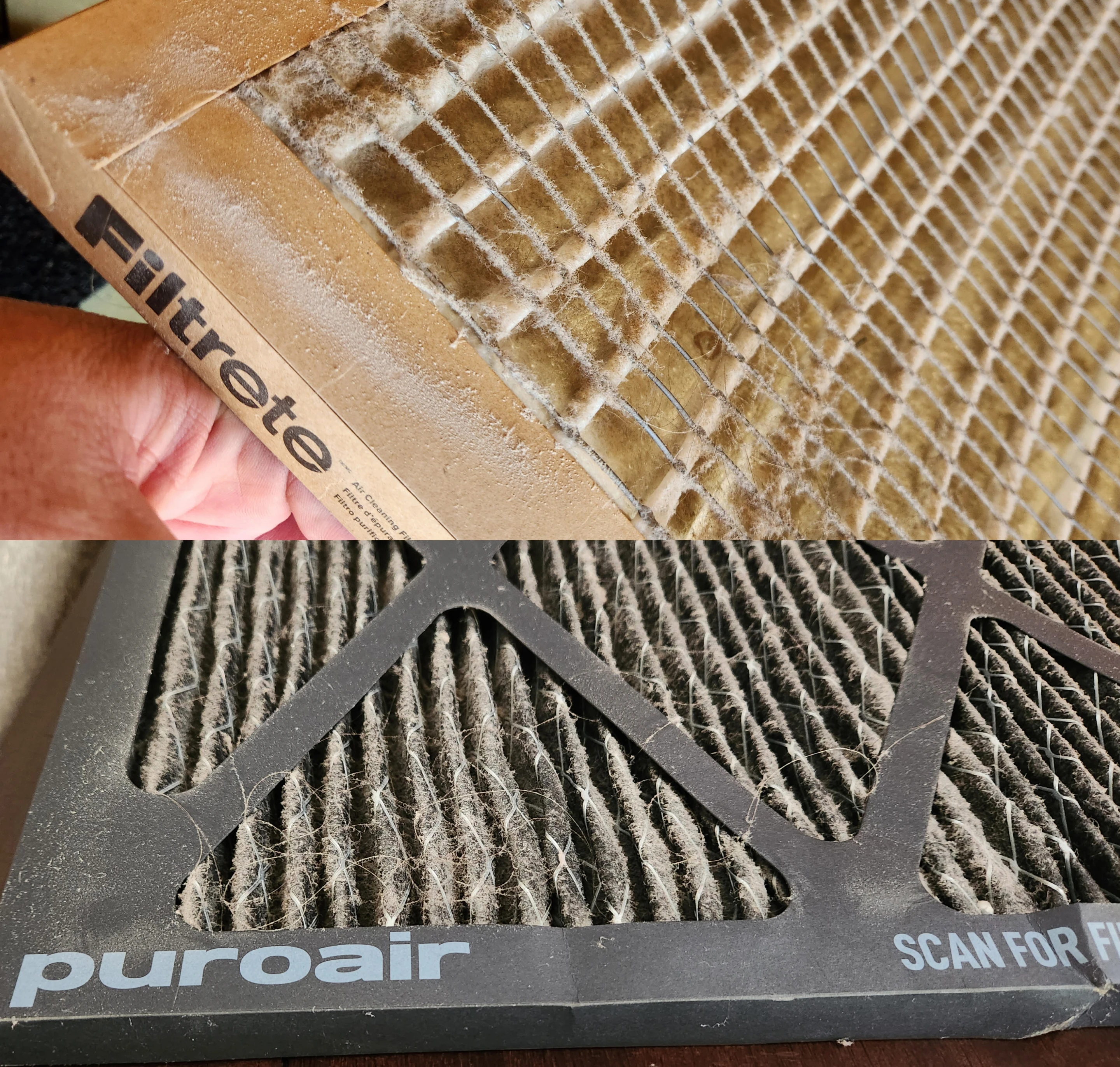
The reviewer describes a home environment exposed to persistent dust, sand, and heavy pollen, with central air and a floor-level return. In that setting, the HVAC filter was evaluated against the reviewer's usual habit of monthly replacement. The article characterizes the Mega Filter as not cheap and notes that while PuroAir says it is good for up to three months, the reviewer did not see that lifespan as realistic in this household. One image caption contrasts a 3M filter after 31 days with the PuroAir Mega Filter after 45 days and bluntly adds that three months did not fit the conditions in that home.
That is not a universal performance verdict, but it is meaningful anecdotal evidence. Filters do not operate in abstract. Their effective life depends heavily on load, airflow, climate, dust, pollen, pets, and how often occupants open windows or ventilate the space. A beach-town setting with constant windblown particles and visible pollen pressure is exactly the kind of use case that can compress replacement intervals well below marketing maximums.
The purifier was run nonstop in the living room, and one image caption indicates the filter was shown after 90 days of continuous use. The source text provided here does not include a formal measurement outcome, but it makes clear that the product was treated as a dedicated room solution rather than a casual supplement.
Why layered filtration is gaining traction
Even with its limits, the review captures an increasingly common approach to home air quality. Consumers are being encouraged to think in layers: first, improve baseline filtration in the HVAC system; second, add a localized purifier where people spend the most time. That approach is especially attractive in households dealing with seasonal pollen, smoke episodes, lingering odors, or fine dust that keeps settling even when surfaces are cleaned regularly.
The source text repeatedly returns to that lived reality. The reviewer says flat surfaces still require frequent dusting and that the home is aired out every day or two. In other words, filtration is being used not as a one-time fix but as an ongoing environmental management tool. That framing matches how the category is evolving commercially. Air-cleaning products are increasingly sold less as luxury gadgets and more as part of the maintenance stack of the home itself.
There is also a product-design message in the pairing. Activated carbon appears in both the HVAC filter and the purifier, suggesting that odor and gaseous contaminant control remain a selling point alongside particle capture. Meanwhile, the HEPA-equipped room unit is positioned as the higher-precision option where users want stronger local control.

Useful signal, limited evidence
The important caution is that this is still a single-source review, not an independent lab comparison or a peer-reviewed performance test. The strongest conclusions available from the supplied text are practical rather than scientific. The products represent two distinct filtration strategies. The HVAC filter's advertised longevity may depend heavily on conditions. The purifier is meant for continuous room use. And together they reflect a broader push toward layered indoor-air management.
That may be enough to make the story relevant beyond the product itself. Consumer air-cleaning coverage often slides into shopping advice or brand promotion. Here, the more interesting takeaway is structural: households are increasingly being asked to manage air quality with a stack of systems, each handling a different part of the job. The PuroAir review does not settle whether that model is optimal, but it does show how firmly it has entered the market.
For readers tracking innovation at the intersection of consumer hardware, home infrastructure, and environmental health, that shift is the real development. Better indoor air is no longer being pitched as a single appliance purchase. It is being presented as a layered architecture, and this review offers a grounded example of how that idea reaches actual homes.
This article is based on reporting by New Atlas. Read the original article.
Originally published on newatlas.com