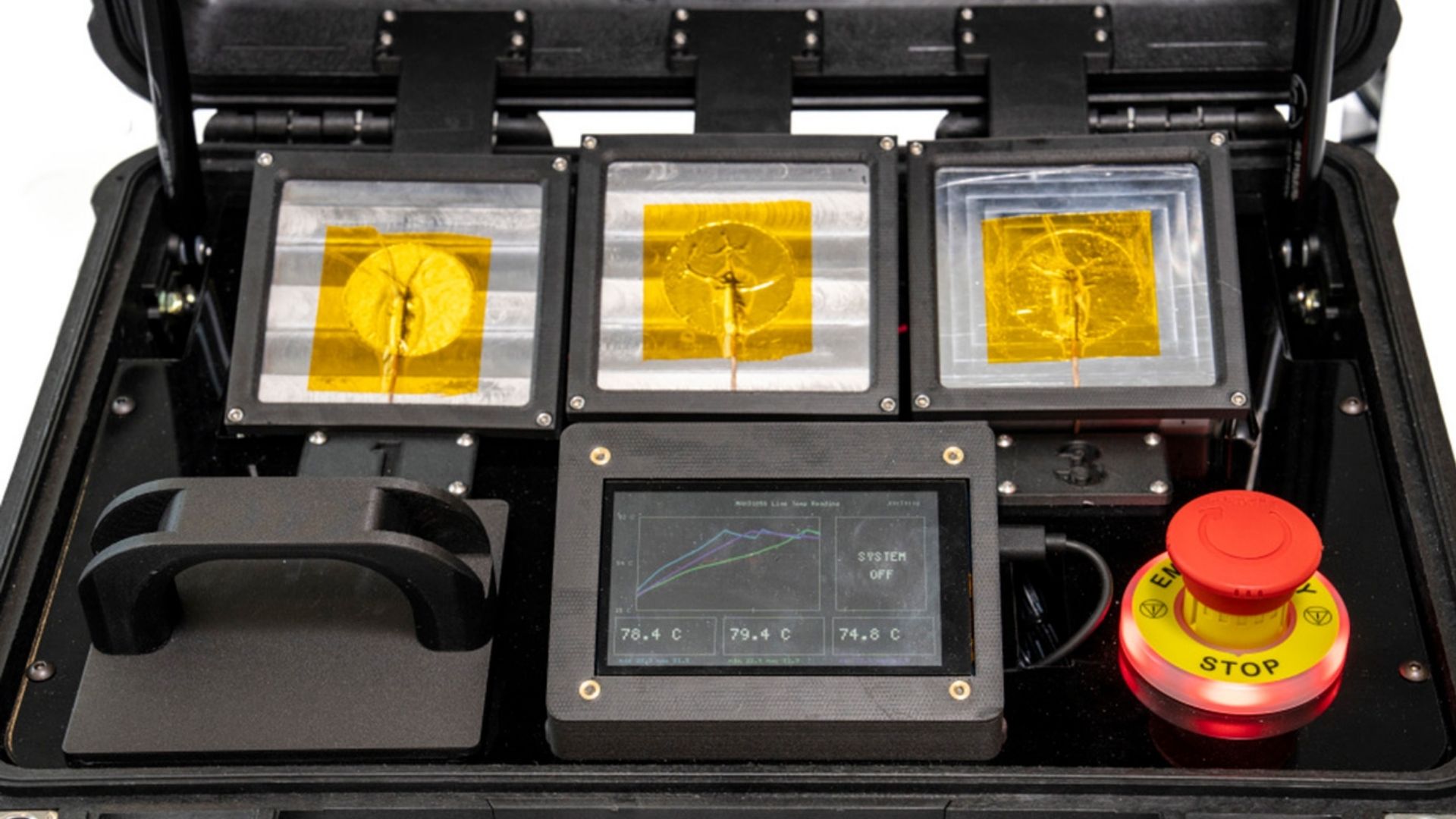
Hypersonic vehicles—those traveling at Mach 5 and beyond—face one of aviation's most brutal environments: atmospheric friction heats their surfaces to thousands of degrees. Protecting sensitive electronics and maintaining structural integrity demands sophisticated cooling systems. But today's thermal management hardware is heavy, bulky, and often a limiting factor in mission performance. Engineers at Johns Hopkins University's Applied Physics Laboratory (APL) are developing a new kind of heatsink that could be a game changer, using additive manufacturing and phase-change materials to reduce cooling system size and weight by more than 50 percent.
The Thermal Bottleneck of Hypersonic Flight
At hypersonic speeds, the air around a vehicle doesn't simply flow past—it compresses, heats, and chemically reacts. The resulting aerodynamic heating can push temperatures beyond 2,000°C on leading edges, while interior avionics may fail if they exceed just a few hundred degrees. Traditional cooling solutions such as active refrigeration loops or liquid-cooled cold plates are often too large or too heavy for sleek, fast platforms. They also consume precious power and add complexity.
The challenge is particularly acute for small hypersonic missiles, interceptor vehicles, and scramjet-powered demonstrators, where every kilogram matters. A vehicle that sheds cooling hardware weight can carry more fuel, more payload, or fly farther and faster. That's why APL's push for a compact, lightweight heatsink has attracted attention across aerospace and defense circles.

How Phase-Change Heatsinks Work
Phase-change materials (PCMs) absorb large amounts of heat as they transition from solid to liquid, acting like thermal sponges. Unlike ordinary heatsinks that merely conduct and dissipate heat, PCMs can soak up heat without a significant temperature rise. This makes them ideal for high-heat, short-duration events like a hypersonic dash.
A typical PCM-based heatsink embeds the material in a metal structure, often aluminum or copper. As the vehicle heats up, the PCM melts, storing thermal energy and keeping attached electronics below critical temperatures. But the volume change during melting, low thermal conductivity of many PCMs, and the need for robust containment have historically limited their application.
Additive Manufacturing as a Game Changer
APL's innovation lies in how the heatsink is made. Using 3D printing, engineers can create complex internal lattice geometries that are impossible to achieve with conventional machining. These microarchitectures can be tuned to optimize heat flow, manage the PCM's expansion, and incorporate surface-area-increasing features that improve thermal performance.
Additive manufacturing also simplifies integration. In a conventionally manufactured system, the heatsink must be machined separately, sealed, and attached to the heat source. In APL's design, the heatsink, PCM containment, and attachment points can be printed as a single monolithic structure. This reduces joints, potential leak paths, and assembly time. It also enables the heatsink to be conformal—shaped to the available space inside a hypersonic vehicle rather than forcing designers to adapt their layout around a thermally inefficient box.
Weight and Volume Savings
According to the researchers, the new approach cuts both size and weight by more than 50 percent. That reduction is significant because cooling can account for a substantial share of a hypersonic vehicle's internal volume. Replacing a standard cold plate with a phase-change heatsink that takes up half the space frees room for guidance systems, warheads, or fuel. Similarly, halving the weight of the thermal management system could enable a larger payload or extend range.
The team is also investigating the use of metallic phase-change materials, which offer higher thermal conductivity than organic waxes and can operate at higher temperatures. These materials, combined with printed microstructures that provide a high-conductivity pathway from the hot component to the PCM, promise even greater performance.

Testing and Validation
Laboratory tests are crucial to prove any thermal technology. APL engineers have reportedly subjected their 3D-printed heatsinks to simulated hypersonic heating profiles, measuring how well they keep attached test electronics within safe temperature limits. Initial results are said to match computer models, which predicts heat soak times and temperature equalization accurately.
The lab is also using X-ray computed tomography and other inspection techniques to verify that the internal channels and lattices printed as designed. Any microscopic defect in a print could compromise thermal performance or lead to failure during intense vibration and thermal shock. By coupling rigorous quality control with additive design, APL is moving closer to flight-ready hardware.

Beyond Hypersonics: Broader Defense Applications
While hypersonic vehicles are the immediate driver, the underlying technology could benefit other systems that experience intense, transient heating. Reusable launch vehicles could use printed PCM heatsinks on actuator mounts and avionics bays. High-power electronics on aircraft, satellites, and naval vessels could similarly see weight and space savings. The defense and aerospace industry is always looking for ways to pack more capability into smaller, lighter packages.
Missile defense interceptors that maneuver at hypersonic speeds inside the atmosphere must shed heat while also altering course. A lightweight heatsink that doesn't interfere with aerodynamic control surfaces is a valuable enabler for such systems. Even for slower supersonic platforms, the benefits of volumetric efficiency and modularity are appealing.
A Hybrid Approach
APL is reportedly exploring hybrid cooling strategies that combine phase-change heatsinks with other methods. For example, using a thin liquid flow to carry heat away during steady-state operation, then switching to PCM melt during high-pulse, transient peaks. A 3D-printed manifold could support both modes in one monolithic structure. Such hybrid approaches could handle both cruise and sprint conditions in future hypersonic demonstrators.
Moreover, the design flexibility of additive manufacturing allows engineers to tailor the heatsink's thermal properties to the orientation of gravity or acceleration. In a hypersonic vehicle that undergoes high G maneuvers, the movement of molten PCM can be managed by capillary structures that keep it in place. Printed wicking fibers and baffles can be designed to work in any orientation or under high acceleration.
From Bench to Flight
Taking a new technology from the lab bench to a Mach 5 vehicle is no small feat. The heatsink must survive vibration, shock, and extreme pressure gradients. It must be compatible with fuels, hydraulics, and other system materials. And it must meet strict reliability standards.
The APL group is expected to continue environmental testing over the next phases, including thermal cycling under vacuum or in high-pressure gas. Eventually, they could flight-test the heatsink on a hypersonic test vehicle, either as a dedicated experiment or as part of a larger avionics pallet. If successful, the 3D-printed phase-change heatsink could become a standard option for future hypersonic programs.
Implications for Future Aerospace Systems
The promise of a 50% or greater reduction in cooling system size and weight changes the calculus for vehicle designers. It might allow a compact air-launched hypersonic missile to carry a more capable seeker or a better countermeasures suite. It could help an uncrewed hypersonic research aircraft pack more instrumentation into a small fuselage. For space access, a printed PCM heatsink might be used to cool avionics in a reusable booster during reentry.
Innovation Spillover
Additive manufacturing combined with phase-change materials is an excellent example of how innovations in one domain can ripple across industries. The same printed lattice structures could be applied to thermal batteries, solar thermal storage, or even building climate control on Earth. The energy sector, for instance, is exploring phase-change materials to store heat from solar plants during off-peak hours. A highly conductive, lightweight printed container could improve the efficiency of such storage systems.
The APL team's research is still evolving, but the initial concept has generated significant interest among aerospace prime contractors and defense planners. Maintaining a competitive edge in hypersonics is high on many nations' military agendas, and thermal management is a critical piece. Innovations that dramatically shrink the size and weight of cooling systems could help enable faster, longer-range, and more maneuverable hypersonic vehicles.
In an era where engineering challenges often seem to require exotic, over-engineered solutions, this approach demonstrates that a smart combination of materials and manufacturing—utilizing known physics and 3D printing's new possibilities—can deliver big wins. While more work remains before these heatsinks fly at hypersonic speeds, the direction is clear: the future of high-speed aerospace will be built with innovators who can cool things down and keep them light.
This article is based on reporting by Interesting Engineering. Read the original article.
Originally published on interestingengineering.com