A famous starburst galaxy just gave astronomers a long-sought measurement
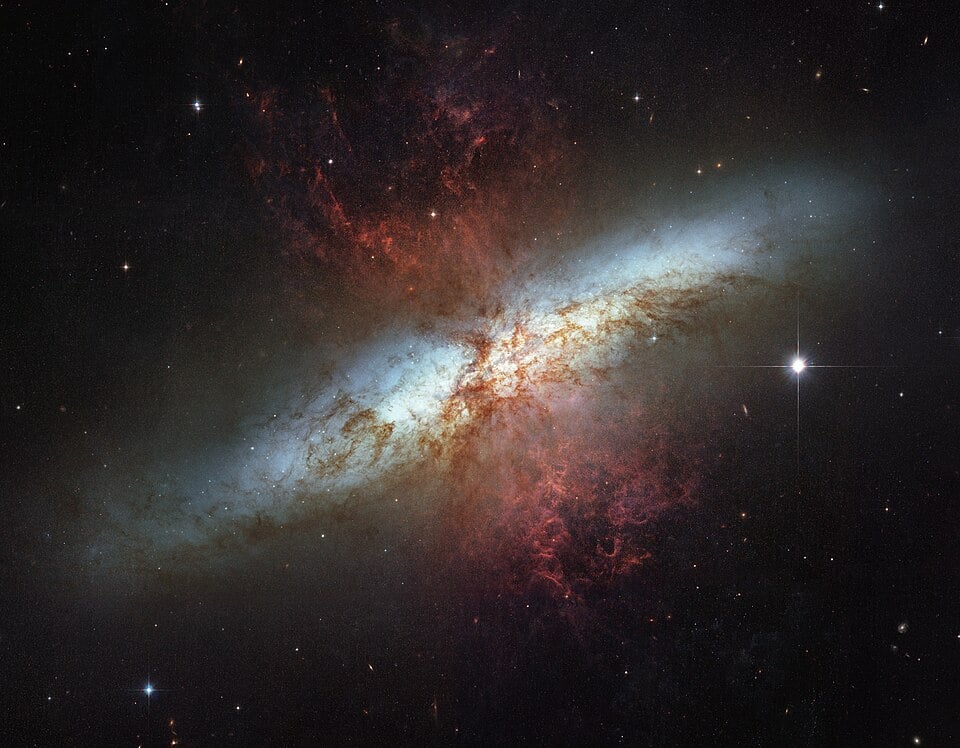
For decades, M82, the Cigar Galaxy, has stood as one of the clearest examples of what happens when a galaxy forms stars at a furious pace. Located about 12 million light-years away in Ursa Major, M82 produces stars at roughly ten times the rate of the Milky Way, and that activity has long been associated with a vast plume of gas reaching about 40,000 light-years from its core.
What astronomers did not know with precision was how fast the hottest gas at the center of that outflow was actually moving. Universe Today reports that the XRISM spacecraft has now provided an answer. Using the Resolve instrument, researchers measured X-ray emissions from superheated iron near the center of M82 and found gas streaming outward at more than 3.2 million kilometers per hour.
That is the kind of result that does more than add a number to a chart. It helps pin down the physical engine behind one of the most dramatic phenomena in nearby-galaxy astronomy.
Why M82 matters
Starburst galaxies occupy an important place in astrophysics because they show what happens when star formation ceases to be a quiet background process and becomes a dominant force in galactic evolution. M82 is one of the classic cases. Its elevated star-formation rate has made it a natural laboratory for studying how galaxies reshape themselves and their surroundings.
The outflow rising from its center is one of the most visible signs of that upheaval. Gas heated and driven outward from the core can alter future star formation, redistribute material, and influence the region around the galaxy itself. But to understand how those outflows work, astronomers need more than images. They need velocity and temperature measurements that connect the observed structure to a physical driver.
XRISM’s key measurement
According to the report, the gas detected by XRISM reaches a temperature of around 25 million degrees Celsius. At that heat, the material exerts enough pressure to push relentlessly outward, behaving in effect like a pressure-release system at the center of the galaxy.
The speed estimate came from spectroscopy. Researchers analyzed the spectral signature of iron and measured how the line broadened as gas moved rapidly in multiple directions. The article compares this to the Doppler effect familiar from a passing ambulance siren changing pitch. In this case, the same principle is applied to X-ray-emitting gas in a galaxy 12 million light-years away.
That direct link between spectral broadening and velocity is what turns a spectacular outflow into a measurable physical process. Rather than infer movement only from shape and scale, astronomers can now point to the hot inner wind itself and describe how fast it is traveling.
What drives the wind
The result strengthens one explanation over another. Universe Today says the measurements confirm that stellar wind and supernova shockwaves near M82’s core are almost certainly the main drivers of the broader galactic outflow. Cosmic rays may still play a supporting role, but they no longer need to carry the primary explanatory weight.
That matters because galactic winds are not just visual curiosities. They are part of how galaxies regulate themselves. If the central engine is powered mainly by intense star formation, stellar winds, and supernova feedback, then M82 becomes a vivid example of how a galaxy can push material outward through its own internal energy budget.
In other words, the galaxy is not merely glowing intensely. It is actively rearranging its environment.
From dramatic image to physical system
M82 has been studied for years because its outflow is so striking. But striking objects can remain physically ambiguous until instruments become sensitive enough to measure the right quantities. XRISM appears to be closing that gap.
The reported wind speed of more than 3.2 million kilometers per hour gives astronomers a firmer basis for modeling how matter escapes the galaxy’s central region. The 25 million degree temperature estimate helps explain how the gas acquires the pressure necessary to sustain that motion. Together, those values make the outflow easier to understand as a dynamic system rather than a static plume.
A broader lesson in galaxy evolution
The deeper importance of the finding is that it clarifies a process relevant well beyond one galaxy. The question of how star formation feeds back into galactic structure is central to modern astrophysics. Galaxies do not simply convert gas into stars in isolation. They also generate winds, shocks, and energy flows that can shape what happens next.
M82 is useful precisely because it shows that process so vividly. With XRISM’s measurement, astronomers now have a more direct view of the hot inner wind that connects intense star formation to the giant outflow visible on much larger scales.
The Cigar Galaxy has long looked like it was throwing material into intergalactic space. Now researchers can describe that act with more precision. That is the quiet power of a good measurement: it turns a familiar spectacle into a better-explained universe.
This article is based on reporting by Universe Today. Read the original article.
Originally published on universetoday.com