The Most Extreme Matter in the Universe
In the first microseconds after the Big Bang, the universe was so hot and dense that quarks and gluons — the fundamental constituents of protons and neutrons — could not bind together into composite particles. Instead, they existed as a free-flowing plasma, a state of matter so exotic that it has only been briefly recreated on Earth in heavy-ion collisions at facilities like CERN's Large Hadron Collider and Brookhaven's Relativistic Heavy Ion Collider, where gold or lead nuclei are smashed together at nearly the speed of light to momentarily recreate conditions of the infant universe.
As the universe cooled, this quark-gluon plasma underwent a phase transition, and quarks became permanently confined inside protons and neutrons. It has not existed freely in the universe since. Or so physicists thought. New theoretical work and observational evidence is converging on a remarkable possibility: quark-gluon plasma, or a closely related quark matter phase, may exist today at the cores of neutron stars, where the densities achieved by gravitational compression rival or exceed those at which quark confinement breaks down.
Neutron Stars as Natural Physics Laboratories
Neutron stars are the remnants of massive stellar explosions — objects typically massing between 1.4 and 2.3 times the mass of the Sun compressed into a sphere perhaps 20 kilometers across. The densities at their cores are extraordinary, reaching several times the density of atomic nuclei. Under these conditions, the behavior of dense nuclear matter is governed by quantum chromodynamics in a regime where calculations are extremely difficult and our experimental knowledge is limited.
At the highest densities, theoretical models diverge dramatically. Some predict that nuclear matter remains as ordinary neutron and proton matter. Others predict a transition to quark matter, where individual quarks become deconfined from their nucleon hosts and flow relatively freely through the stellar interior — a cold, dense analog of the quark-gluon plasma that existed in the hot early universe.
The Observational Path to Proof
The key is the equation of state: the mathematical relationship between pressure and density inside the star that determines its mass, radius, and tidal deformability. Different models of neutron star matter predict different equations of state and therefore different observable stellar properties.
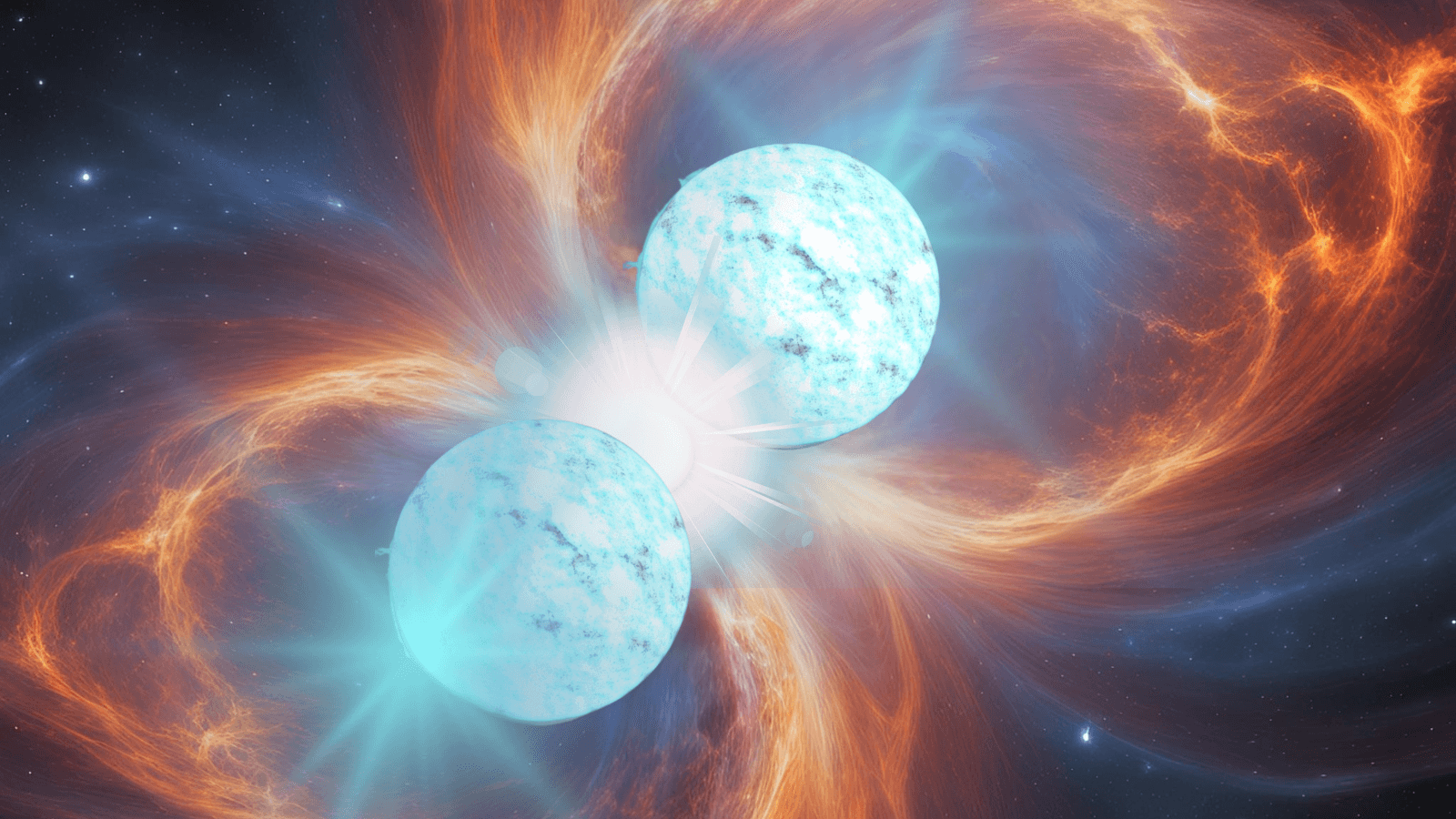
The gravitational wave observations from neutron star mergers, beginning with the landmark GW170817 event in 2017, have already constrained the equation of state significantly. The tidal deformability measurement from that event — how much each neutron star deforms in the other's gravitational field before collision — rules out the stiffest and softest equations of state, narrowing the range of allowed interior structures. Future gravitational wave observations with improved detectors, combined with NICER X-ray telescope measurements of neutron star radii, could narrow the allowed range further — potentially to the point where the presence or absence of a quark matter core becomes discriminable.
Why This Matters
The question of whether quark matter exists in neutron stars is not merely academic. If quark matter cores are confirmed, it would represent a profound connection between the physics of the early universe and the physics of the densest objects in the present universe. The Big Bang and the interior of every massive star's stellar remnant would share a fundamental form of matter — a continuity that speaks to the deep unity of physical law across extreme conditions.
Practically, quark matter in neutron stars would affect how those stars behave during mergers, how quickly they cool after formation, and what happens during the violent final seconds before two neutron stars collide and potentially form a black hole. Understanding these details matters for interpreting the gravitational wave and electromagnetic signals from neutron star mergers — signals that provide our best current measurements of the Hubble constant and that carry information about the astrophysical origin of heavy elements including gold and platinum.
The Path Forward
The next generation of gravitational wave detectors — Einstein Telescope in Europe and Cosmic Explorer in the United States — will observe neutron star mergers with sensitivity and cadence orders of magnitude beyond current instruments. Combined with continued NICER observations and next-generation X-ray telescopes, they will generate the dataset needed to either confirm or definitively rule out quark matter in neutron star interiors. Within the next decade, one of the most ancient questions in physics — what ultimately happens to matter under the most extreme compression — may finally have an observational answer.
This article is based on reporting by Space.com. Read the original article.