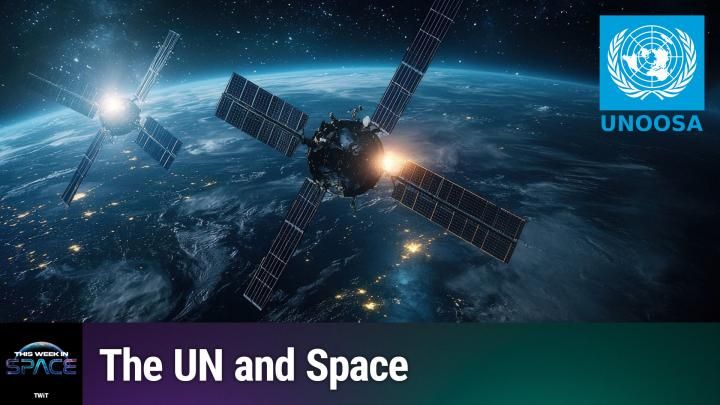
Shining a Light on Space Governance
As commercial launches multiply and nations race to establish lunar footholds, the question of who governs outer space has never been more urgent. Episode 197 of the This Week In Space podcast tackles this question head-on with an in-depth look at the United Nations Office for Outer Space Affairs, known as UNOOSA. The episode provides a rare window into an organization that quietly shapes the future of human activity beyond Earth.
Hosts Rod Pyle and Tariq Malik sit down with UNOOSA Director Aarti Holla-Maini and space policy expert Rick Jenet to explore the office's critical role in maintaining order beyond Earth's atmosphere and ensuring that space remains accessible to all nations.
What UNOOSA Actually Does
Established in 1958, just one year after Sputnik launched the space age, UNOOSA serves as the UN's hub for international cooperation in the peaceful use of outer space. The office oversees the implementation of five key UN treaties on outer space, including the foundational 1967 Outer Space Treaty, which has been ratified by over 110 nations and remains the cornerstone of international space law. UNOOSA also maintains the Register of Objects Launched into Outer Space, a critical database tracking every satellite, probe, and piece of hardware sent beyond our atmosphere.
Director Holla-Maini discusses how UNOOSA navigates the increasingly complex landscape of space activities, from megaconstellation deployments involving thousands of satellites to deep-space resource extraction proposals that raise entirely new legal questions. The office must balance the interests of established space powers with emerging spacefaring nations seeking equitable access to orbital resources.
Challenges in the Modern Space Era
The conversation reveals the mounting pressures facing international space governance. With private companies launching thousands of satellites annually and multiple nations planning crewed missions to the Moon and Mars, existing frameworks drafted decades ago are being tested in unprecedented ways. Issues like space debris mitigation, radio frequency spectrum allocation, and planetary protection protocols require constant updating and careful diplomatic negotiation among nations with competing interests.
Jenet highlights the role UNOOSA plays in capacity building, helping developing nations participate meaningfully in space activities rather than being left behind. This includes providing access to satellite data for disaster response, agricultural planning, and climate monitoring, applications that directly improve lives on the ground.
Why It Matters Now
As humanity's presence in space expands at an accelerating pace, the structures governing that expansion become essential infrastructure for preventing conflict and ensuring sustainability. UNOOSA's work may lack the glamour of rocket launches and lunar landings, but it provides the diplomatic and legal foundation upon which all sustainable space exploration ultimately depends. Without effective governance, the promise of space could give way to competition and chaos.
This article is based on reporting by Space.com. Read the original article.

Originally published on space.com