Artemis II is underway
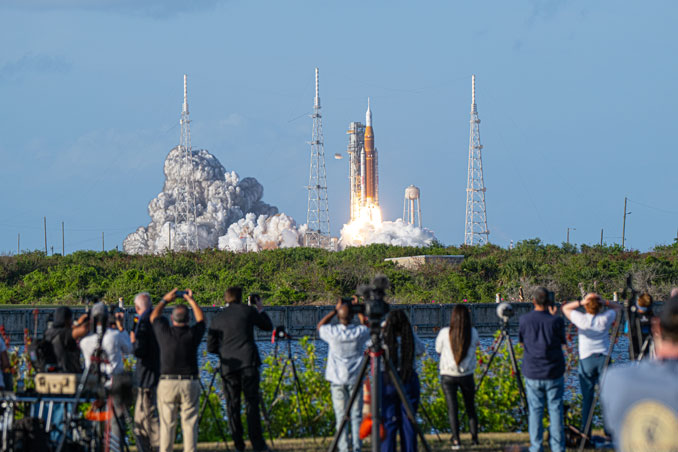
NASA’s Artemis II mission is now in flight, sending four astronauts on an approximately 10-day journey around the Moon and back aboard the Orion spacecraft. The launch, which took place on April 1, marks the first piloted moon mission since the Apollo era ended 53 years ago and the first crewed test of Orion.
The crew consists of NASA astronauts Reid Wiseman, Victor Glover and Christina Koch, along with Canadian Space Agency astronaut Jeremy Hansen. According to the supplied source text, the mission will carry them farther from Earth than any astronauts before them, though they will not land on the Moon or enter lunar orbit.
A test flight with long-term consequences
Artemis II is explicitly a test mission. NASA is using it to evaluate Orion in its second flight overall and its first with a crew on board. The mission is also meant to test flight controllers and operational procedures needed for future lunar missions as NASA works toward sustained human activity around and on the Moon.
The source text frames the mission as the opening step in a broader campaign that NASA hopes will lead to repeated lunar missions, long-duration stays and eventually a moon base. That is part of the agency’s wider Artemis architecture and its stated goal of returning astronauts to the lunar environment with greater frequency.
Why the launch mattered beyond symbolism
Crewed moon missions carry enormous symbolic weight, but Artemis II also has immediate technical significance. NASA had to work through hydrogen leaks in the Space Launch System rocket’s first stage and an upper-stage propellant pressurization issue before getting to launch. Those delays pushed the mission about two months later than planned, according to the supplied source text.
Even on launch day, the countdown hit minor issues that extended a final hold at the T-minus 10-minute mark. The problems were ultimately resolved, and the SLS rocket launched successfully at 6:35 p.m. EDT on April 1.
That smooth recovery matters because Artemis is not just about one launch. It is about proving that the vehicle stack, the capsule and the operational teams can support the cadence and reliability needed for future missions deeper into the program.
The crew and the mission profile
The astronauts were named to the mission in 2023. Their flight is designed as a lunar flyby rather than a landing attempt, giving NASA a chance to exercise crewed deep-space operations without adding the further complexity of a surface mission. Orion’s systems, crew procedures and mission-control coordination will all be under scrutiny throughout the flight.
The supplied source text describes Artemis II as a trail-blazing flight intended to help pave the way for later lunar landings. That places heavy importance on mission execution even without a landing objective. A clean test now reduces uncertainty for what follows.
The geopolitical layer
The source material also notes NASA’s aim to return to the Moon as part of a broader superpower competition with China, which plans to send taikonauts to the lunar surface before the end of the decade. That context has become a recurring part of Artemis-era messaging. The mission is therefore scientific and operational, but also strategic.
In that sense, Artemis II functions on several levels at once: it is a spacecraft test, a human-spaceflight milestone, and a public demonstration that the United States is moving again in crewed deep-space exploration.
What comes next
The mission now shifts from launch to execution. The immediate objective is to complete the lunar flyby and return safely, while gathering the technical and operational data needed for future Artemis missions. The supplied NASA image article confirms the launch, while the additional source text outlines the mission’s role in validating Orion and preparing for later lunar expeditions.
For now, the main point is simple and consequential. After more than five decades without a piloted moon mission, astronauts are once again on their way around the Moon, and the Artemis era has entered its crewed phase.
This article is based on reporting by Spaceflight Now. Read the original article.
Originally published on spaceflightnow.com