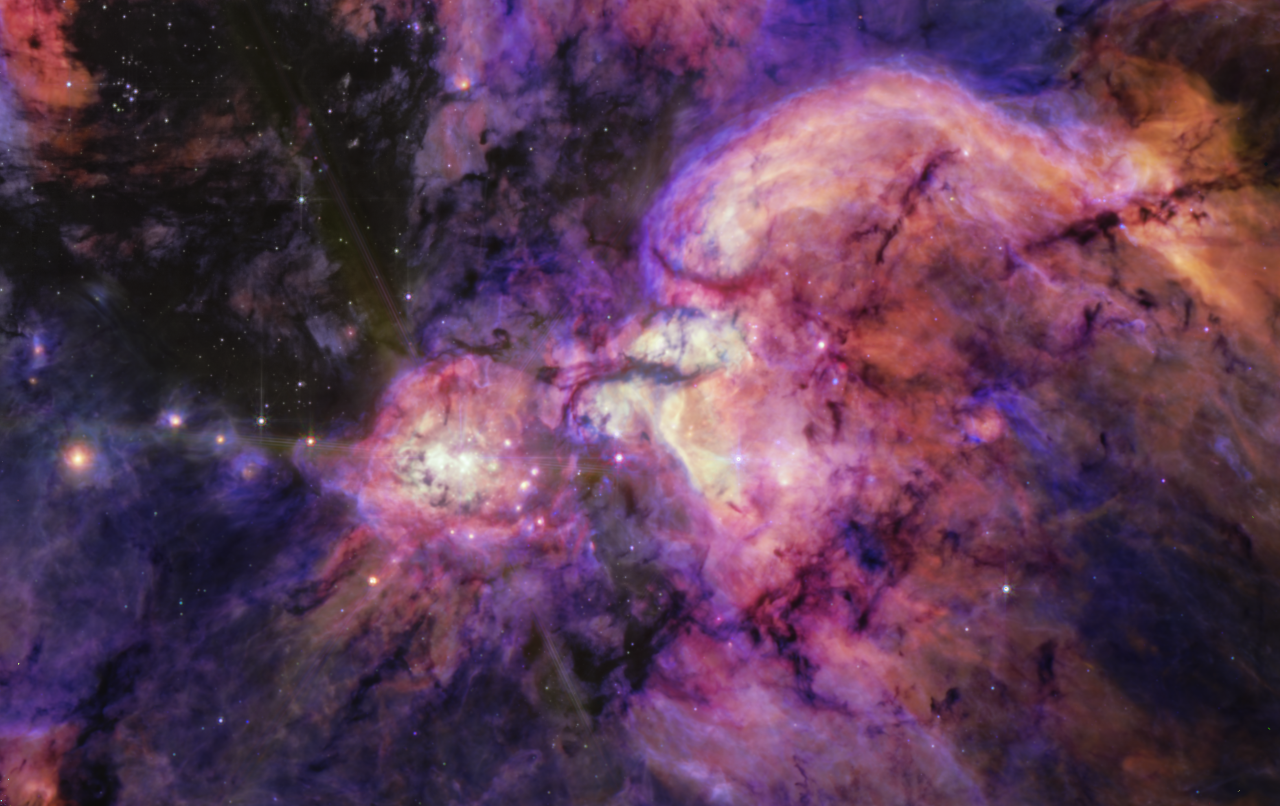
JWST peers into one of the Milky Way’s busiest stellar nurseries
The James Webb Space Telescope is giving astronomers a much clearer look at the giant star-forming region Westerhout 51, or W51, revealing structures and young stars that had been hidden behind dust. The supplied report describes new observations led by University of Florida doctoral candidate Taehwa Yoo, using Webb to study the region in infrared wavelengths that can penetrate material blocking optical and ground-based infrared views.
W51 lies about 17,000 light-years from Earth in the direction of Sagittarius. It is one of the Milky Way’s major starbirth regions, making it an important natural laboratory for studying how stars, especially massive young stars, emerge inside dense clouds of gas and dust. In regions like this, the most dramatic phases of formation are often concealed from traditional telescopes, which is why Webb’s infrared capabilities are so valuable.
Dust no longer hides as much of the story
The central gain from the new observations is straightforward: astronomers can now see parts of the star-forming process that were previously obscured. The supplied source quotes University of Florida astronomer Adam Ginsburg saying that with optical and ground-based infrared telescopes, astronomers could not see through the dust to detect the young stars, but now they can.
That change is not merely visual. It affects how researchers build models of stellar formation. If the earliest and most active zones are hidden, astronomers are forced to infer parts of the process indirectly. Webb reduces that uncertainty by exposing fine detail in the structures it can observe, allowing scientists to inspect the environments around forming stars more directly.
The report says the team’s data revealed multiple distinct features in W51, including dust filaments, protoclusters, cometary dust globules shaped by nearby radiation, and shell-like structures within H II regions. Each of these features can help researchers reconstruct how radiation, gravity, turbulence, and local chemistry interact during starbirth.
A closer look at massive young stars
One of the most important scientific outcomes is the ability to study hidden, young massive stars. Massive stars play an outsized role in galactic ecosystems. Their radiation, winds, and eventual deaths can reshape nearby clouds, trigger or suppress later star formation, and enrich surrounding space with heavier elements.
The supplied report quotes Yoo as saying that James Webb allows astronomers to see those hidden, young massive stars forming in the region and study their formation mechanisms. That is a meaningful step because massive star formation is harder to observe and model than lower-mass star formation. These stars evolve quickly, remain embedded in dense environments, and strongly alter their surroundings even while still forming.
By identifying the environments around these objects more clearly, researchers can test ideas about whether massive stars form through scaled-up versions of the processes seen in Sun-like stars or whether additional mechanisms dominate in crowded, extreme regions.
Webb’s strengths also highlight its limits
The W51 observations are also a useful reminder that even the most capable new observatories do not reveal everything. The supplied report says some aspects of starbirth remain hidden behind clouds too dense even for JWST to penetrate. To address that, the team compared Webb data with observations from the Atacama Large Millimeter Array, or ALMA, which uses radio wavelengths to probe different parts of the same environment.
That comparison showed that only a fraction of stars are detectable by both telescopes. In practical terms, that means each observatory is seeing a different slice of the truth. Webb can reveal many structures and embedded stars that older infrared tools missed, but ALMA can still access material and sources that remain opaque even to JWST.
This is a central lesson of modern astronomy: discovery increasingly comes from combining instruments rather than expecting any one telescope to provide a complete account. Infrared and radio observations together can map both the luminous and deeply buried phases of stellar assembly. W51 appears to be a strong example of how complementary datasets refine the picture.

Why W51 matters beyond one image set
Star-forming regions like W51 are not just visually striking. They are part of a broader effort to understand how galaxies evolve. Star formation governs how gas is converted into stellar populations, how feedback shapes interstellar clouds, and how the conditions for future planetary systems emerge.
The structures described in the supplied report show how complex this process is. Dust filaments suggest channels where material is organized and funneled. Protoclusters point to regions where many stars are taking shape in proximity. Cometary objects indicate intense sculpting by nearby radiation. H II regions record how newborn stars ionize and disrupt their birthplace. Together, these features turn W51 into a dynamic archive of stellar construction and destruction happening at once.
Webb’s ability to resolve these structures in detail is therefore important beyond this single target. It strengthens astronomy’s toolkit for studying similar regions in the Milky Way and, by analogy, in other galaxies. Better observations of nearby star factories can improve interpretation of more distant unresolved systems where only aggregate light is available.
A sharper but still incomplete map of starbirth
The W51 results underscore a familiar pattern in science: better instruments answer old questions while exposing how much remains hidden. James Webb has clearly expanded what astronomers can see inside dusty stellar nurseries. The supplied report makes that clear in both the imagery and the scientific framing around young massive stars.
At the same time, the comparison with ALMA shows that some of the region still lies behind a curtain that infrared light alone cannot fully lift. That does not diminish Webb’s contribution. It clarifies where its observations fit in a larger observational strategy.
For now, the most important development is that one of the Milky Way’s major starbirth regions has become more legible. W51 is yielding a richer picture of how stars form inside chaotic, dust-heavy environments, and Webb is proving exactly why its infrared vision matters. Astronomers are no longer limited to guessing at many of the hidden structures inside this cloud. They can finally start seeing them in detail.
This article is based on reporting by Universe Today. Read the original article.
Originally published on universetoday.com