Unexpected Brightening of a Periodic Comet
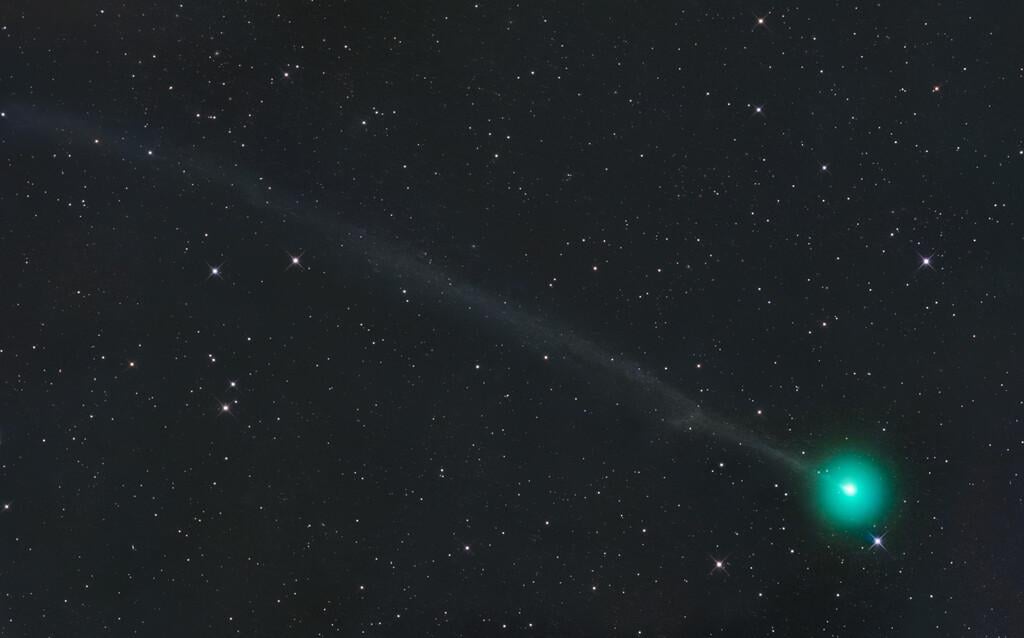
Comet watchers were caught off guard late last week when periodic comet 220P McNaught suddenly erupted in a dramatic outburst, brightening by an astonishing 7 magnitudes in a single day. The event, first noted by observer Mike Kelley using images from the Zwicky Transient Facility, transformed the faint comet from a +17th magnitude smudge into an object that briefly peaked at +8th magnitude—an increase in brightness of roughly 8,000 times. Although not originally on the list of anticipated bright comets for 2026, 220P McNaught is now within reach of binoculars or a small telescope for northern hemisphere observers willing to brave the early morning hours.
Discovery and Orbital Characteristics
Comet 220P McNaught holds the distinction of being the first of 18 comets discovered by prolific Australian astronomer Robert McNaught. It was initially spotted as a faint +17th magnitude smudge on images captured by the Siding Spring Observatory on the night of May 20, 2004. The comet follows a 5.5-year orbit around the Sun, and its current trajectory suggests it was likely captured by Jupiter's gravity into its present-day orbit, lagging slightly behind in a 2:1 resonance with the gas giant. This orbital dance with Jupiter is typical of many periodic comets in the Jupiter family.
Outburst Details and Observations
The outburst, which occurred around June 1st, 2026, was confirmed by multiple observers. Initial reports indicated a 7-magnitude brightening, corresponding to a 600-fold increase in brightness. However, later backup observations suggested the comet may have reached +8th magnitude, representing an even more impressive 8,000-fold increase. Such dramatic brightening events are not fully understood, but they are thought to result from the sudden release of volatile ices—such as carbon dioxide or carbon monoxide—as the comet approaches the Sun. The European Space Agency's Rosetta mission provided a close-up look at a similar outburst on Comet 67P/Churyumov-Gerasimenko, offering valuable insights into the processes that drive these explosive events.
Viewing the Comet
For northern hemisphere observers, comet 220P McNaught is well-placed in the dawn sky, sitting about 65 degrees from the Sun during June. However, its low altitude—just 10 degrees above the eastern horizon—and the encroaching dawn light present challenges. Observers at mid-northern latitudes, such as southern Virginia (around 37°N), have reported needing to wake up as early as 4 AM to catch the comet before dawn washes out the sky. The comet is currently visible low in the east about two hours before local sunrise. Using a DwarfMini smartscope, one observer easily located the comet, which was listed in the device's database as '220P'. For those with standard binoculars or small telescopes, a dark, unobstructed eastern horizon is essential.

Perihelion and Future Prospects
Comet 220P McNaught reaches perihelion on June 14th, 2026, at a distance of 1.6 Astronomical Units (AU) from the Sun—just outside the orbit of Mars. As it swings around the Sun, the comet may continue to exhibit activity, though outbursts are inherently unpredictable. After perihelion, the comet will begin to fade as it recedes from the Sun. Observers are encouraged to take advantage of the current window while the comet remains bright. Even if the outburst subsides, the comet's proximity to perihelion could sustain its visibility for a short time longer. For those unable to observe in the early morning, the comet's brightness may still be detectable with larger telescopes from more southerly latitudes.
Scientific Significance
Outbursts like that of 220P McNaught provide valuable opportunities for scientists to study the volatile composition and physical processes of comets. The sudden release of gas and dust can reveal subsurface materials that are otherwise hidden. Amateur and professional astronomers alike are encouraged to monitor the comet's brightness and report their observations to organizations such as the International Comet Quarterly. Continued monitoring may help refine models of cometary activity and improve predictions for future outbursts. As one of the few comets discovered by Robert McNaught, 220P carries a legacy of discovery that continues to contribute to our understanding of the solar system's small bodies.
This article is based on reporting by Universe Today. Read the original article.

Originally published on universetoday.com