A gap in black hole masses is coming into focus
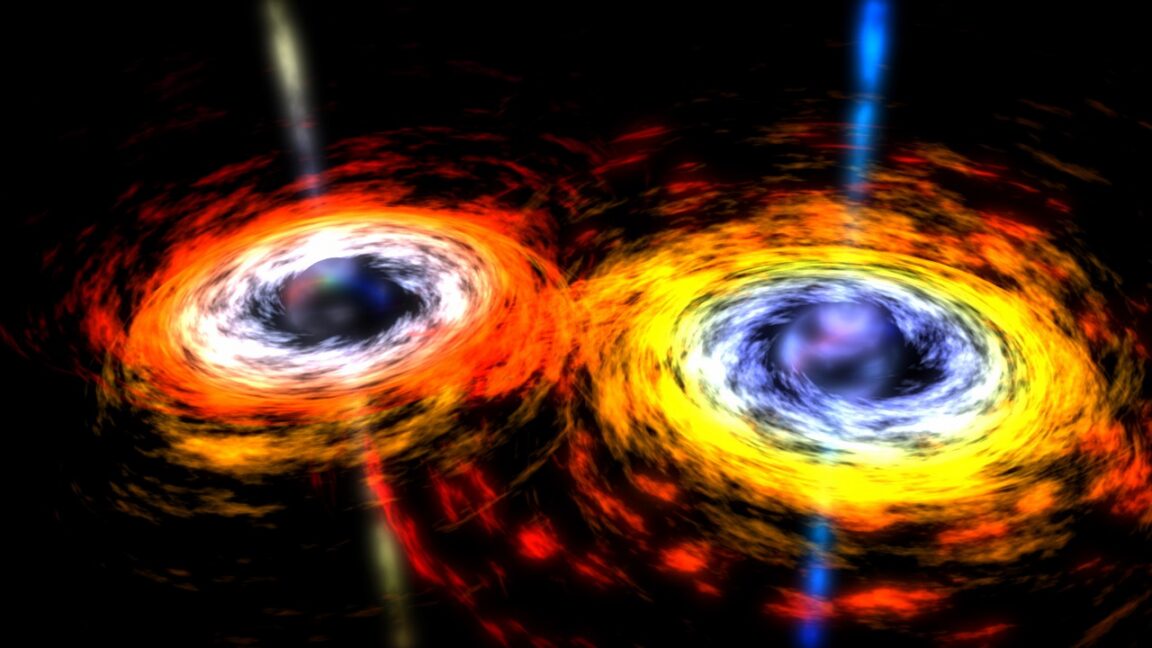
Researchers analyzing years of gravitational-wave detections say the growing catalog of black hole mergers may now be revealing a long-predicted feature of stellar evolution: a “mass gap” where black holes should be scarce. The significance of that gap is substantial. It supports the idea that some very massive stars do not collapse into black holes at all, but instead are completely destroyed in pair-instability supernovae.
The finding marks an important shift in what gravitational-wave astronomy can do. Early detections were dramatic because they confirmed that black hole mergers could be observed directly. With four gravitational-wave detectors now contributing data over multiple years, the field is moving beyond isolated discoveries and toward population-level science. Instead of asking only whether a merger happened, researchers can start asking what the pattern of many mergers reveals about how stars live and die.
Why a mass gap matters
In ordinary core-collapse scenarios, a star’s outer layers are blasted outward in a supernova while the inner material collapses inward, forming either a neutron star or a black hole depending on the mass involved. If stellar masses simply trailed off smoothly at the high end, it would be natural to expect black hole masses to do something similar.
But theoretical models have long suggested a break in that distribution. At extreme masses, the density of photons in a star’s core can become so high that some of their energy converts into electron-positron pairs. That process drains away the photon pressure that helps support the star against collapse. The result is a sudden contraction of the core.
For stars in the relevant mass range, that contraction can trigger a violent burst of oxygen fusion. In the most extreme version, the explosion is so energetic that it tears the star apart completely, leaving no remnant black hole behind. In somewhat less extreme cases, repeated outbursts can strip away much of the star’s mass before final collapse, producing a smaller remnant than the original star might suggest.

From theory to evidence
The challenge has always been confirmation. Pair-instability supernovae are well developed in modeling, but direct observational proof is difficult. Candidate events have been proposed, yet it remains hard to distinguish them cleanly from other types of luminous stellar explosions using conventional astronomy alone.
That is what makes the black hole mass distribution so valuable. If pair-instability really wipes out stars in a particular mass range, then the missing remnants should leave a statistical fingerprint. According to the supplied report, the new analysis suggests that fingerprint is now emerging in the merger data already collected by gravitational-wave observatories.
This does not mean the question is fully settled. The article describes the result as a hint and emphasizes that the gap supports the pair-instability explanation rather than conclusively proving it. Even so, the importance of the signal is clear. Population data from black hole mergers is beginning to test stellar-death models in a way that was previously out of reach.
Why gravitational-wave astronomy is entering a new phase
The broader scientific shift may be as interesting as the specific result. Gravitational-wave astronomy began with headline-making firsts. Now it is maturing into a tool for comparative astrophysics, where the collective properties of many detections can illuminate formation channels, stellar environments, and the physics of extreme objects.
The supplied source draws a comparison to exoplanet science, where early discoveries were exciting in themselves but later gave way to a more statistical approach. Once enough planets had been found, astronomers could use their frequency and distribution to infer how planetary systems form. Black hole mergers may be approaching a similar inflection point.
If so, the implications extend beyond this one mass-gap question. A sufficiently large and well-characterized merger catalog could help constrain how often stars form in binaries, how metallicity shapes stellar evolution, and whether some black holes are built through repeated mergers rather than single-star collapse. Each additional detection becomes not just an event, but a data point in a much larger cosmic census.

A missing population can be a powerful result
Science often advances by finding new objects, but sometimes the most revealing discovery is an absence. In this case, the apparent lack of black holes in a certain mass band may point directly to one of the most violent fates a star can experience: destruction so total that nothing compact remains.
That makes the result compelling even in its early form. Rather than relying on a single dramatic supernova, astronomers are using the accumulated aftermath of stellar evolution itself. The black holes that do exist, and the masses they seem not to occupy, are together sketching the outlines of a process that has been difficult to witness directly.
As the detector network continues to gather data, that sketch should sharpen. If the mass gap persists and grows more statistically robust, pair-instability supernovae will move from a plausible theoretical outcome to a strongly supported feature of how the most massive stars die. That would be a major step in linking stellar theory, explosive astrophysics, and gravitational-wave observation into one coherent picture.
This article is based on reporting by Ars Technica. Read the original article.
Originally published on arstechnica.com