GameStop wants to buy eBay. The harder part is paying for it.
GameStop has launched one of the more surprising corporate moves of the year: an unsolicited $55.5 billion offer to acquire eBay. The proposal, outlined by GameStop chairman and chief executive Ryan Cohen in a letter to eBay chairman Paul Pressler, argues that eBay has underperformed, overspent on sales and marketing, and could be revitalized through a combination with GameStop’s physical retail network.
The scale of the offer is what makes it instantly disruptive. eBay’s market capitalization is more than four times larger than GameStop’s, leaving investors and observers focused less on the strategic pitch than on the financing challenge behind it. GameStop says it would fund the deal through a mix of cash, stock, and debt financing, but skepticism emerged immediately over whether it can realistically support a transaction of this size while managing its own ongoing business pressures.
A brick-and-mortar pitch for a digital marketplace
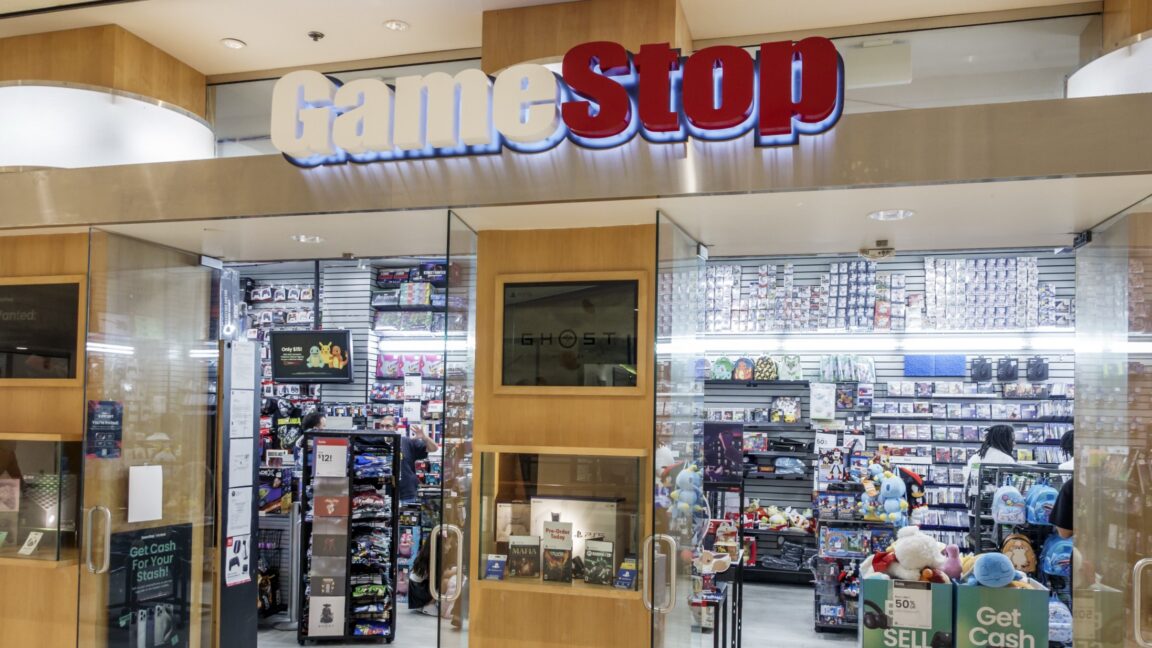
GameStop’s argument is built around a thesis that its roughly 1,600 U.S. locations could become operational assets for eBay rather than relics of a shrinking retail footprint. In Cohen’s framing, stores would function as local authentication centers, intake points, shipping nodes, and even live-commerce studios. Staff who already inspect and grade gaming hardware and trading cards would be repurposed into a distributed verification layer for online sellers.
That pitch is aimed at one of eBay’s persistent challenges: trust. By moving more item inspection and fulfillment into physical locations, GameStop says listings could carry stronger credibility while sellers gain access to a national logistics network without requiring eBay to undertake large new capital spending. It is also positioning those stores as a way for eBay to compete in live commerce by turning parts of the chain into broadcast-capable retail spaces.
Conceptually, the plan tries to convert GameStop’s physical footprint from a cost center into differentiated infrastructure. It is a notable attempt to reframe legacy retail stores as a service layer for marketplace commerce. But the practical challenge is that the industrial logic of a merger does not solve the capital structure problem. A strategically interesting combination is not the same as a financially executable one.

Why markets are focusing on the money
That gap showed up quickly in market reaction. As of the report, GameStop shares were down about 2 percent while eBay shares were up about 5 percent. The divergence suggests investors see value in the possibility of eBay receiving an opportunistic premium, while remaining unconvinced that GameStop can credibly deliver what it is offering.
Those doubts reflect GameStop’s current position. The company has survived well beyond the meme-stock frenzy that once transformed it into a symbol of retail-investor power, but it is still a business dealing with contraction in its store base. The report notes that GameStop reportedly closed about 470 U.S. stores at the start of 2026 after closing 590 U.S.-based stores in 2024. That is not the balance-sheet backdrop that usually accompanies a $55.5 billion bid for a much larger platform company.
GameStop is asking the market to accept two things at once: that it can finance a massive transaction largely through debt and that the resulting combined company would be stronger because of its stores. Those are distinct claims, and each carries significant risk. Debt on that scale would likely require lender confidence not just in the merger story but in GameStop’s ability to stabilize and operationalize a far larger business.
Cohen’s vision is also a leadership proposal
The offer is not merely a capital-markets event. It is also a governance proposition. Cohen intends to become chief executive of the combined company if eBay accepts the deal and the merger closes. GameStop emphasized in a press release that Cohen owns about 9 percent of the company and receives no salary, cash bonuses, or golden parachute, stating that he would be compensated solely on the performance of the combined company.
That framing is meant to signal alignment. It suggests a turnaround leader willing to tie his rewards directly to execution. But it also underscores how personal the bid is. This is not a quiet financial overture. It is an attempt to present a new operating philosophy for eBay: lower costs, more physical-world verification, more logistics integration, and more aggressive commercialization of live selling.
For eBay, the decision is not simply whether the number is large. It is whether the offer is credible enough to engage seriously. Boards weigh price, certainty, financing, regulatory risk, and strategic alternatives. On certainty alone, an unsolicited offer from a smaller company with a difficult funding story starts from a weak position.

A test of what GameStop is now
The proposal is still significant even if it goes nowhere. It shows that GameStop is trying to define itself as something other than a shrinking specialty retailer. The company wants to be seen as an acquirer, allocator of capital, and architect of a hybrid commerce model that blends storefronts with online marketplaces.
That ambition matters because the company’s public identity has often been shaped by volatility rather than operating strategy. An aggressive bid for eBay is a way to force a new conversation, one centered on infrastructure, trust, fulfillment, and platform economics. Whether that conversation produces a deal is another matter.
For now, the bid stands as a vivid mismatch between the scale of a vision and the burden of proving it can be financed. GameStop may believe its stores can give eBay something unique. The market appears to be asking a more basic question first: can GameStop realistically buy the company it wants to reinvent?
This article is based on reporting by Ars Technica. Read the original article.
Originally published on arstechnica.com
