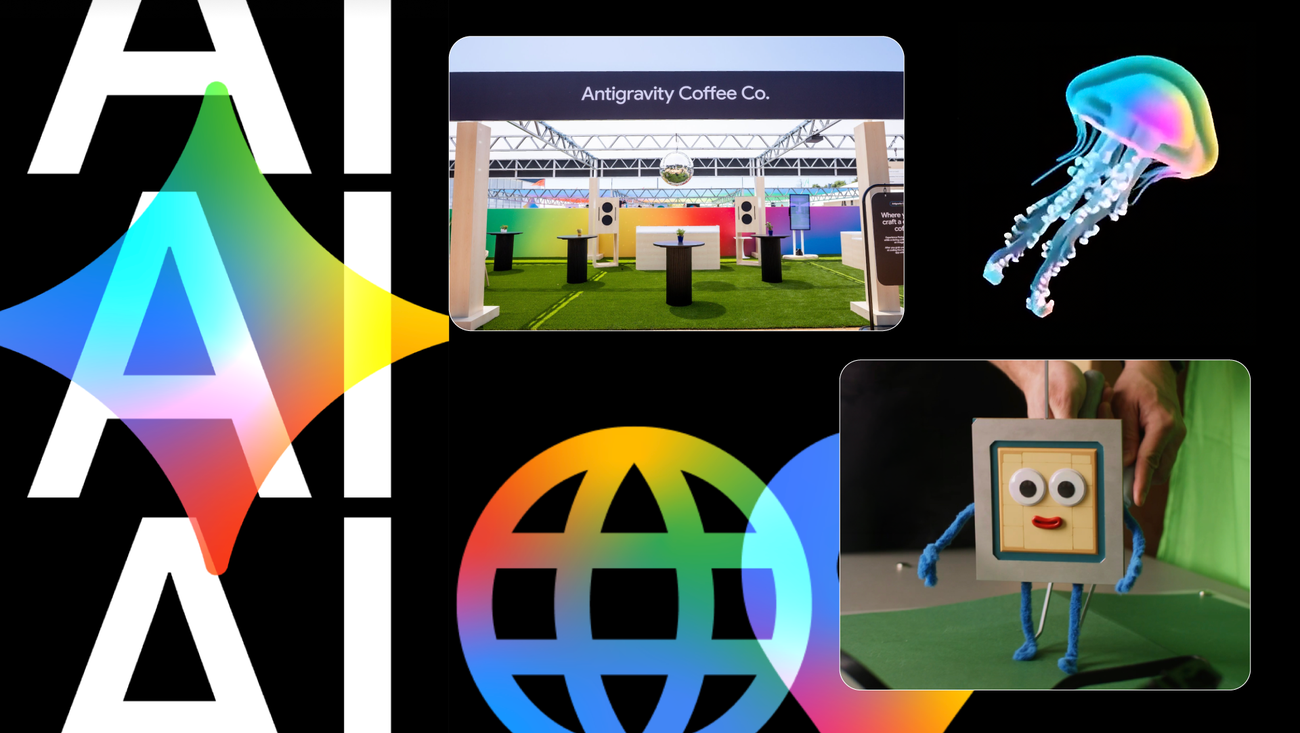
Google used its own conference to demonstrate an internal AI workflow
Google says it did more than announce AI products at I/O 2026. It also used those tools to help build the event itself. In a new post from the company, Google described how teams applied Gemini and other AI systems across film, visual development, and production tasks, positioning the conference as a working example of AI-assisted creative operations inside a major tech organization.
The central message is familiar but important: AI, in Google’s telling, worked best not as a replacement for human creative work but as a way to accelerate iteration, automate routine tasks, and expand the range of what production teams could test quickly. The company framed the exercise as a response to a question it says people keep asking: what can AI actually do in a real production environment?
That makes the post both a behind-the-scenes account and a strategic signal. Google is not just selling AI models to developers and consumers. It is also trying to normalize the idea that high-profile media and event production can run through an AI-augmented workflow without sacrificing the role of human direction.
The “TPU Training Day” example
The most detailed case in the supplied text is a short film called “TPU Training Day,” also referred to as “Timmy TPU.” Google says the project began with simple physical materials, including cardboard and markers, and was then expanded with AI-assisted techniques in collaboration with director Laurie Rowan and Nexus Studios.
According to the company, the production blended puppetry, traditional animation, and AI. The workflow began with captured character performances using puppetry and simple 3D animation, which gave the team control over framing and camera movement. From there, Google says it used Nano Banana to generate stylized first frames from the raw footage.
To maintain consistency, the team built a custom tool inside Google AI Studio so it could test those generated frames at scale and verify pixel-level matches before creating sequences. In other words, the AI-generated imagery was not simply accepted on first pass. It was wrapped in a production process aimed at consistency and controlled output.
What Google is trying to prove
The company’s broader argument is that AI can “unlock creativity and offload the mundane tasks,” freeing teams to spend more time on decisions that require human judgment. This is a standard industry claim, but Google’s post gives it a more operational shape by tying it to named tools, specific outputs, and the production of a globally visible event.
That matters because many AI demonstrations remain abstract. A model can generate images or rewrite text, but that does not show how it behaves inside a deadline-driven production environment with continuity requirements, brand constraints, and collaborative review. By describing internal use at I/O, Google is offering an answer to that gap.
The company also appears to be making a cultural argument. If AI is integrated well enough, viewers stop noticing how it was used and focus on the finished experience. That, in Google’s view, is not a failure of visibility but a sign that the tools are being used properly.
The limits of the claim
The supplied text comes from Google’s own account, so it should be read as a company description of its workflow rather than as an independent assessment of quality or efficiency. It does not quantify how much time or money was saved, and it does not compare AI-assisted output against a conventional production process using the same creative brief.
Still, the details are useful because they show where Google thinks the persuasive case for AI now sits. The pitch is no longer only about raw generation. It is about orchestration, consistency, and rapid prototyping under human direction. The reference to a custom tool inside AI Studio is especially telling: companies may need workflow scaffolding around models, not just access to the models themselves.
That is a more mature view of AI deployment. In practice, organizations adopting these systems often find that the surrounding process matters as much as the model. Prompting, version control, review loops, style consistency, and editorial judgment all determine whether generated material becomes usable production work.
An internal case study with external ambitions
Google’s I/O post functions as a case study for its own products. By showing that Gemini and related tools were used to produce conference media, the company is effectively saying that its AI stack is ready not just for demos but for visible, complex creative applications. That message is aimed at marketers, studios, developers, and enterprise teams weighing how far to integrate generative systems into live production pipelines.
The account also reflects a wider shift in the AI market. Vendors increasingly need to show applied workflows, not just benchmark scores. Businesses deciding whether to adopt these tools want to know how they fit into collaborative work, how they maintain consistency, and how much human oversight remains necessary.
Google’s answer, at least in this telling, is that AI works best as an experimental layer wrapped around human craft. I/O 2026 was not just a launch stage for that idea. It was part of the demonstration.
This article is based on reporting by Google AI Blog. Read the original article.
Originally published on blog.google