A phase 2 study tests an alternative to ribavirin
Lassa fever remains one of West Africa’s most difficult viral diseases to treat. Hospitalized patients can face high fatality rates, and treatment options have long been limited. A new phase 2 randomized controlled trial published in Nature Medicine now offers early clinical evidence that favipiravir could become a meaningful alternative.
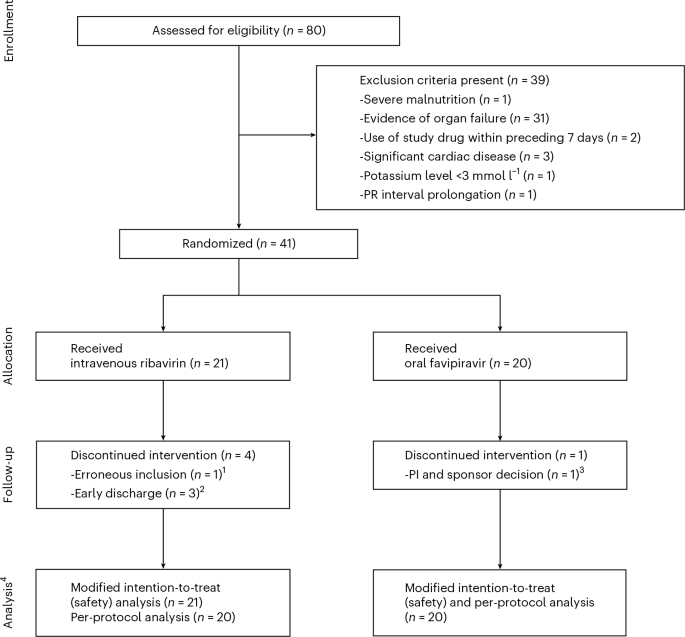
The open-label study was conducted at two reference hospitals in Nigeria and enrolled adults with mild-to-moderate Lassa fever confirmed by RT-PCR testing. Researchers randomized 41 patients, assigning 21 to ribavirin and 20 to favipiravir. Thirty-six participants completed the full 10-day follow-up period. The trial’s main goals were not to prove superiority on survival or symptom resolution, but to establish whether favipiravir could achieve dependable pharmacokinetic performance and whether its safety and tolerability would compare reasonably with the current standard.
On those primary endpoints, the study succeeded. Researchers reported that favipiravir reached reliable plasma exposure in a one-compartment pharmacokinetic model. In steady state, the drug showed a median maximum plasma concentration of 50.9 mg l−1, a half-life of 10.9 hours and an area under the curve over 240 hours of 9,275 mg l−1 h−1. For a disease area where evidence has been sparse and treatment decisions often rely on limited options, that alone is significant. It means investigators now have a clearer idea of how the drug behaves in real patients under clinical trial conditions.
Why the results matter
Lassa fever is endemic in parts of West Africa, and any progress on therapeutics carries outsized importance. Ribavirin has been used for years, but better-supported alternatives have been badly needed. Favipiravir had already shown promise in preclinical work, which is why the Nigerian trial focused on whether the drug could be delivered at high enough exposure levels while remaining manageable for patients.
The safety picture in this trial was encouraging. Investigators recorded 30 drug-related treatment-emergent adverse events, and those events were evenly distributed between the two treatment groups. Based on the supplied study summary, that suggests favipiravir did not create an obvious new safety penalty relative to ribavirin in this small cohort. For clinicians and health systems, that kind of balance matters. A new antiviral is only useful if it can be given reliably in real hospital settings without introducing disproportionate new risks.
The trial was also notable for where it was run. Generating evidence inside countries that regularly confront Lassa fever is essential for translating research into practice. The study did not rely on a hypothetical outbreak model or retrospective review. It evaluated hospitalized adults in Nigeria, where the disease burden is real and immediate. That gives the findings practical weight, even if larger trials will still be needed before treatment standards change.

An early signal, not a final verdict
What this study does not yet establish is equally important. The supplied source text frames the trial around pharmacokinetics, safety and tolerability, not definitive clinical superiority. With only 41 patients randomized, the study was not large enough to settle whether favipiravir improves survival, speeds viral clearance, or reduces complications more effectively than ribavirin across broader patient populations. It also focused on mild-to-moderate disease in adults, which leaves open questions about severe disease, pediatric use and performance across different care environments.
Still, phase 2 trials are supposed to answer foundational questions before larger efficacy studies begin, and this one appears to have done that. Reliable drug exposure means the dosing strategy is plausible. A balanced adverse-event profile means researchers can justify further testing. In outbreak-prone settings, where therapeutics often move slowly from laboratory promise to bedside reality, that is a meaningful step forward.
The implications extend beyond a single drug comparison. Lassa fever has often been overshadowed by more globally visible viral threats, despite its regular impact in endemic regions. A credible pipeline of better-evaluated antivirals could change that, especially if later trials can show stronger patient outcomes. This study helps move the field from theoretical promise toward a more evidence-based treatment future.
What comes next
The next logical step is larger, more definitive clinical testing. Researchers will need to assess whether favipiravir’s pharmacokinetic promise translates into measurable clinical benefit and whether its performance holds up in more diverse cohorts. Questions around timing of treatment, disease severity, and operational use in overstretched hospitals will all matter.
For now, the trial’s main contribution is clarity. Favipiravir can be studied in real Lassa fever patients, at high dose, with dependable exposure and tolerable safety in comparison with ribavirin. In a disease area where therapeutic progress has been slow, that is not a marginal update. It is the kind of incremental but credible result that can support the next phase of serious clinical development.
This article is based on reporting by Nature Medicine. Read the original article.

Originally published on nature.com


