A computational route into a difficult clinical problem
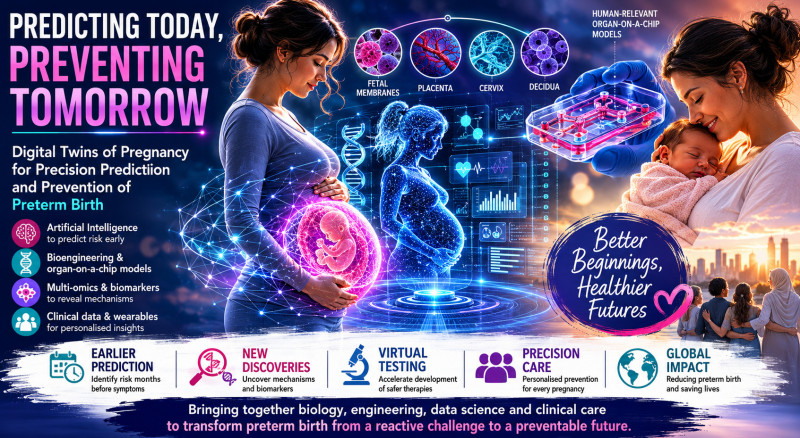
Researchers have developed a digital-twin framework intended to evaluate how drugs may affect the immune system and the timing of labor, according to a Nature Medicine research highlight. The approach could support more personalized interventions aimed at preventing spontaneous preterm labor, a condition that often emerges without warning signs or clearly identified risk factors.
The framework addresses a central challenge in pregnancy research: clinical trials involving pregnant people are difficult to conduct. Those constraints can slow the development and evaluation of treatments, especially when the proposed treatment may influence both maternal biology and pregnancy outcomes.
Digital twins are computational representations designed to model aspects of a real system. In this case, the reported framework is intended to model immune-system effects and time to labor. Rather than presenting it as a replacement for clinical care or clinical trials, the research highlight frames the system as a way to safely evaluate potential drug effects and to explore interventions before they are tested in the real world.
Why preterm birth needs better tools
About one in 10 pregnancies involves a preterm birth, according to the Nature Medicine report. The burden is made harder to address because many cases occur without warning signs or known risk factors. That limits the usefulness of strategies that depend solely on identifying high-risk patients well in advance.
Growing evidence suggests that disruptions in the immune adaptations that normally occur during pregnancy may play a role in spontaneous preterm labor. Pregnancy requires the immune system to adapt over time, and the research described in the highlight focuses on how drug interventions could affect that biology as labor approaches.
That focus matters because a treatment that changes immune activity may have complex consequences. A drug could affect more than one biological pathway, and the timing of an intervention may be as important as the intervention itself. A model that can examine immune effects alongside time to labor could therefore help researchers narrow questions that would be difficult to answer directly through conventional studies alone.

What the digital-twin framework is designed to do
The reported framework was developed to evaluate drug effects on the immune system and on time to labor. Nature Medicine says it could enable personalized interventions, suggesting that the model is meant to account for differences among pregnancies rather than assume a single response applies to everyone.
Personalization is particularly relevant in spontaneous preterm labor because the condition does not present as one uniform pathway. The source text does not specify the individual drugs evaluated, the data used to build the model, or the performance measures reported by the underlying research. Those details are important for judging a computational system’s readiness for wider use, and they are not established by the supplied highlight.
Even so, the direction of travel is clear. A digital twin could be used to compare potential interventions under simulated conditions, assess their predicted effect on immune behavior and labor timing, and help identify which questions merit further laboratory or clinical investigation. This kind of computational testing may be especially valuable where direct experimentation is limited by ethical and practical considerations.
Complementing, not bypassing, evidence
The promise of a digital-twin approach should not be confused with proof that a treatment prevents preterm birth. A computational framework can generate predictions and guide research, but clinical decisions still require robust evidence of safety and benefit. This is especially true in pregnancy, where treatment decisions must account for the health of both the pregnant person and the developing fetus.
The source material emphasizes that challenges in running clinical trials during pregnancy constrain drug development. That makes tools for safer early-stage evaluation valuable, but it also underscores why validation is essential. A model must be tested against relevant observations and its limits must be understood before its outputs can be used to shape care.
For researchers, the immediate value may lie in making hypotheses more precise. Instead of testing every possible intervention in the same way, teams may be able to use the framework to prioritize candidates, examine possible timing effects and identify cases where immune-system changes appear most relevant. That could make later studies more focused.

An early step toward more tailored prevention
The research highlight positions the digital twin as a possible tool for personalized prevention of preterm birth. Its importance lies not in a claim of an immediate clinical solution, but in creating a structured way to study an urgent problem where conventional evidence generation is unusually difficult.
If subsequent research confirms that such models can reliably predict relevant drug effects and labor timing, they may become part of a broader toolkit for preterm-birth research. That toolkit would still need clinical observation, carefully designed studies and medical judgment. But a digital representation of pregnancy-related immune adaptation could give scientists a safer way to explore which interventions deserve those limited and demanding research opportunities.
For a condition that often arrives without clear early warnings, better ways to understand biological variation may be as important as discovering a single new drug. The reported framework offers one route toward that goal: use computation to investigate the immune and timing questions that are hardest to test directly, then carry the strongest findings forward for validation.
This article is based on reporting by Nature Medicine. Read the original article.
Originally published on nature.com