Brazil is trying to make genomic medicine a public health service
Brazil is moving to embed large-scale genomics into its universal healthcare system through the Genomas Brasil program, an effort described in Nature Medicine as a national push to combine sequencing capacity, infrastructure and clinical implementation at scale. The initiative is notable not only for its size, but for where it is being built: inside the Unified Health System, or SUS, one of the world’s largest public healthcare networks.
The core idea is straightforward. Instead of treating genomic medicine as a niche service reserved for elite hospitals or private-pay patients, Brazil is attempting to place it inside routine public care. That means linking genetic data generation with the institutions, laboratories and care pathways needed to put results to use in real clinical settings. The Nature Medicine commentary frames that combination as a path toward “genomic equity” and precision public health, especially for countries in the global south that want to avoid importing a model designed around narrower, wealthier health systems.
Why the program matters beyond Brazil
Genomic medicine has long carried a contradiction. The science promises earlier diagnosis, better disease stratification and more tailored treatment, but the practical benefits have often accumulated where research funding, sequencing infrastructure and specialist clinics are already concentrated. Large public systems in middle-income countries face a harder problem: how to build genomics at scale without deepening existing inequalities in access to advanced care.
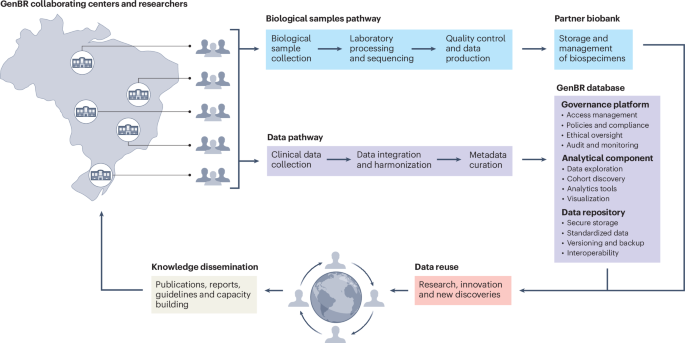
That is what makes Genomas Brasil strategically important. According to the source text, the program is not limited to sequencing alone. It combines sequencing, infrastructure and clinical implementation, suggesting that policymakers are treating genomics as a systems challenge rather than a laboratory exercise. In practice, that distinction matters. Sequencing genomes is only one part of precision medicine. Health systems also need sample logistics, data pipelines, interpretation capacity, integration with clinicians, and a route for acting on findings.
For countries trying to modernize public health capabilities, that end-to-end design could be more valuable than a stand-alone research project. It implies a national framework that connects data generation with care delivery and with population-level planning. If the model proves workable, it may offer a template for countries that want to build precision medicine without relying entirely on fragmented pilot programs or private sector uptake.

A public health framing, not just a research framing
The commentary’s emphasis on precision public health is important. Precision medicine is often discussed in terms of individual patients: a diagnosis clarified, a treatment selected, a risk profile refined. Public health works on a different scale. It asks how evidence, screening and data systems can improve outcomes across entire populations, especially in settings where resources must be allocated carefully.
By placing Genomas Brasil inside SUS, Brazil appears to be testing whether genomics can function as public infrastructure. That could affect how screening priorities are set, how rare diseases are recognized, and how genomic knowledge is distributed across regions rather than concentrated in major academic centers. The source text also highlights population screening and genome research as relevant subject areas, reinforcing the idea that the program is meant to operate at both research and service levels.
That approach carries political as well as scientific significance. Universal systems are often judged on whether they can absorb new technologies without undermining broad access to essential care. A genomics program inside SUS therefore becomes a test of institutional capacity: can a public system adopt advanced molecular tools while preserving its equity goals?
Brazil’s diversity could shape the value of the effort
One reason global observers may pay close attention is Brazil’s population diversity. Although the supplied text is only a preview, it situates the initiative in a context where genomic equity is a central concern. In genomics, underrepresentation has practical consequences. When databases are skewed toward a limited set of ancestries, interpretation can be less reliable for populations that are poorly represented.
A national genomics effort in a large, diverse country can therefore serve two purposes at once. It may expand access to genomic services domestically, while also enriching the evidence base used to interpret variation more accurately. That does not guarantee immediate clinical gains, but it can improve the foundations on which future diagnostics, screening strategies and research programs are built.
The implication is broader than one country. Many nations in Latin America, Africa and Asia face a similar gap between the promise of genomic medicine and the realities of public health delivery. A workable Brazilian model would show that a universal system can pursue advanced genomics without waiting for a fully private or boutique-care pathway to emerge first.

The hard part is operational, not rhetorical
Programs like this tend to succeed or fail on execution. The source text points to a “national framework” for GenBR, suggesting centralized planning, but framework diagrams are easier to publish than nationwide clinical workflows are to sustain. Scaling genomics in a public system requires durable funding, laboratory standards, data governance, workforce training and clear clinical criteria for when testing should be used.
It also requires trust. Genomic programs raise questions about consent, data stewardship and how benefits are shared across the health system. For a publicly embedded initiative, those questions become more sensitive because the state is not merely funding research; it is helping define the infrastructure through which genomic information is collected and acted upon.
Still, the source text suggests Brazil is attempting to move beyond isolated demonstration projects. That alone marks a shift. Rather than asking whether genomics belongs in public healthcare, Genomas Brasil appears to start from the premise that it does, and focuses instead on how to build it responsibly at scale.
What to watch next
The most consequential outcomes will likely be practical rather than symbolic. Observers will want to know whether the program improves access to genetic testing, whether results can be translated into clinical decisions across different regions, and whether the underlying infrastructure becomes a durable part of SUS rather than a temporary innovation layer.
If Brazil can show that sequencing, interpretation and implementation can be connected inside a universal system, Genomas Brasil may become one of the clearest examples yet of precision medicine being adapted for public health rather than premium care. That would make it relevant far beyond Brazil’s borders.
Key points
- Genomas Brasil is being built inside Brazil’s Unified Health System rather than outside it.
- The program combines sequencing, infrastructure and clinical implementation at national scale.
- Its stated significance extends to genomic equity and public health in the global south.
- The main test now is whether the model can deliver durable, system-wide clinical value.
This article is based on reporting by Nature Medicine. Read the original article.
Originally published on nature.com


