How a person moves may carry far more health information than conventional gait measures capture. Researchers reporting in Nature Medicine have developed a foundation model that analyzes three-dimensional skeletal motion and uses it to predict a broad range of health phenotypes, from grip strength and sleep quality to measures related to body composition.
The study frames gait as a potential multisystem vital sign rather than only a symptom assessed in relation to a particular injury or disease. Its central finding is that a learned representation of whole-body movement improved prediction across numerous health domains beyond what could be inferred from basic physical characteristics alone.
From stride measurements to movement embeddings
Conventional gait assessment often relies on engineered features such as cadence and stride length. Those measurements are clinically useful, but they reduce a complex, coordinated movement into a limited set of predefined variables.
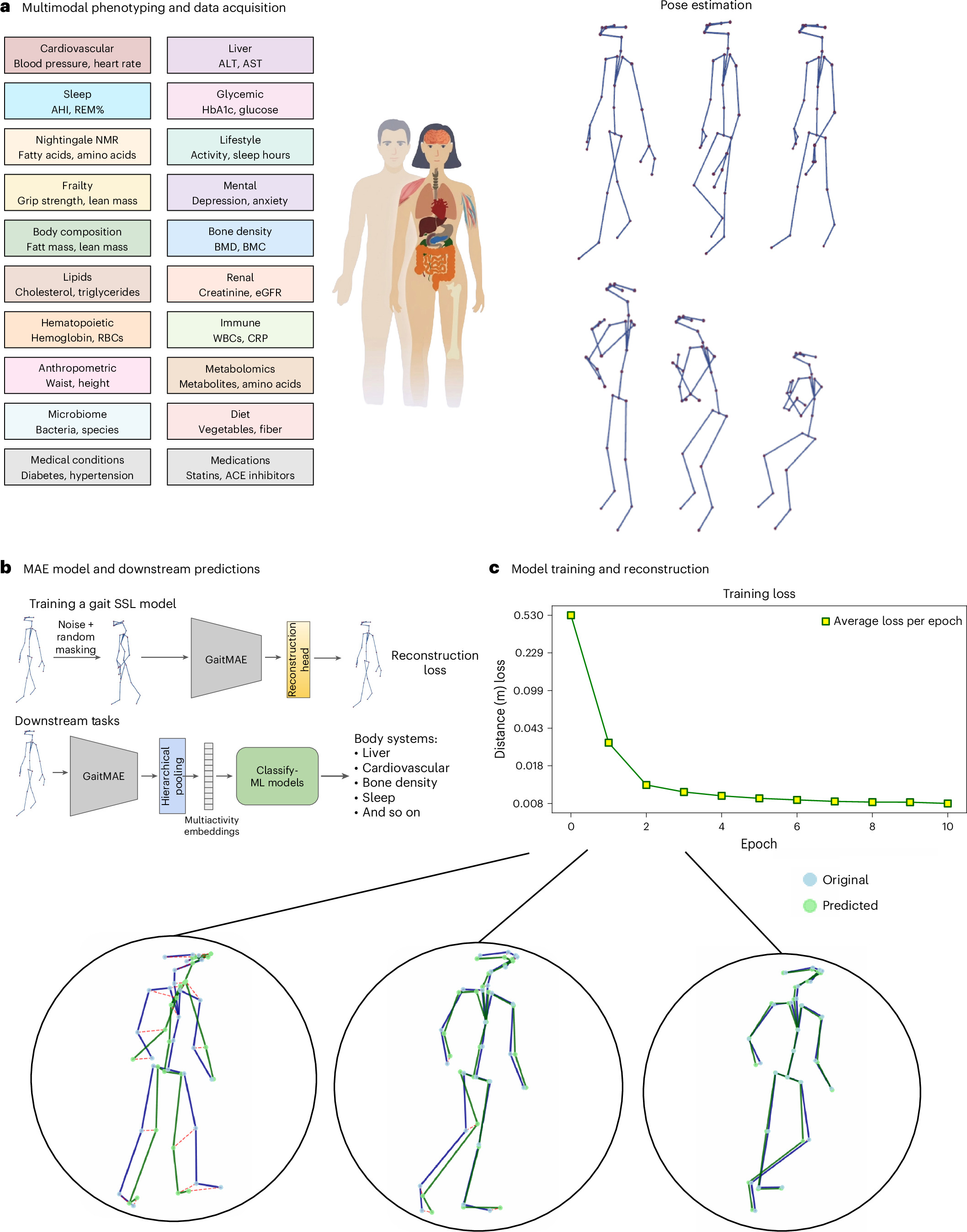
The new approach instead uses a model trained on three-dimensional skeletal motion. A single depth camera recorded participants performing five motor tasks. The model converted the resulting motion into learned embeddings: numerical representations intended to capture how joints move together over time.
The research dataset included 3,328 deeply phenotyped adults. The authors tested whether those movement embeddings could predict 3,210 health-related phenotypes spanning 18 body systems. They report that the embeddings significantly predicted 1,887 of those phenotypes.

Predicting age, body composition and health measures
The model outperformed engineered gait features in predicting several headline measures. The reported correlations were 0.69 for age, 0.91 for body mass index and 0.83 for visceral adipose tissue area. These results do not mean that a walking recording replaces a clinical test; rather, they show that the model’s representation of movement contained information associated with those measures.
The researchers also compared predictions using gait embeddings with a baseline that used age, body mass index, visceral adipose tissue and height. Adding the movement embeddings improved prediction in all 18 body systems among males and in 17 of 18 systems among females, according to the paper. The embeddings also improved prediction of clinical diagnoses and medication use.
The breadth of those associations is the study’s most consequential claim. A short motion capture session could eventually provide a passive and scalable complement to existing assessments, if the findings are validated in other populations and translated responsibly into clinical workflows.
Different body regions carried different signals
The researchers used anatomical ablation analyses to examine which parts of the body contributed to particular predictions. Leg dynamics were the dominant source of information for metabolic and frailty predictions. Torso dynamics, meanwhile, encoded information associated with sleep and lifestyle phenotypes.
That result reinforces the idea that gait is not simply a measurement of the legs. Walking reflects balance, strength, coordination, posture and the integrated operation of multiple body systems. A model that retains the temporal relationships among body joints may recognize patterns that are lost when analysis is restricted to step count, speed or stride length.

A possible passive vital sign
The authors say their results establish gait as an independent multisystem biosignal and motivate its integration into routine clinical assessment as a scalable, passive vital sign. The study’s setup is notable because it used a single depth camera rather than a specialized motion-capture laboratory.
That accessibility could matter if future research confirms the findings across settings and populations. It could enable standardized movement assessments in clinics, rehabilitation programs or longitudinal health studies. But the published results describe predictive relationships, not a standalone diagnostic tool. Any real-world use would need careful validation, clear clinical thresholds and safeguards around how sensitive motion and health data are collected and used.
For now, the work expands the clinical argument for looking at how people move. Rather than treating gait as a narrow marker of mobility, the researchers show that three-dimensional motion may offer a window into health across the body.
This article is based on reporting by Nature Medicine. Read the original article.
Originally published on nature.com