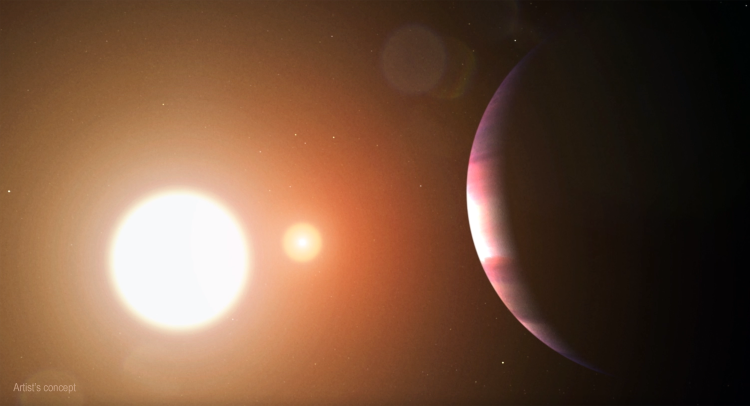
A search for planets with two suns widens
Astronomers analyzing data from NASA’s Transiting Exoplanet Survey Satellite, or TESS, say they have identified 27 new candidate planets orbiting binary star systems. The finding expands one of the more difficult frontiers in exoplanet science: the search for circumbinary planets, or worlds that travel around two gravitationally bound stars instead of one.
The candidate systems were reported in a study published in the Monthly Notices of the Royal Astronomical Society by researchers from the United States and Australia. Their main advance is methodological. Rather than relying only on the standard transit technique, the team used a different signal, called apsidal precession, to search for planets in systems where traditional detection is especially hard.
The result does not yet confirm 27 new worlds in a definitive sense. The objects remain candidates, and key physical properties such as size are still uncertain. But the survey suggests that astronomers may have been overlooking a substantial number of planets in binary systems because the usual tools are biased toward only the easiest orbital geometries to observe.
Why circumbinary planets are hard to find
Most exoplanet discoveries still begin with the transit method, which measures small dips in starlight when a planet passes in front of its host star from Earth’s point of view. The technique has been extraordinarily successful around single stars. Binary systems complicate that picture.
In a circumbinary system, two stars orbit each other while the planet orbits both. That geometry creates moving targets, irregular timing, and a much narrower set of viewing angles for clean transits. In practical terms, researchers can miss real planets simply because their orbits are tilted in ways that do not line up neatly with Earth-based observations.
That limitation matters because binary stars are common in the galaxy. If astronomers rely too heavily on transit detections alone, they risk building an incomplete map of where planets form and what kinds of systems can host them.
The study’s lead author, Margo Thornton of the University of New South Wales in Sydney, said the team wanted a survey approach that was not restricted by orbital orientation. That is the core promise of the work: broadening the search beyond the narrow subset of systems that happen to stage a photogenic transit for observers on Earth.

The new method: reading orbital twists instead of shadow crossings
The team examined 1,590 eclipsing binary stars that show apsidal precession. In simple terms, apsidal precession is the gradual rotation or twisting of an orbit’s shape over time. In these systems, a planet’s gravitational influence can subtly alter the stars’ orbital behavior. That creates a measurable signal even when a planet never passes directly in front of both stars from our vantage point.
Using that signal as a planetary clue opens a new lane for discovery. Rather than waiting for a rare, well-aligned transit, astronomers can infer the possible presence of a planet from how the binary pair behaves dynamically. The technique does not replace transit work, but it complements it by targeting systems that have been difficult to probe with standard methods.
The discovery of 27 candidates from this sample suggests the approach may be scalable. If similar analyses are extended across larger datasets, the known population of circumbinary planets could grow significantly. That would matter not just for counting planets, but for understanding how stable planetary systems emerge in environments with more complicated gravitational choreography.
What scientists still need to learn
The current candidates are an important first pass, not the end of the process. The study notes that their physical properties remain inconclusive. Astronomers still need to confirm whether each signal truly reflects a planet and then determine characteristics such as mass, radius, and orbital stability.
One likely next step is radial velocity follow-up. That method detects the wobble induced by an orbiting planet and can help confirm the object while refining its properties. In single-star systems, radial velocity has long been a standard companion to transit observations. In binaries, it is more complex, but still valuable as a confirmation tool.
Confirmation will be especially important because candidate lists can include false positives. Stellar interactions, measurement noise, or incomplete modeling can sometimes imitate planetary effects. A robust pipeline of follow-up observations will determine how many of the 27 objects remain standing as fully validated worlds.

Why this matters for planetary science and habitability questions
Circumbinary planets have long captured public imagination because they resemble the fictional double-sunset world of Tatooine. But the scientific importance goes well beyond visual novelty. These systems test theories of planet formation under conditions that differ sharply from the calmer environment around a single star.
If planets can form and persist in greater numbers around binary stars than once assumed, models of disk evolution, migration, and long-term orbital stability may need adjustment. The more examples researchers find, the better they can compare which planetary architectures are common, which are rare, and how stellar multiplicity shapes the final outcome.
Habitability is a more distant question, but an inevitable one. A candidate list alone cannot tell scientists whether any of these worlds could support life. Yet simply identifying more circumbinary systems is a necessary foundation for later work on temperature ranges, atmospheric prospects, and orbital conditions. Before researchers can ask whether such planets are habitable, they need enough confirmed examples to study seriously.
A reminder that detection bias still shapes discovery
One of the most important implications of the study is methodological humility. Exoplanet catalogs are not pure mirrors of the galaxy. They are shaped by the strengths and weaknesses of detection tools. If a class of planets is hard to see, it may appear rare even when it is not.
By targeting apsidal precession in eclipsing binaries, this survey argues that part of the apparent scarcity of circumbinary planets may be observational rather than physical. That does not prove such planets are abundant. But it does show that astronomers are still improving how they look, not just what they find.
As TESS continues to generate data and follow-up campaigns grow more sophisticated, techniques like this may help fill in one of the more intriguing blank spots in planetary science. The 27 candidates are not yet a confirmed menagerie of two-sun worlds. They are, however, a strong sign that the census of such systems is far from complete.
This article is based on reporting by Universe Today. Read the original article.

Originally published on universetoday.com