The Army is putting more weight behind non-kinetic protection
BAE Systems has secured the U.S. Army’s Soft Kill Active Protection System program of record, marking a step forward in the military’s effort to add electronic warfare defenses to ground vehicles facing missiles, drones, and other guided threats. According to the company, the first phase of the award is valued at $20 million and will support further development of its soft-kill technology.
The system centers on BAE’s Rapid Optical Observation and Kill program, or ROOK. Rather than physically intercepting an incoming threat, ROOK is designed to defeat it through non-kinetic effects by confusing or jamming missiles or drones before they can strike the vehicle. In other words, the Army is continuing to build a layered defense model in which traditional armor and hard-kill interceptors are complemented by systems that disrupt the attacker’s sensors, guidance, or control links.
Why the award matters
Soft-kill systems have become more relevant as battlefields fill with relatively cheap aerial threats and precision-guided weapons. Ground formations are increasingly exposed not only to anti-armor missiles but also to drones that can scout, track, and attack from above. A soft-kill system promises a different kind of response: one that may be reusable, sustainable, and less dependent on finite stocks of interceptors or ammunition.
BAE described that logic directly, calling such defenses cost-effective and highlighting what it characterized as an “infinite magazine depth” for systems that continuously disrupt enemy electronics. The company also framed soft-kill measures as a critical complement to other protective layers, not a full replacement for kinetic defenses.
How ROOK fits the Army’s longer effort
- BAE said ROOK is a spiral development of its earlier TERRA RAVEN system.
- The company won the Army’s 2019 Soft Kill Rodeo competition with TERRA RAVEN.
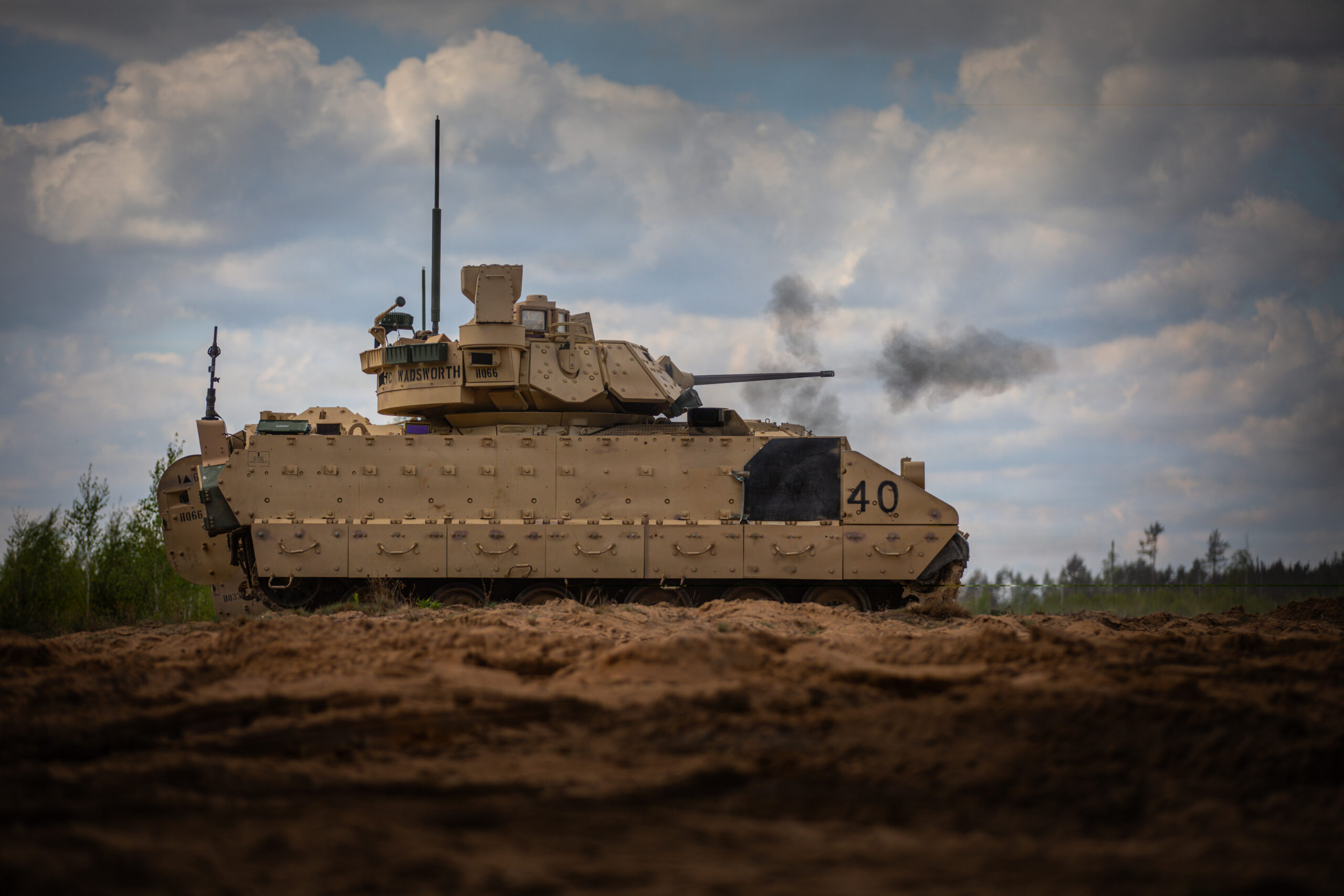
- Later in 2019, the Army indicated the winning system should be integrated onto a Bradley Fighting Vehicle.
- The new contract also supports further development tied to BAE’s Stormcrow defense system, which uses lasers against airborne threats.
That lineage matters because it suggests the Army is not starting from scratch. The award builds on several years of work around soft-kill protection, including earlier demonstrations that positioned BAE as a serious contender in the category. The ROOK award appears to formalize and extend that trajectory into a program-of-record framework, which tends to carry more strategic significance than a one-off prototype effort or trial.
What is still unclear
One of the main open questions is exactly which Army vehicles will get the system first. When asked, BAE deferred to the Army, and the Army had not responded by press time in the source report. That leaves unresolved how widely the technology may spread across the armored fleet and whether the first integrations will focus on vehicles that already face elevated drone and missile risk in Europe or other theaters.
There is also the broader question of how soft-kill systems will be combined with other active protection measures. Modern vehicle survivability is moving toward architecture rather than any single product: sensors, jammers, lasers, guns, and interceptors all have to be coordinated into a coherent defensive stack. The significance of the award is therefore not just that BAE won a contract, but that the Army is continuing to formalize this layered approach as an operational requirement.
For industry, the award is another sign that electronic warfare and directed-energy-adjacent technologies are becoming more central to land warfare procurement. For the Army, it reflects a recognition that ground vehicles cannot rely only on armor and traditional firepower when faced with proliferating guided threats. If ROOK performs as intended, the program could shape how the service protects combat vehicles in an era defined by drones, sensors, and contested electromagnetic environments.
This article is based on reporting by Breaking Defense. Read the original article.
Originally published on breakingdefense.com