Un debate de décadas sobre Marte recibe una nueva respuesta geológica
Los científicos han debatido durante mucho tiempo si Marte alguna vez albergó un vasto océano en gran parte de su hemisferio norte. Uno de los mayores problemas ha sido la ausencia de una costa. Los investigadores esperaban que un gran océano estable dejara algo parecido a un anillo de bañera: un límite nivelado y claramente rastreable que mostrara dónde estuvo el agua. Sin embargo, las posibles costas marcianas que se han identificado parecen distorsionadas por varios kilómetros en elevación.
Un nuevo artículo en Nature, descrito por Universe Today, sostiene que esa quizá era la característica equivocada a priorizar. En lugar de buscar una costa nítida, los investigadores Abdallah Zaki y Michael Lamb, de Caltech, sugieren que los científicos deberían haber buscado una plataforma continental.
La hipótesis de la plataforma
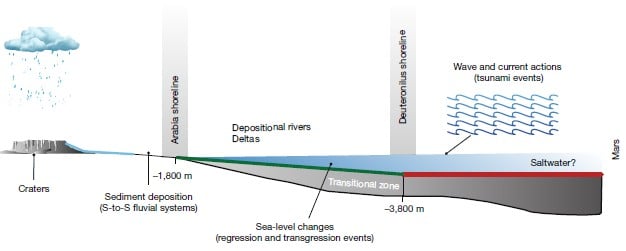
En la Tierra, la característica a gran escala más prominente de un margen oceánico no es la costa visible, sino la llanura costera de pendiente suave y la plataforma continental bajo el agua. Según el informe, los investigadores compararon patrones de pendiente en la Tierra y Marte y encontraron lo que describen como una coincidencia casi exacta de zona plana en Marte entre aproximadamente -1.800 y -3.800 metros de elevación.
La escala de la característica es llamativa. La región similar a una plataforma cubre 10,2 millones de kilómetros cuadrados, o casi el 7% de la superficie marciana. Eso por sí solo la convertiría en una de las pruebas geológicas más importantes propuestas hasta ahora en el prolongado debate sobre el océano.
El argumento se refuerza por dónde aparecen otras pistas. La fuente dice que muchos deltas conocidos encontrados por rovers y orbitadores se sitúan dentro de esta zona. Dos supuestas costas conocidas como Arabia y Deuteronilus también se encuentran dentro de ella, y allí mismo se concentran gruesas acumulaciones de rocas estratificadas y arcillas. Esos materiales están asociados con agua de larga duración.
Por qué las costas parecen deformadas
El problema de la costa deformada ha perseguido durante años la hipótesis del océano antiguo, porque un cuerpo de agua estable no debería dejar un margen que varíe drásticamente en elevación. Se habían propuesto varias explicaciones. Una era el verdadero desplazamiento polar, en el que los cambios en la distribución de masa de un planeta alteran su orientación y deforman las características de la superficie. Otra sugería que el enorme levantamiento volcánico alrededor de Tharsis curvó la corteza del planeta mientras el océano aún existía.
El nuevo estudio apunta a una explicación más simple. Sin tectónica de placas que recicle la corteza, los deltas marcianos y los depósitos costeros podrían haberse acumulado y alterado el margen visible con el tiempo. En esa interpretación, la costa obvia se convirtió en un objetivo engañoso, mientras que la geometría más amplia de la plataforma preservó la señal más fuerte.
Si eso es correcto, el hecho de no encontrar un anillo de bañera ordenado nunca fue una prueba decisiva contra un océano. Puede que haya reflejado una intuición terrestre aplicada demasiado literalmente a un planeta con reglas geológicas distintas.
Una mejor forma de leer Marte
La idea de la plataforma importa porque replantea cómo los científicos buscan entornos antiguos en otros mundos. En vez de preguntarse si Marte conservó una costa familiar, la cuestión pasa a ser si su topografía registra una amplia zona de transición marina. Es una firma geológica más sutil, pero potencialmente más robusta.
También ayuda a conectar varias líneas de evidencia que a menudo se han discutido por separado: deltas, arcillas, depósitos sedimentarios en capas y costas candidatas. Al situarlas dentro de una sola región similar a una plataforma, el estudio ofrece un marco coherente en lugar de una colección de observaciones sugerentes pero desconectadas.
Por qué esto importa más allá de un debate cartográfico
La existencia de un gran océano antiguo en Marte tendría implicaciones para la historia climática, el transporte de sedimentos y la habitabilidad a largo plazo del planeta. Los entornos acuáticos duraderos están entre los objetivos más importantes en la búsqueda de vida pasada, porque ofrecen tiempo y estabilidad para la química, la deposición de sedimentos y, potencialmente, la biología.
Este nuevo trabajo no cierra el caso por sí solo, pero cambia los términos del argumento. La ausencia de una costa de libro de texto se ha tratado a menudo como una gran debilidad de la hipótesis del océano. El modelo de plataforma sugiere que Marte puede haber conservado un registro diferente, y quizá más revelador, de su pasado acuoso.
Si futuros trabajos respaldan la interpretación, uno de los enigmas más persistentes de la ciencia marciana podría terminar teniendo una respuesta sencilla. El planeta rojo no dejó de conservar la huella de un océano. Los científicos quizá solo estaban buscando la forma equivocada.
Este artículo se basa en la cobertura de Universe Today. Lee el artículo original.
Originally published on universetoday.com