Jupiter's Light Show Gets Complicated
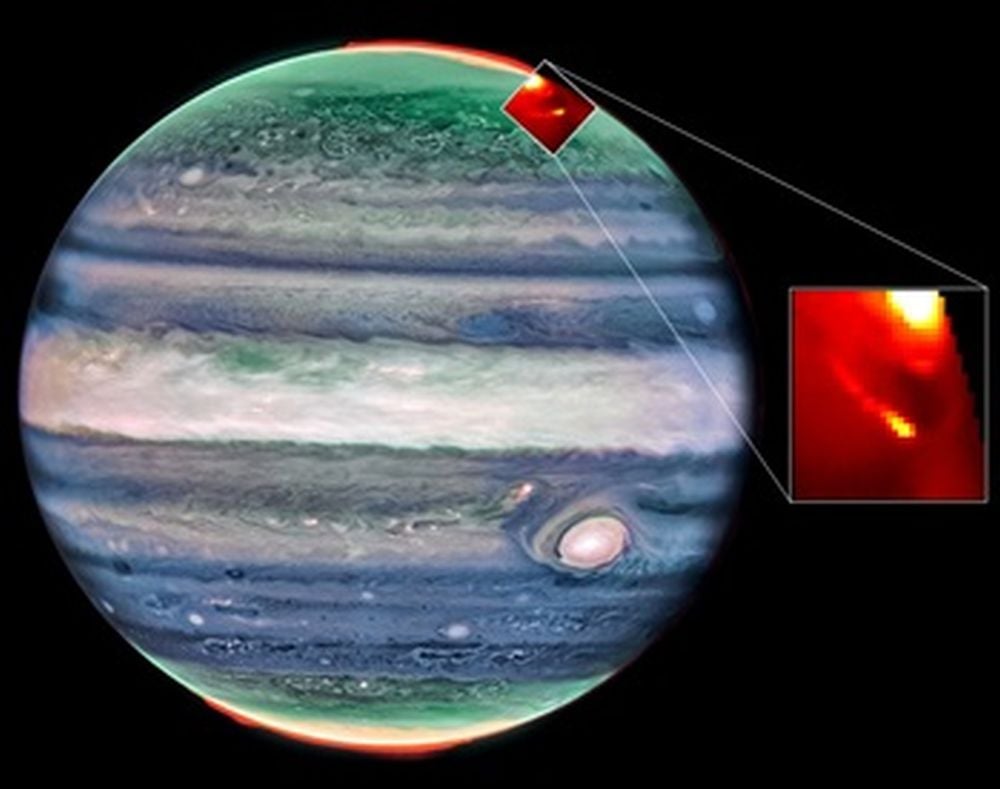
The James Webb Space Telescope has delivered the first infrared spectra of the bright spots in Jupiter's northern aurora created by the planet's Galilean moons, and the results are challenging scientists' understanding of how the giant planet's magnetosphere works. The observations reveal that the auroral footprint of Io, Jupiter's volcanic moon, is far more variable in temperature and density than anyone expected.
Jupiter's aurorae are the most powerful in the solar system, generated by charged particles spiraling along the planet's immense magnetic field lines and slamming into the upper atmosphere. Unlike Earth's aurorae, which are driven primarily by the solar wind, Jupiter's are powered largely by material ejected from its moons — particularly Io, which spews roughly one ton of sulfur dioxide gas per second from its volcanic surface.
Io's Auroral Footprint Under the Microscope
Each of Jupiter's four Galilean moons creates a distinct bright spot in the planet's aurora as it moves through the magnetosphere and generates electromagnetic disturbances that propagate along magnetic field lines to the atmosphere. Io's footprint is the brightest and most well-studied, visible in ultraviolet observations since the Hubble Space Telescope first detected it in the 1990s.
JWST's Near-Infrared Spectrograph observed these footprints in unprecedented detail, measuring the emission lines of molecular hydrogen in the three to five micrometer wavelength range. These spectral lines are sensitive to both the temperature and density of the atmospheric gas being excited by incoming charged particles, providing diagnostic information that ultraviolet observations alone cannot deliver.
The results showed that Io's auroral footprint varies dramatically in both temperature and density on timescales of hours to days. The temperature fluctuations span a range that existing magnetospheric models cannot easily explain, suggesting that the interaction between Io's plasma torus and Jupiter's magnetic field is more complex and dynamic than previously understood.
What Could Drive the Variability
Several hypotheses are being considered to explain the extreme variability. One possibility is that changes in Io's volcanic output — which is known to fluctuate as different volcanic centers become more or less active — alter the rate at which plasma is injected into the magnetosphere, leading to variations in the energy deposited into Jupiter's atmosphere.
Another hypothesis involves magnetic reconnection events in Jupiter's magnetosphere, analogous to the substorms that produce auroral brightening on Earth. If magnetic field lines periodically reconnect and release stored energy, they could produce bursts of particle precipitation that temporarily heat the auroral footprint to extreme temperatures.
A third possibility is that the variability reflects changes in the Alfven wave system that connects Io to Jupiter's atmosphere. These electromagnetic waves carry energy from the moon to the planet, and their propagation through the complex plasma environment around Jupiter could produce fluctuations in the delivered power.
Implications for Magnetospheric Science
Jupiter's magnetosphere is the largest structure in the solar system, extending tens of millions of kilometers from the planet. It serves as a natural laboratory for studying magnetized plasma processes that occur throughout the universe, from other planets to pulsars and active galactic nuclei.
The JWST observations indicate that even the best current models of Jupiter's magnetosphere are missing key physics. The extreme variability of Io's auroral footprint suggests rapid, large-scale changes in magnetospheric conditions that steady-state models cannot reproduce. This finding will likely motivate new generations of time-dependent simulations that capture the dynamic coupling between Io, the plasma torus, and Jupiter's atmosphere.
Europa and Ganymede Footprints
JWST also observed the auroral footprints of Europa and Ganymede, though these are significantly fainter than Io's. Preliminary analysis suggests that these footprints are more stable, consistent with the lower plasma production rates of these moons compared to volcanically active Io. However, Ganymede's footprint shows some unique features related to its own intrinsic magnetic field — the only moon in the solar system known to possess one.
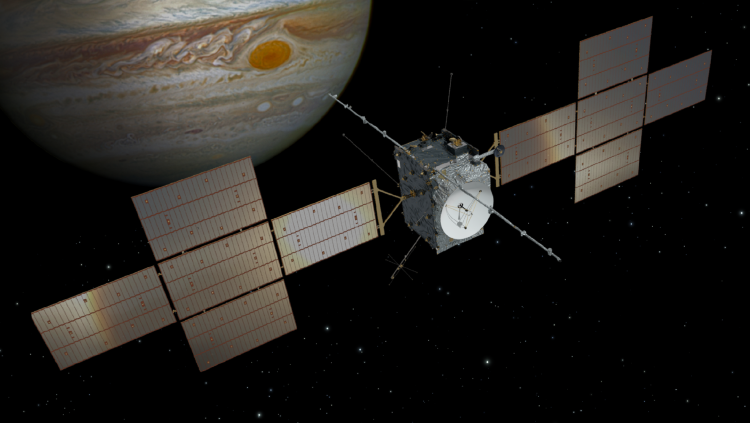
The observations represent just the beginning of JWST's contribution to Jupiter science. Future observations planned over the coming years will track the auroral footprints over longer timescales, potentially correlating changes with specific volcanic events on Io or magnetospheric dynamics observed by other missions. The ESA's JUICE spacecraft, currently en route to Jupiter with a planned arrival in 2031, will provide complementary in-situ measurements that could help explain what JWST is seeing from afar.
This article is based on reporting by Universe Today. Read the original article.
Originally published on universetoday.com