Washington links ceasefire to an expansive assessment of military damage
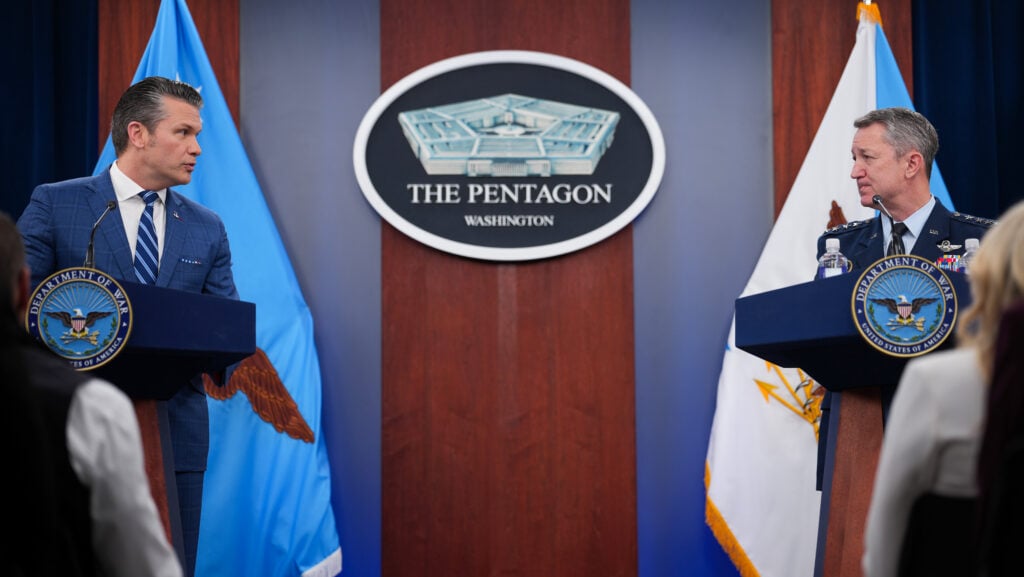
As a two-week ceasefire between the United States and Iran took hold, Pentagon leaders used a press briefing on April 8 to present a sweeping account of what they say U.S. operations achieved during more than five weeks of conflict. Defense Secretary Pete Hegseth called the outcome a “decisive military victory,” while Chairman of the Joint Chiefs of Staff Gen. Dan Caine outlined what the Pentagon described as extensive destruction across Iran’s military infrastructure.
The briefing framed the ceasefire not as a pause after a limited exchange, but as the endpoint of a campaign Washington says fundamentally degraded Tehran’s ability to project force, rebuild key capabilities, and contest control of regional airspace and sea lanes.
The Pentagon’s claims of battlefield impact
According to Caine, internal U.S. analysis found that during Operation Epic Fury the U.S. struck 13,000 targets and that American forces and Gulf partners intercepted 1,700 ballistic missiles. He said roughly 80% of Iran’s air defense systems were destroyed, along with 90% of its regular maritime fleet and 95% of its naval mines.
Caine also provided a detailed assessment of damage to the defense industrial base. He said the Pentagon believes it damaged or destroyed 20 naval production and fabrication sites, nearly 80% of Iran’s nuclear industrial base, and 80% of its missile facilities. He further said the U.S. and its partners struck approximately 90% of Iran’s weapons factories, including every factory producing Shahed one-way attack drones and every factory making guidance systems used in those drones.
Those claims, if sustained and independently confirmed, would amount to one of the most consequential degradations of Iranian military capacity in decades. They suggest the campaign reached well beyond frontline platforms and into the industrial backbone required for long-term reconstitution.
What U.S. officials say was achieved
Hegseth’s description of the campaign was maximalist. He said America’s military achieved every objective on plan and on schedule, and he argued that Iran’s navy, air force, comprehensive air defenses, and missile program had all been rendered largely ineffective. He also emphasized that the Strait of Hormuz remained open for commerce under the ceasefire arrangement, linking military outcomes to global market stability.
The economic dimension is part of the Pentagon’s message. By stressing that shipping through the strait would continue, U.S. officials were signaling that one of the conflict’s biggest strategic risks, disruption to a vital global energy chokepoint, had at least temporarily been contained.
At the same time, the briefing made clear that Washington is treating the damage to Iran’s production capacity as the campaign’s most durable result. Tactical losses can often be replaced. Industrial losses are harder to recover from, especially when factories, fabrication sites, and supply chains are hit repeatedly.
Why the industrial-base claim matters most
Modern conflicts are not decided only by how many launchers, aircraft, or ships a military loses in a given week. They are also shaped by whether that military can repair, replenish, and scale production. In that sense, Caine’s emphasis on missile facilities, drone factories, naval production, and guidance-system manufacturing is central to the Pentagon’s argument that the operation changed Iran’s medium-term military outlook, not just its immediate battlefield posture.
If the Pentagon’s assessment is accurate, Tehran may face a prolonged recovery in several intertwined areas: maritime operations, missile production, air defense, and unmanned systems. U.S. officials explicitly argued that this damage would take years to rebuild.
That would have implications well beyond the current ceasefire. It could alter deterrence calculations for regional states, shift procurement and planning assumptions among U.S. partners, and complicate Iran’s ability to sustain the proxy and missile-centered strategy it has used across the region.
Important caveats remain
The source text also includes a notable qualification: despite U.S. claims of military success, Iran has continued to retain the ability to strike targets across the region. That point matters because it undercuts any assumption that capability has been reduced to zero. Severe degradation is not the same thing as full elimination.
It also means the ceasefire rests on a contested reality. The Pentagon is presenting one side’s damage assessment during an active and fragile political transition from open conflict to temporary restraint. Independent verification of battlefield and industrial losses typically lags official claims, particularly when access is limited and both sides have incentives to shape the narrative.
For that reason, the briefing should be read as an authoritative statement of U.S. military assessment, not yet as a fully settled historical account. Still, the scale and specificity of the figures offered by Caine make the briefing notable on its own terms. This was not a vague declaration of success. It was a detailed argument that Iranian capability had been systematically dismantled across multiple domains.
A ceasefire framed as proof of coercive effectiveness
The broader message from Washington is that the ceasefire validates the campaign’s effectiveness. Pentagon leaders are portraying the agreement as the outcome of sustained operational pressure that left Iran with sharply diminished military options. Whether that interpretation holds will depend on what happens next: whether commerce through Hormuz remains uninterrupted, whether Iran attempts reconstitution or retaliation, and whether the ceasefire evolves into something more durable.
For now, the two-week pause arrives alongside one of the strongest public Pentagon claims in years about the strategic destruction of an adversary’s military-industrial base. The immediate fighting may have paused. The debate over how much Iran actually lost, and how long those losses will matter, is only beginning.
This article is based on reporting by Breaking Defense. Read the original article.
Originally published on breakingdefense.com