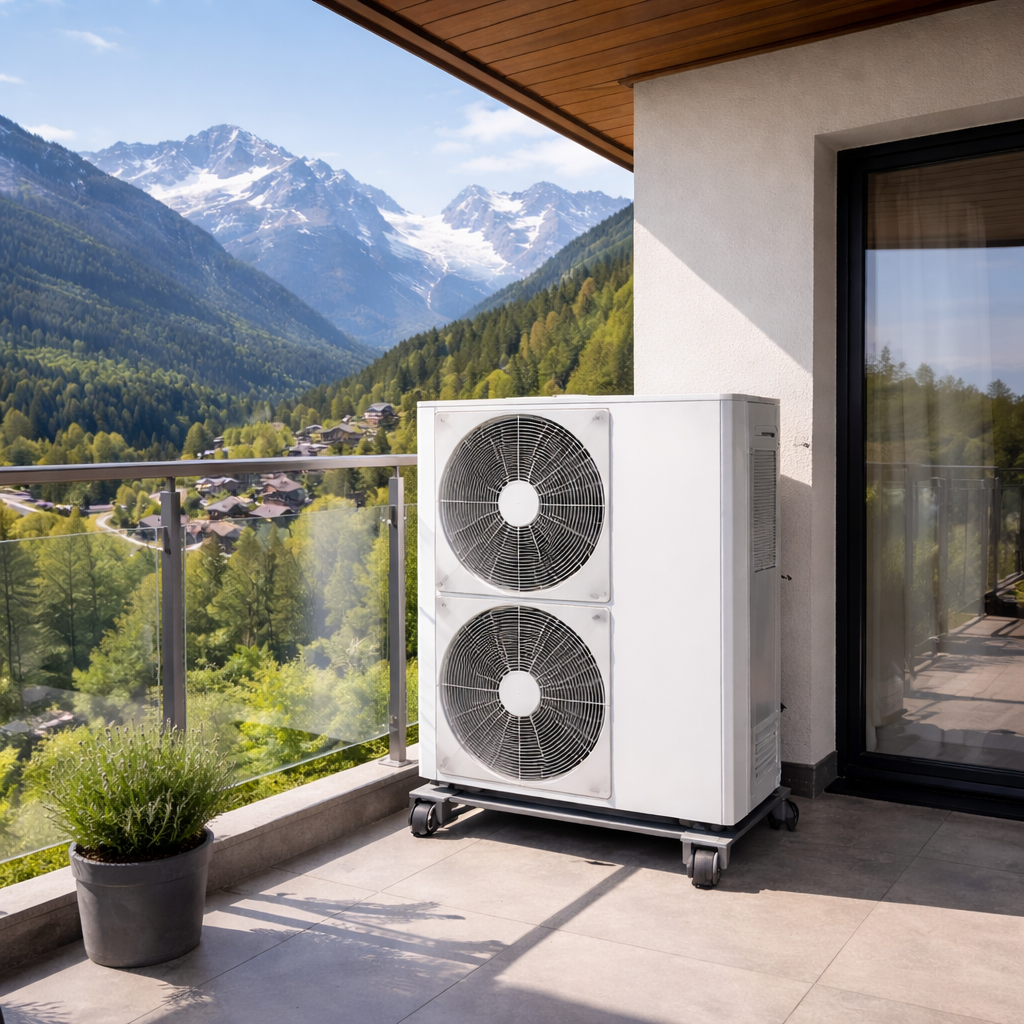
Climate change may ease one cold-weather penalty for heat pumps
A new analysis from researchers at the University of Trento examines a narrow but increasingly important question for Europe’s mountain regions: if Alpine winters warm, will air-to-water heat pumps work better? Their answer is qualified. According to the study, warmer conditions can slightly reduce the efficiency losses tied to defrost cycles, but that improvement does not erase a deeper operational problem. Start-up cycling losses remain substantial, and they continue to limit overall gains even as average temperatures rise.
The work focuses on photovoltaic-linked air-to-water heat pumps operating in Alpine settings, which the researchers describe as climate-change hotspots because warming is happening quickly and terrain conditions are complex. That combination matters. Heat pumps are central to many decarbonization strategies, but cold-climate performance is shaped not just by headline temperatures. Real efficiency is also affected by how often systems need to stop, restart, and defrost.
The researchers said the novelty of their approach is the explicit use of experimentally derived and validated correlations for start-up and defrosting degradation inside a dynamic TRNSYS simulation framework. In practical terms, that means the model tries to capture losses that are often treated too simply in high-level performance estimates. By looking at present and future climate conditions, the team aimed to test whether warming weather materially changes the balance.
Defrosting becomes less punishing as winters soften
One result is relatively intuitive. If temperatures climb, conditions that trigger frost formation become less severe or less frequent, and the energy penalty from defrosting can fall. That produces a modest improvement in modeled heat pump efficiency. For policymakers and planners, that is not trivial. Cold-weather performance has long been one of the main questions raised in mountain and northern markets, especially where building electrification is expected to scale quickly.
Still, the research does not suggest that climate change suddenly turns Alpine heat pumps into frictionless systems. The efficiency gains described in the article are slight, not transformative. The study points instead to a more nuanced picture: some weather-related losses can shrink, but equipment behavior during repeated starts and stops remains a major constraint.
That distinction is important because it separates ambient climate trends from system design realities. A warmer winter can reduce the need for defrosting, but it does not automatically solve how a unit behaves when it cycles on and off. If cycling remains frequent, performance losses persist.

Start-up cycles are still the bigger problem
The most consequential takeaway is that start-up degradation continues to weigh on seasonal performance. That matters because discussions around heat pump deployment often center on broad climate suitability, while operational inefficiencies can receive less attention. The Trento team’s findings suggest those operational details may be decisive when estimating real-world performance, especially in regions where systems face variable demand and harsh weather swings.
In other words, climate warming alone is not a substitute for better engineering and control strategies. Even in a future with somewhat milder winter conditions, the penalty from repeated restarts can still keep systems from reaching the gains that simpler models might imply. For the industry, that reinforces the need to focus not only on compressor performance or refrigerant improvements, but also on the logic and hardware decisions that affect cycling behavior.
The study also highlights a broader modeling issue. If start-up and defrost losses are not represented with enough realism, forecasts for building electrification can look better than actual performance in the field. That gap matters for installers, utilities, and public agencies making decisions about incentives, grid impact, and retrofit economics.
Why the findings matter beyond one mountain region
Although the case study is centered on Alpine conditions, the authors say the framework can be used to assess air-to-water heat pump performance under present and future climate conditions globally. That gives the work relevance beyond Italy. Many regions are trying to expand electric heating while also managing winter peak demand, rooftop solar integration, and building retrofit costs. Better modeling of part-load behavior, start-up penalties, and defrost losses can improve those plans.
The findings also land in the middle of a policy moment. Heat pumps are being promoted not just as efficient appliances, but as infrastructure for electrified homes that increasingly interact with rooftop PV and more dynamic grids. In that context, seasonal performance assumptions matter a great deal. Small inefficiencies spread across large housing stocks can become meaningful system-level costs.
For building owners, the research is a reminder that climate suitability is only one part of the equation. Installation quality, controls, sizing, and usage patterns still shape outcomes. For manufacturers, it points to a clear area for competitive improvement: reducing the drag from start-stop operation may be as important as extracting incremental gains from warmer-weather operation.
A modest boost, not a free efficiency dividend
The headline result is easy to overstate, but the study resists that temptation. Yes, warmer Alpine conditions appear to trim some defrost-related losses. No, that does not mean climate change produces a straightforward efficiency dividend for heat pumps. The benefit is modest, and the remaining penalties from start-up cycling are significant enough to keep overall gains in check.
That makes the work valuable precisely because it is restrained. It does not frame warming as a technological shortcut. Instead, it shows that even in a future climate that is somewhat less hostile to winter heat pump operation, system behavior still matters. For a technology expected to shoulder a larger share of heating demand, that is the kind of detail the energy transition cannot afford to ignore.
This article is based on reporting by PV Magazine. Read the original article.
Originally published on pv-magazine.com