Tesla shifts its charging buildout with a folding V4 design
Tesla is moving from its long-running V3 Supercharger hardware to a new V4 generation built around higher power and faster site rollout. According to the company’s charging update, the new V4 setup can deliver up to 500 kilowatts to passenger vehicles and up to 1.2 megawatts for the Tesla Semi, a major increase in capacity compared with earlier fast-charging eras.
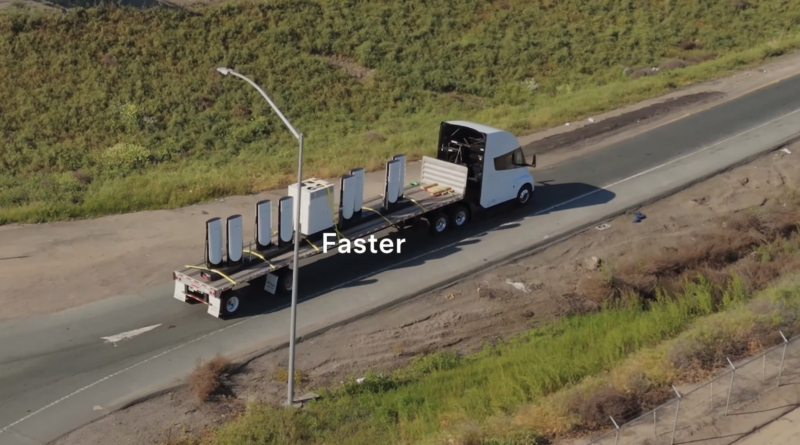
The design change is not limited to electrical output. Tesla is also introducing what it describes as a folding unit architecture. The charging posts themselves do not fold, but the base platform can be configured in two ways: a folded arrangement with back-to-back stalls or an unfolded layout that extends the installation into a single longer row. Tesla says each station includes eight charging posts.
Why the new layout matters
The company is framing the redesign as an infrastructure and logistics improvement as much as a charging upgrade. Tesla says the new form factor allows 33% more units to fit on a delivery truck, reduces installation costs by 20%, and cuts deployment time in half. Those claims matter because charging networks are often constrained not only by hardware performance, but by permitting, site work, transportation, and construction costs.
If the figures hold at scale, the V4 redesign could let Tesla add capacity more quickly in markets where utilization is rising and more non-Tesla vehicles are using the network. That is increasingly important now that the Supercharger system is serving a broader EV base beyond Tesla’s own lineup.

Higher output, broader role
The jump to 500-kilowatt charging for cars stands out on its own. Fast charging once centered on 50-kilowatt equipment, so Tesla’s latest hardware underscores how quickly the sector’s expectations have changed. The Semi figure is even more notable, with Tesla saying the same platform can reach 1.2 megawatts for heavy-duty applications.
That puts the V4 rollout in the middle of a broader industry competition over charging speed, freight electrification, and total cost of deployment. Tesla’s update does not present the hardware as an experimental concept. It presents it as a practical scaling tool: easier to transport, cheaper to install, and quicker to get into the ground.
A strategic asset for the EV market
The Supercharger network remains one of Tesla’s most important advantages, and the company’s latest announcement shows it is still investing in that position. The combination of higher-power hardware and a more compact deployment model suggests Tesla is trying to improve both customer experience and network economics at the same time.
For the wider EV market, the significance is straightforward. Charging speed is important, but so is how quickly new sites appear and how affordable they are to build. Tesla is arguing that its V4 system improves both. If the company can translate those design efficiencies into real-world expansion, the change could influence how the next generation of fast-charging infrastructure is planned and shipped.
This article is based on reporting by CleanTechnica. Read the original article.
Originally published on cleantechnica.com