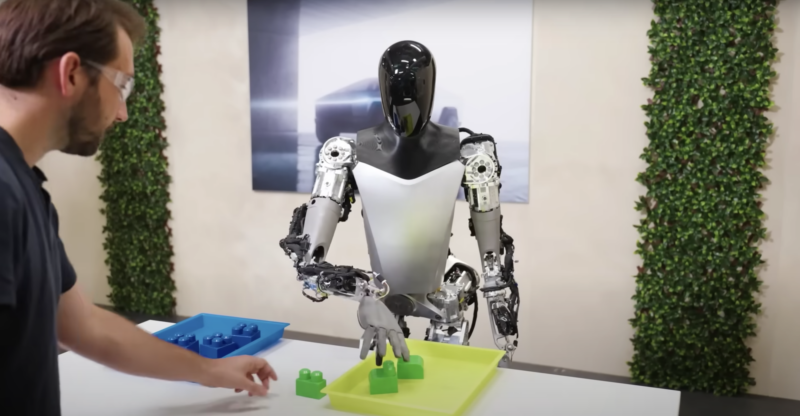
Tesla shifts factory planning toward humanoid robots
Tesla has outlined an aggressive new production plan for its Optimus humanoid robot program, according to language cited from the company’s latest quarterly report. The key points are unusually concrete for a robotics effort still in development: preparations for the first large-scale Optimus factory will begin shortly in the second quarter of 2026; the first-generation line is designed for one million robots a year; that line will replace the Model S and Model X lines in Fremont; and Gigafactory Texas is being prepared for a second-generation line designed for long-term annual production capacity of 10 million robots.
Those figures are substantial enough to make the announcement noteworthy even before broader market questions are answered. Moving from experimental robotics demonstrations to factory planning at million-unit scale marks a strategic escalation. It also suggests Tesla wants investors, suppliers, and competitors to view Optimus not as a side project but as a future manufacturing pillar.
What the production plan says about Tesla’s priorities
The most immediate signal is factory allocation. The quarterly-report language cited by CleanTechnica states that the first-generation Optimus line will replace the Model S and Model X lines in Fremont. That indicates Tesla is willing to repurpose capacity previously associated with low-volume premium vehicles in order to support a robotics ramp. Whatever the exact commercial timing of that change, the message is clear: physical production space once tied to legacy flagship EVs is being redirected toward humanoid robots.
That matters because factory space is a hard commitment. Companies can talk broadly about future platforms for years, but line replacements and plant preparation carry a different level of seriousness. Even if the planned capacities are aspirational or staged over time, Tesla is signaling that Optimus belongs in the same strategic conversation as its major vehicle programs.
The scale claim is extraordinary
A first-generation line designed for one million robots annually is already a large number for an undeployed product category. The longer-term Texas figure is larger still. A second-generation line designed for 10 million robots per year suggests Tesla is thinking in terms closer to consumer electronics scale than conventional industrial robotics. That does not prove demand exists at those levels. It does show the company is framing Optimus as something intended for mass production rather than bespoke enterprise deployment.
For the technology and energy industries, that framing is important on its own. Tesla’s identity has long rested on vertically integrated manufacturing, power electronics, batteries, and software-defined vehicles. Applying that same high-volume manufacturing mindset to robotics could influence investor expectations across adjacent sectors, from industrial automation to AI hardware and supply-chain planning.
Demand remains the unanswered variable
The CleanTechnica piece centers on a question many observers will share: who will buy robots at that scale? The supplied source text does not provide a direct Tesla answer. It notes that the company’s robots have not yet demonstrated broad, well-established capabilities in public and that early use is expected in Tesla factories and other industrial settings before any later consumer push. The same source text also raises uncertainty over whether companies would spend tens of thousands of dollars per unit on humanoid systems with meaningful limitations.
That skepticism is part of the story because it highlights the gap between announced production ambition and visible market proof. Scaling a product category requires more than a factory plan. It requires task fit, economics, deployment reliability, and a customer base willing to absorb the output. None of that is established by the quarterly-report excerpt alone.
Still, it would be a mistake to dismiss the announcement merely because the demand side remains unsettled. Major platform shifts often begin with supply-side bets before downstream use cases fully crystallize. Tesla appears to be making exactly that kind of bet.
Why this matters beyond Tesla
If even part of this roadmap materializes, the effects could extend well beyond one company. Suppliers would have to consider component volumes for actuators, sensors, onboard compute, and energy systems. Competitors in robotics would face new expectations about speed and manufacturing scale. Labor, automation, and industrial policy debates would intensify if humanoid systems moved from prototype fascination to repeatable production lines.
There is also a cultural dimension. Tesla is positioning humanoid robots not as remote lab curiosities but as products intended for factories first and potentially much broader deployment later. That could reshape how markets talk about robotics adoption, even if commercial traction arrives slowly.
The real test starts after the announcement
For now, the announcement establishes intent, not validation. The strongest supported facts are the production plans and the plant references to Fremont and Texas. The weakest area remains end-market certainty. That tension is precisely what makes the story significant. Tesla is trying to industrialize a category that has not yet proved itself at comparable scale.
The next milestones will determine whether this is remembered as an inflection point or as another ambitious manufacturing projection. Either way, the company has now tied real factory planning to humanoid robotics, and that alone moves the conversation forward. The question is no longer whether Tesla wants Optimus to matter. It is whether the market can meet the scale Tesla says it is preparing to build.
This article is based on reporting by CleanTechnica. Read the original article.

Originally published on cleantechnica.com