A failure mode the solar sector did not expect
Solar glass is supposed to be the protective layer that lets a photovoltaic module survive years of weather, heat and mechanical stress. Increasingly, though, operators and testing labs are reporting modules whose glass cracks without obvious triggers such as hail, impact or extreme storms. What began appearing several years ago has grown into a major industry concern.
According to pv magazine’s report, spontaneous glass breakage is now viewed by Kiwa PVEL as the most significant reliability issue affecting glass-glass modules. The problem has been observed across multiple countries, module model types and mounting configurations, making it difficult to dismiss as a niche manufacturing defect or a site-specific installation error.
That breadth is what elevates the issue from a technical curiosity to a meaningful industry risk. Solar developers, owners and financiers rely on predictable long-term performance. When a module’s outer barrier can fail without a clear initiating event, it introduces uncertainty into maintenance planning, warranty disputes and asset valuation.
Why this matters now
The timing is awkward for the solar industry. Module manufacturing has been under sustained price pressure, and supply chains have been optimized for scale and lower cost. Those dynamics have helped make solar more competitive, but they may also have narrowed quality margins in components that are easy to overlook when efficiency and price dominate purchasing decisions.
The pv magazine report points to manufacturing pressures and the absence of clear standards as two reasons the industry is struggling to resolve the problem. If spontaneous breakage stems from stress within the glass, production tolerances, handling practices or module assembly choices, then a low-cost environment can make fixes harder to implement consistently. Companies may not want to absorb added costs unless testing standards and buyer expectations force them to do so.
That creates a classic reliability trap. The industry can recognize a problem as serious, yet still move slowly if responsibility is diffuse and remediation is not standardized.

What researchers and labs are seeing
The article describes scientists, operators and test labs seeing unexplained breakage since about 2021. That persistence suggests the issue is not simply a short-lived anomaly tied to one production batch. Kiwa PVEL’s assessment is particularly important because testing labs often sit at the intersection of manufacturer claims and field reality. Their visibility across products and markets allows them to detect patterns individual project owners may miss.
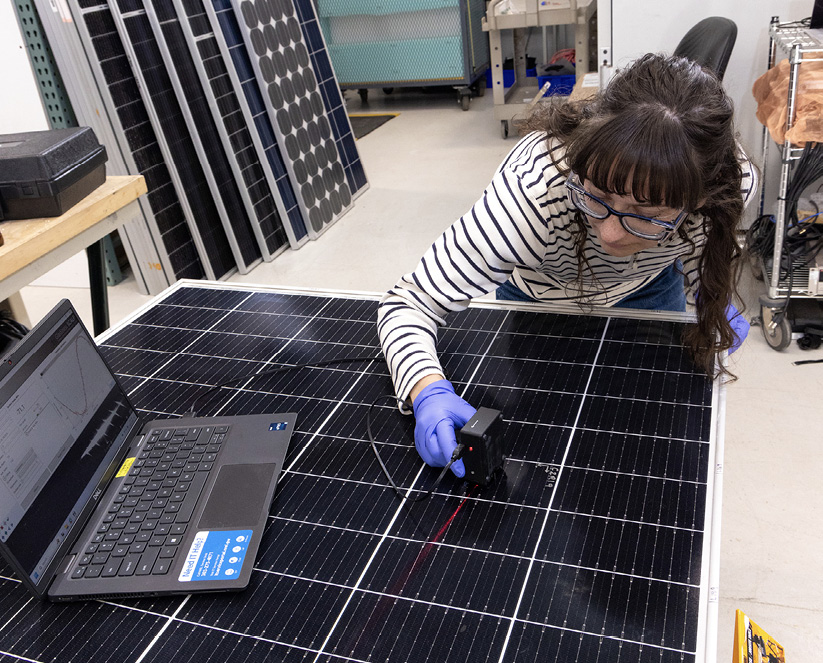
One image in the report shows glass stress being measured with a scattered light polariscope, underscoring that researchers are examining the physical properties of the glass itself rather than only external operating conditions. The scientific term may still be “spontaneous glass breakage,” but the industry is clearly trying to move from description toward causation.
Even so, the report indicates that solutions remain constrained by incomplete standards and the complexity of the problem. That means owners may continue to encounter failures before a universal screening or certification response is in place.
The implications for utility-scale deployment
For project developers and operators, a widespread glass reliability issue can ripple through the economics of large-scale solar in several ways. Damaged modules may need replacement, reduce output, increase inspection costs and trigger warranty negotiations that consume time and capital. If failures emerge across geographies and racking types, insurers and lenders may also begin paying closer attention to module construction details that previously received less scrutiny.
Glass-glass modules have often been promoted for durability and long service life. That makes spontaneous breakage especially disruptive because it challenges one of the architecture’s core selling points. If the most serious reliability concern today affects modules marketed for resilience, buyers may become more demanding about test data and manufacturing controls.
The issue could also influence procurement behavior. Large buyers may press manufacturers for more transparent quality assurance around glass stress, handling and assembly. Over time, that could shift competition away from price alone toward documented reliability performance.
An industry-scale quality question
The deeper significance of the breakage problem is that it highlights the tension between rapid scaling and component robustness. Solar has spent years driving down cost and expanding deployment. That success can mask small weaknesses until fleets age and failures become visible in the field. When they do, the cost of fixing them is borne not only in replacement modules, but in confidence.
The sector is still in the stage of defining the problem more precisely, but the warning from testing experts is already clear: spontaneous glass breakage is no longer an isolated oddity. It is a top-tier reliability concern that the industry will have to address with better diagnostics, stronger standards and, likely, tougher manufacturing discipline.
This article is based on reporting by PV Magazine. Read the original article.
Originally published on pv-magazine.com