Ports are emerging as strategic testbeds for lower-cost hydrogen
A new study from the University of Naples Federico II suggests Mediterranean ports could become unusually important sites for hydrogen production as Europe and neighboring markets search for scalable decarbonization options. According to findings highlighted by pv magazine, the levelized cost of hydrogen at the ports studied could range from €5.7 to €8.6 per kilogram in fully renewable configurations and from €2.5 to €13 per kilogram in hybrid systems that combine renewables with grid electricity.
The range is wide, but the headline number matters. A cost floor of €2.5 per kilogram implies that under favorable electricity-price and emissions conditions, hybrid production could substantially improve the economics relative to all-renewable setups. For a sector where cost remains one of the biggest barriers to adoption, that is a notable result.
The study also points to an operational advantage specific to ports. They are already energy and logistics hubs, they sit close to industrial demand and maritime transport, and they can serve as nodes for import, export, storage, and distribution. If hydrogen is to move from pilot deployments to system-level use, ports are among the most plausible places for that buildout to begin.
Why hybrid configurations look stronger in this analysis
The researchers found that production costs are highly sensitive to two factors: the price of grid electricity and the emissions intensity attached to that electricity. In a fully renewable configuration, cost depends heavily on the performance of local solar and wind resources as well as the utilization profile of electrolyzers. Hybrid systems, by contrast, can lower costs by drawing on grid power when economics or availability favor it, though that advantage depends on how clean and affordable the grid is.
That tradeoff helps explain the broad €2.5 to €13 per kilogram range for hybrid systems. Grid access can improve utilization and reduce cost in some ports, but in other locations expensive or carbon-intensive electricity can erase the benefit. The study therefore does not claim that hybrid is always cheaper. It shows that hybrid can be much cheaper under the right conditions.
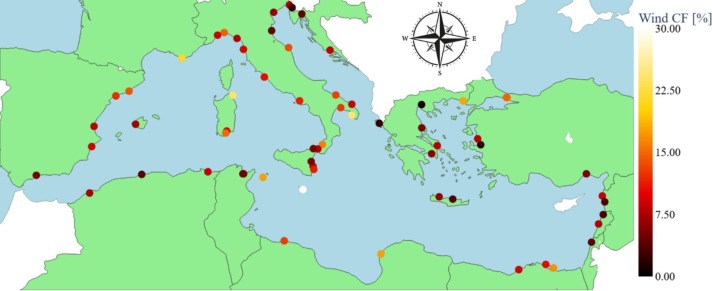
Solar emerged as the most consistent resource across the analyzed ports, while wind performed better in selected locations. That distinction is significant for planners because consistency can matter as much as peak output. Stable solar performance may simplify sizing decisions and improve predictability for operators, even if certain ports with strong wind regimes can deliver better results in specific cases.
The supplied source text references a chart of PV capacity factors for the analyzed Mediterranean ports, reinforcing the study’s attention to location-specific resource quality. In other words, this is not a generic endorsement of hydrogen at ports. It is a comparative analysis that treats geography, resource patterns, and electricity conditions as central to project viability.

What this means for hydrogen infrastructure decisions
The broader significance of the study lies in where it places hydrogen inside the decarbonization map. Ports are difficult sectors to clean up because they combine shipping, heavy transport links, industrial activity, and storage infrastructure. At the same time, that complexity creates opportunity. A successful hydrogen project at a port can connect production with multiple downstream uses, including industrial feedstock, mobility, or derivative fuels such as e-fuels.
pv magazine paired the study with mention of wider industry developments, including new hydrogen and e-fuel projects, advanced electrolyzer technologies, and EU-backed infrastructure expansion. Even without going beyond the supplied text, the framing is clear: the cost analysis arrives in a moment when infrastructure strategy is becoming as important as technology performance.
That is where the port model becomes compelling. A port can act as a local demand center while also connecting to broader trade routes. If production costs can be brought down through careful combinations of solar, wind, and grid electricity, ports could become anchor points for larger hydrogen corridors rather than isolated demonstration sites.
Still, the study’s numbers should be read as a map of possibility, not a guarantee of bankable outcomes in every location. The levelized cost of hydrogen depends on assumptions about electricity, utilization, and emissions that can shift with policy and market conditions. A €2.5 per kilogram outcome is meaningful because it shows what the system might achieve under favorable circumstances. It does not mean every Mediterranean port is close to that threshold today.
What the study summary shows
- Fully renewable hydrogen production at Mediterranean ports was estimated at €5.7 to €8.6 per kilogram.
- Hybrid systems were estimated at €2.5 to €13 per kilogram depending on electricity prices and emissions intensity.
- Solar appeared as the most consistent energy resource across the ports studied.
- Wind outperformed solar in select locations.
- The analysis positions ports as potentially strategic sites for large-scale decarbonization infrastructure.
For energy planners, the main lesson is not that one technology has won, but that location-specific design matters. Hybrid systems may offer the strongest cost case where grids are relatively affordable and clean. Fully renewable systems may be more attractive where policy, permitting, or emissions constraints favor them despite higher modeled costs. In both cases, the port setting offers a realistic route to scale because it links production directly to logistics and industrial demand.
Hydrogen’s critics have often pointed to poor economics and scattered use cases. This study does not settle that debate. But it does sharpen it by showing where the economics could improve first. Mediterranean ports may not become uniform hydrogen winners, yet the analysis suggests some of them could become early proof points for lower-cost, operationally integrated production. In a sector defined by uneven progress, that is a meaningful step.
This article is based on reporting by PV Magazine. Read the original article.
Originally published on pv-magazine.com