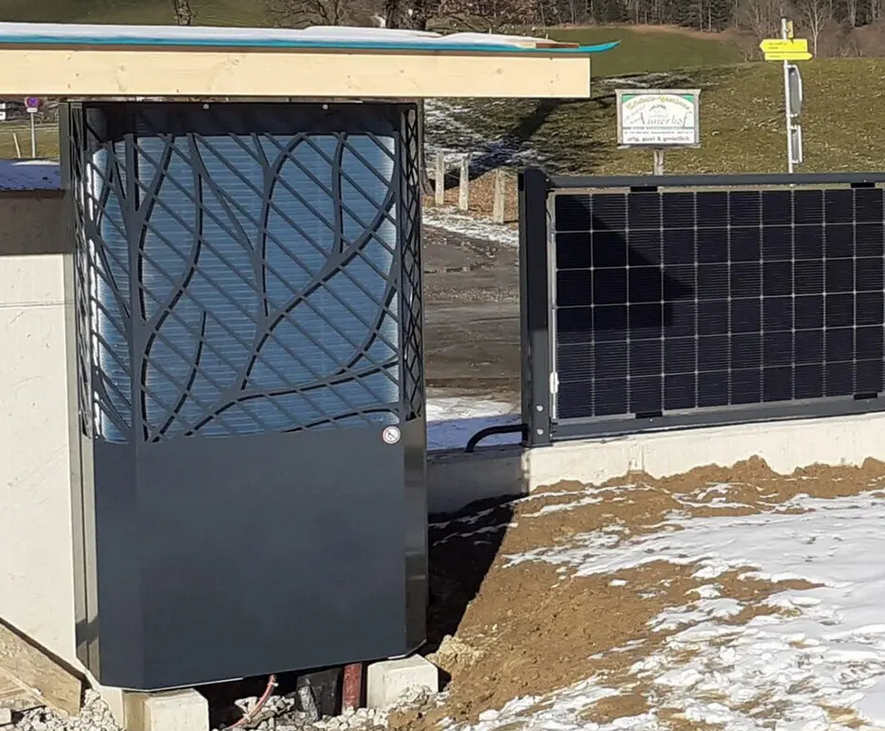
Lambda introduces a new propane heat pump line
Austrian manufacturer Lambda Wärmepumpen GmbH has unveiled a new air-to-water heat pump series called Eureka, built around propane refrigerant and aimed at residential, commercial, and industrial projects. According to the supplied report, the launch includes multiple models, with EU10L, EU13L, and EU15L manufactured in Austria, while EU20L and EU35L are produced in Italy.
The company says the series uses a patented fluid mechanics system that improves heat transfer by four to six times while maintaining a temperature difference of just 3 K between air and refrigerant. The supplied metadata also notes a seasonal coefficient of performance ranging from 4.50 to 6.10, positioning the product as a high-efficiency entrant in the air-to-water heat pump market.
Why the technical claims matter
Heat pumps are increasingly central to building electrification, but their real-world impact depends heavily on efficiency, operating stability, and power consumption during challenging conditions. That is why Lambda’s claims are significant. The company told the source that efficiency tests conducted by an independent testing institute under EN14825 showed significantly reduced energy consumption, higher performance, and fewer as well as shorter defrost cycles.
The most concrete numerical claim in the supplied text is that the new series can reduce electricity consumption by more than 30%. If that performance holds across installations, it would be meaningful for both operating costs and broader grid demand management, especially in colder climates where heat-pump performance under winter conditions becomes a decisive factor.
Defrost behavior is especially important in air-source systems. Frequent or prolonged defrost cycles can cut effective efficiency and reduce comfort. A system that shortens those cycles, while maintaining heat transfer performance, addresses one of the practical constraints that building owners often care about more than headline laboratory metrics.

Propane and the market direction of heat pumps
The use of propane is also notable. The supplied source identifies the line specifically as a propane heat pump series, which aligns with wider industry interest in refrigerants associated with lower climate impact than some legacy alternatives. The report itself does not provide comparative regulatory or environmental analysis, so the strongest supported point is simply that Lambda is placing propane at the center of this product family.
That matters because refrigerant choice is increasingly part of the commercial proposition in HVAC markets. Buyers are no longer evaluating equipment only on heating output and upfront price. They are also paying attention to efficiency standards, installation constraints, and long-term regulatory compatibility. A new series built around propane therefore lands in a market already primed to scrutinize both performance and refrigerant strategy.
Independent testing gives the launch more weight
Many equipment launches rely on manufacturer claims that remain difficult to assess from announcement materials alone. In this case, the supplied report says Lambda cited independent efficiency tests conducted according to EN14825. That does not settle every question about field performance, but it strengthens the launch by tying the performance case to an external testing framework rather than pure marketing language.
The company’s framing is also specific. Instead of presenting efficiency as an abstract benefit, it links the system to lower electricity use, higher performance, and shorter defrost cycles. Those are operational outcomes that matter to installers, building operators, and energy planners.
For commercial and industrial users in particular, a more efficient air-to-water heat pump can have implications beyond one building. As electrified heating expands, aggregate demand profiles and power consumption during cold periods become grid-relevant issues. Equipment improvements that cut energy use by large percentages therefore matter to the wider energy transition as well as to individual customers.
European rollout shows where demand is strongest
Lambda told the source that its products are sold in Austria, Germany, Switzerland, Italy, the Benelux countries, France, and Sweden through professional partners. That geographic footprint suggests the company is targeting markets where heat-pump adoption is already a live policy and consumer issue.
Those are also markets with varied climate conditions, building types, and regulatory contexts. A product positioned for residential, commercial, and industrial use needs enough flexibility to meet diverse deployment requirements. The range of model sizes in the Eureka line appears designed to address that spread, although the supplied source does not include full technical specifications for each unit.
Manufacturing split between Austria and Italy may also reflect a scaling strategy aimed at serving multiple European markets efficiently. The source does not provide production volumes, but the multinational manufacturing setup suggests the company is preparing for broader regional demand rather than a small domestic rollout.
The bigger significance
The development is important because heating technology is now a core battleground in energy transition policy. Buildings need lower-emission heating options that can perform reliably and economically, and manufacturers are under pressure to improve real-world efficiency rather than simply advertise decarbonization benefits.
Lambda’s new series appears to be aimed directly at that demand. The supplied claims point to better heat transfer, lower temperature differential, strong seasonal performance figures, and materially lower electricity consumption. If these characteristics translate well into field installations, the launch could help strengthen the case for air-to-water heat pumps across more building types.
For now, the most defensible conclusion is that Lambda has introduced a technically ambitious new product line backed by independent testing claims and positioned for multiple European markets. In a heating sector where efficiency, refrigerant choice, and operational reliability all matter, that is a meaningful product launch rather than a routine refresh.
This article is based on reporting by PV Magazine. Read the original article.
Originally published on pv-magazine.com