The Iridium Bottleneck in Green Hydrogen
Green hydrogen produced by electrolysis of water using renewable electricity is widely viewed as critical for decarbonizing industrial processes that cannot easily run on electricity directly — steel production, shipping, chemical synthesis, and long-duration energy storage. The technology works and is scaling, but it has a materials problem.
Proton exchange membrane (PEM) electrolyzers, which offer efficiency and dynamic response advantages over alkaline systems, require iridium as a catalyst for the oxygen evolution reaction at the anode. Iridium is one of the rarest elements on Earth, with global annual production of roughly seven to eight tonnes, primarily as a byproduct of platinum mining in South Africa. If the global electrolyzer industry were to reach hundreds of gigawatts of installed capacity, demand for iridium would exceed supply by a significant margin.
Ionautics, a startup based in Sweden with roots at the Royal Institute of Technology (KTH) and the RISE Research Institute of Sweden, has spent more than five years developing a solution: vapor-deposited porous iridium layers that achieve strong catalyst performance using dramatically smaller amounts of the metal than conventional PEM electrode designs.
Five Years to Prove the Technology
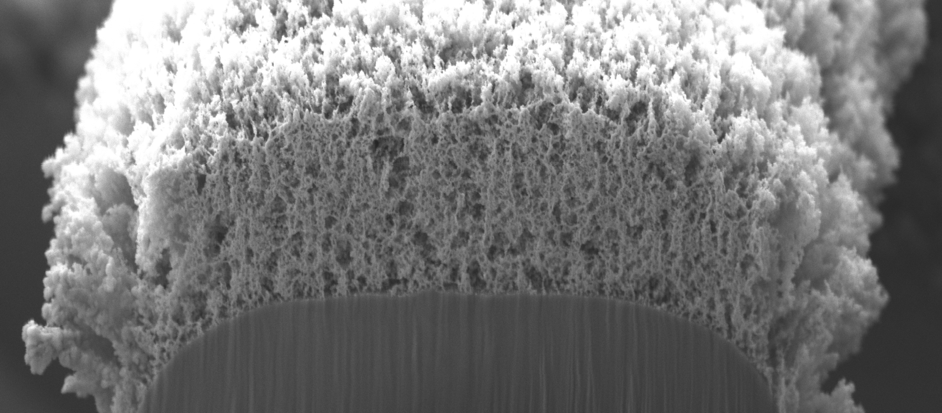
The Ionautics approach uses high-power impulse magnetron sputtering to create nano-structured iridium coatings with very high surface area relative to the amount of material deposited. High surface area is what makes a catalyst effective — more iridium atoms are available for the electrochemical reaction, so less total material is needed to drive a given amount of hydrogen production.
Extended testing has demonstrated the coatings achieve benchmarking performance at ultra-low iridium loadings — less than 0.1 milligrams per square centimeter, compared to conventional loadings of 0.3 to 1.0 mg per square centimeter or more. The Swedish Energy Agency has funded the research, which has now progressed to full-scale industrial production preparation.
Meanwhile: Europe's Largest Green Hydrogen Plant Moves Forward
In parallel, thyssenkrupp nucera signed a contract with Moeve for 300 MW of alkaline water electrolysis technology for the Onuba project in Spain, described as the largest green hydrogen plant in southern Europe. The contract covers 15 standardized 20 MW electrolyzer units, reflecting the modular assembly approach that enables faster deployment than custom-engineered installations. Southern Spain's solar resources position the facility to serve both the Iberian market and potential hydrogen export to northern Europe.
A second thyssenkrupp nucera contract was announced concurrently: a front-end engineering design contract with Juno Joule for a 260 MW electrolysis plant in India targeting green ammonia production primarily for export to Europe as a hydrogen carrier. The India project targets a final investment decision in fiscal year 2026-27, reflecting the emerging structure of global green hydrogen trade where production is built in regions with abundant renewable resources and products are consumed in industrial economies that lack sufficient domestic capacity.
This article is based on reporting by PV Magazine. Read the original article.
Originally published on pv-magazine.com