From Theory to Engineering Reality
For years, hydrogen has occupied a prominent position in maritime decarbonization discussions, valued for its zero-carbon combustion and theoretical energy density. A final study released by DNV on behalf of the European Maritime Safety Agency (EMSA) has now shifted that conversation from aspirational potential to quantified engineering burden — and the picture that emerges is considerably more challenging than many in the industry had hoped.
DNV, the Norwegian classification society whose safety assessments carry significant weight across the global shipping industry, was commissioned by EMSA to evaluate the practical safety requirements for hydrogen-fueled vessels. The findings do not close the door on hydrogen shipping, but they substantially raise the cost and complexity bar that any vessel owner or designer must clear before putting hydrogen into commercial service.
The Safety Engineering Gap
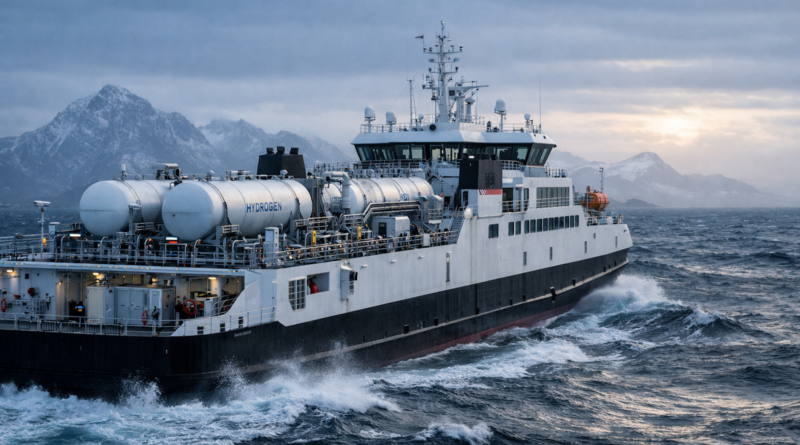
The core finding of the DNV study is that hydrogen's physical properties create safety challenges that cannot be managed through incremental adaptation of existing vessel designs. Hydrogen has an extremely wide flammability range — it ignites in air concentrations between 4 and 75 percent — and its molecules are small enough to permeate materials that would reliably contain other fuels. This combination requires purpose-built containment systems, enhanced ventilation in all spaces where hydrogen could accumulate, and redundant detection and emergency response capabilities throughout the vessel.
These requirements translate directly into additional structural weight, increased design complexity, and higher capital costs. For some vessel classes, particularly those where space and weight budgets are tightly constrained, meeting the safety envelope for hydrogen may require fundamental rethinking of the naval architecture rather than simple fuel system substitution.

Cost Implications for Shipowners
The financial implications are significant. Unlike liquefied natural gas, which required meaningful retrofits when it entered shipping as an alternative fuel, hydrogen demands a more fundamental redesign of how fuel is stored, handled, and distributed aboard a vessel. Cryogenic liquid hydrogen storage requires insulation systems that maintain temperatures below -253°C. Compressed gaseous hydrogen offers simpler storage but at much lower energy density, requiring larger tank volumes that eat into cargo capacity.
DNV's analysis indicates that these engineering demands will add substantially to vessel construction costs across ship types. For operators already navigating thin margins under IMO emissions regulations, the additional capital and operational expenditure associated with hydrogen represents a significant deterrent relative to alternatives like ammonia, methanol, and advanced biofuels that share some of hydrogen's environmental promise with lower engineering overhead.
Why the EMSA Study Matters
Classification societies and maritime safety regulators take DNV assessments seriously when setting the rules that govern what vessels can be built and how they must be operated. The EMSA study will inform European regulatory frameworks governing alternative fuel vessels, and its conclusions are likely to influence how quickly permitting and certification pathways for hydrogen ships develop.
Regulatory clarity is a prerequisite for commercial investment. Shipowners and lenders will not commit capital to hydrogen vessel projects without knowing what safety standards they must meet and what certification process they face. Until those frameworks are established, hydrogen's commercial deployment in maritime applications will remain constrained to demonstration projects and niche applications.

Where Hydrogen Still Has a Case
The DNV study does not dismiss hydrogen shipping entirely. For short-sea routes where vessels return to port frequently, gaseous hydrogen storage becomes more viable because refueling logistics are simpler and the energy density penalty matters less. Ferries, harbor tugs, and coastal cargo vessels operating on predictable schedules present more favorable conditions for hydrogen than deep-sea container ships making multi-week transoceanic voyages.
The study also acknowledges that future materials and engineering developments could reduce the safety overhead that currently drives costs. New hydrogen-compatible materials, improved sensor systems, and better containment technologies are active areas of research that could change the calculus over a longer time horizon.
The Competitive Landscape for Maritime Fuels
The maritime decarbonization transition is effectively a race among several fuel pathways, and the EMSA study's findings on hydrogen's cost challenges will benefit competing alternatives. Ammonia, which can be synthesized from renewable hydrogen but stored and transported using infrastructure more similar to existing LPG systems, has emerged as a leading deep-sea decarbonization fuel for precisely the reasons the DNV report highlights: more manageable safety profile, higher energy density, and a clearer regulatory pathway. Methanol and advanced biofuels offer even less disruptive transitions for existing vessel fleets.
This article is based on reporting by CleanTechnica. Read the original article.

Originally published on cleantechnica.com