A sodium-ion push into stationary storage
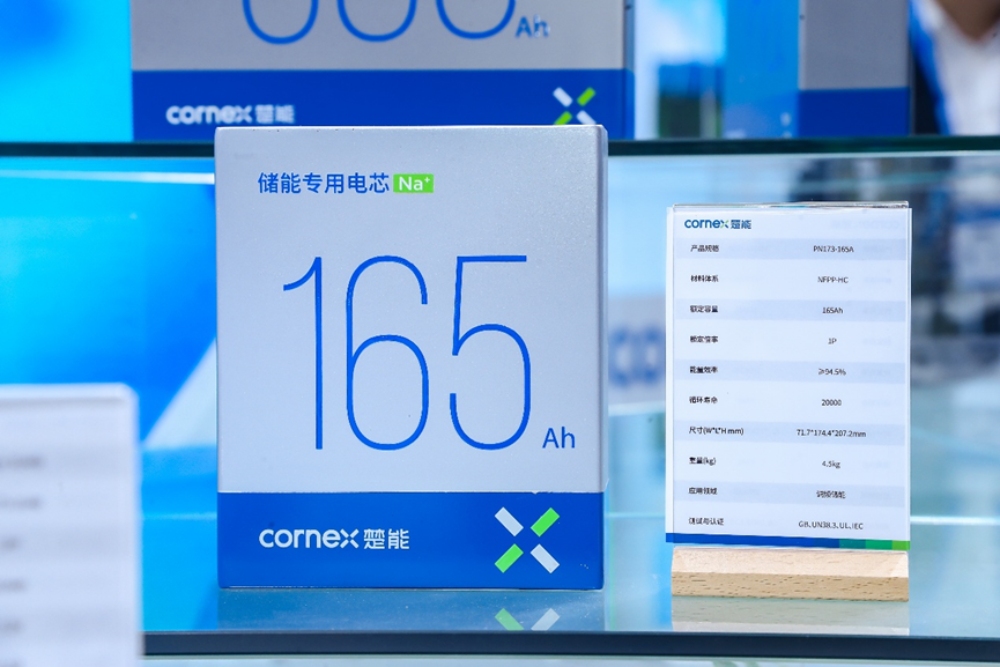
Chinese battery manufacturer Cornex New Energy has introduced a new sodium-ion prismatic cell for stationary energy storage, adding a 165 Ah model to a product lineup that also includes a 58 Ah version. The launch points to a more focused effort to move sodium-ion technology beyond the lab and into commercial storage systems where weight matters less than cost, durability, and operating profile.
The newly highlighted cell, identified as PN173-165A, is aimed squarely at the stationary market rather than electric vehicles. That matters because grid and industrial storage projects often prioritize cycle life, safety certifications, and operating economics over the highest possible energy density. In that setting, sodium-ion chemistry has been watched closely as a possible alternative or complement to lithium-ion systems.
What Cornex says is inside the cell
According to the company, the 165 Ah cell uses sodium iron pyrophosphate in the cathode and polyanion-type NFPP hard carbon in the anode. Those material choices are notable because they reflect the industry’s broader search for chemistries built around more abundant materials and supply chains that may be less exposed to the same pressures shaping lithium markets.
Cornex says the cell has received several certifications, including the GB Chinese national standard, UN38.3, UL, and IEC 62619. For energy storage buyers, certification progress is not a side detail. It is one of the practical gates between a promising chemistry announcement and real-world project deployment.

Performance claims target frequency regulation
Cornex is positioning the new cell as suitable for frequency regulation, a demanding grid service that rewards systems able to respond quickly and cycle often. The company says the PN173-165A delivers 1P energy efficiency of 94.5% and a cycle life of more than 20,000 cycles.
If those figures hold up in deployment, they would strengthen the case for sodium-ion batteries in applications where repeated cycling and long service life matter more than packing maximum energy into minimum mass. Frequency regulation, grid balancing, and other stationary tasks are the kinds of use cases where sodium-ion vendors hope they can compete on lifecycle value rather than headline energy density alone.
The cell weighs 4.5 kilograms and measures 71.7 millimeters by 174.4 millimeters by 207.2 millimeters. In response to a query cited in the source report, Cornex said the nominal gravimetric energy density is 102 Wh/kg at 0.5P. That figure remains well below the kind of energy density associated with mainstream lithium-ion cells, but the comparison is not as straightforward in stationary systems, where footprint, cycle life, safety profile, and materials cost can shift the economics.
Why sodium-ion keeps drawing attention
The significance of this launch is less about one cell alone than about where it fits in the broader storage market. Sodium-ion has been discussed as a potentially useful chemistry for large-scale energy storage because it may help ease dependence on lithium supply dynamics while opening more options for applications that do not need vehicle-grade performance.
That does not automatically make sodium-ion a replacement for lithium-ion. The source article itself frames the new product as part of an effort to improve competitiveness against the weight of the lithium-ion battery sector. In other words, Cornex is entering a market where lithium-ion already has scale, manufacturing maturity, and deep commercial adoption.
Still, stationary storage has become one of the most plausible entry points for sodium-ion. Developers and utilities increasingly need a wider mix of battery technologies as grids add more renewable generation and as storage projects are asked to do more balancing, shifting, and stability work. A chemistry with lower energy density can still become relevant if it delivers useful lifetime performance, acceptable efficiency, and bankable safety credentials.
Commercial relevance will depend on execution
The Cornex announcement suggests that sodium-ion suppliers are now trying to move the discussion from future promise to product definition. Buyers will still want evidence from field deployment, cost benchmarks, and system-level integration data before treating sodium-ion as a mainstream procurement option. But product launches like this one help show that the technology is entering a more operational phase.
For now, Cornex’s message is clear: sodium-ion is being developed not just as an experimental alternative, but as a practical storage chemistry for grid services such as frequency regulation. The new 165 Ah prismatic cell will not settle the competitive debate with lithium-ion on its own. It does, however, add another concrete data point to a market increasingly interested in storage diversity, longer cycle life, and chemistries built for the specific demands of stationary power systems.
This article is based on reporting by PV Magazine. Read the original article.
Originally published on pv-magazine.com