Canada Shifts to Fleet Average Emissions Standards
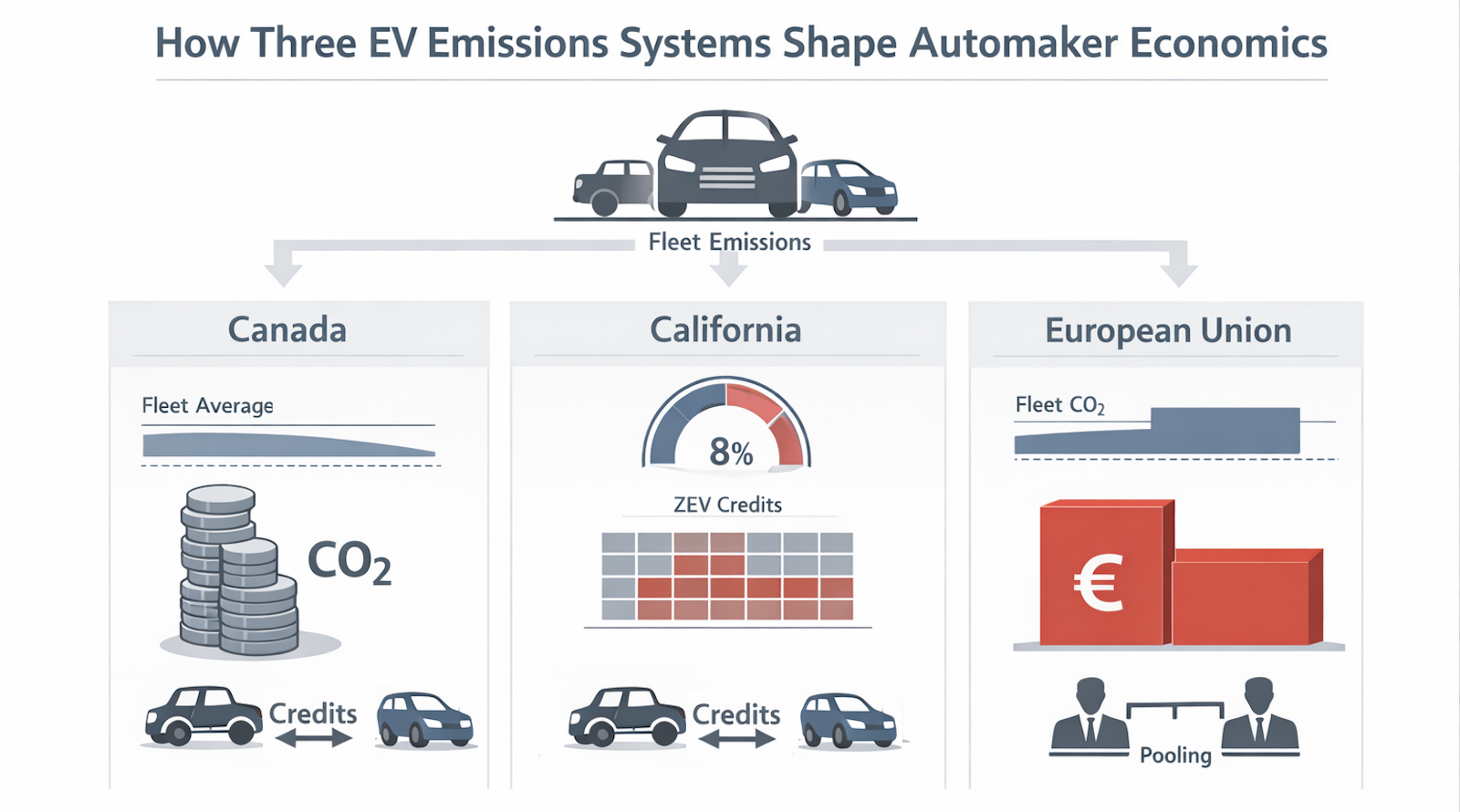
Canada has quietly overhauled its electric vehicle policy architecture, moving away from explicit EV sales mandates toward fleet average CO2 emissions standards with credit trading. While the change appears procedural on the surface, it fundamentally reshapes how automakers calculate compliance, how money flows between firms, and how quickly manufacturers must transition their lineups. Canada's system converts emissions differences into lifetime tons of CO2 credits, using mileage assumptions of approximately 195,000 miles for sedans and 226,000 miles for light trucks. A single zero-emission SUV can generate roughly 60 tons of lifetime credits under this framework.
California's ZEV Credits and Europe's Penalty System
California takes a different approach through its Zero Emission Vehicle credit system, which ties credits to vehicle range using a formula that typically yields 3 to 4 credits per qualifying vehicle. The state expresses compliance as a percentage of total sales, with targets approaching 40% in the late 2020s. Credits trade on an open market with fluctuating prices, but individual vehicle credit values are capped.
The European Union, meanwhile, sets fleet average CO2 targets at 93.6 grams per kilometer for 2025 through 2029. Manufacturers that exceed this threshold face penalties of 95 euros per gram per kilometer per vehicle sold. The EU allows manufacturer pooling arrangements for joint compliance but does not operate an open credit commodity market. Instead, penalties function as the primary financial enforcement mechanism.

The Financial Exposure Gap
The differences become stark when applied to a hypothetical automaker selling 300,000 vehicles annually with just 8% EV sales. Under Canada's system, such a manufacturer would face roughly 5.5 million tons of lifetime CO2 deficit, translating to approximately $550 million in exposure at $100 per ton credit pricing. In California, the same manufacturer would face a shortfall of around 45,000 credits with costs dependent on volatile market pricing. In Europe, the theoretical penalty exposure balloons to approximately 3.6 billion euros, reflecting the EU's aggressive per-vehicle penalty structure.
Why the Compliance Unit Matters
The design of each regulatory system shapes capital flows as significantly as the stringency of emission targets shapes actual emissions reductions. Canada's mass-based credit system creates large, visible compliance commodities that generate substantial inter-firm financial transfers. California's bounded credit markets provide liquidity with per-vehicle caps. Europe's penalty framework embeds compliance into coordinated industrial arrangements through manufacturer pooling. For automakers operating across all three jurisdictions, understanding these structural differences is as critical as understanding the targets themselves. The compliance unit is not just an accounting detail; it materially determines competitive advantage and financial strategy in the global EV transition.
This article is based on reporting by CleanTechnica. Read the original article.

Originally published on cleantechnica.com




