What Is Engine Blueprinting?
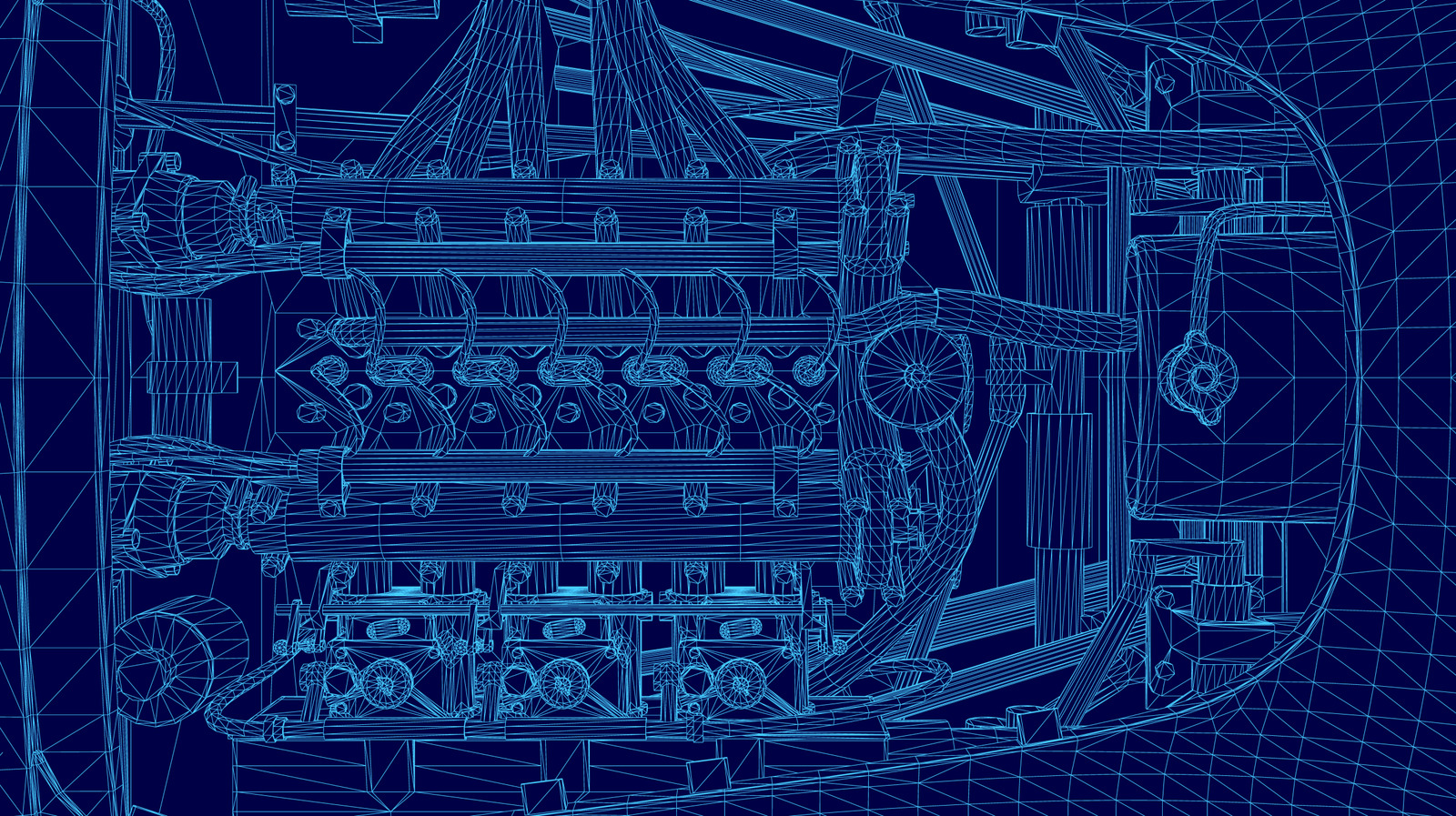
If you've heard racing enthusiasts and drag racers discuss blueprinting but have no idea what they're talking about, this explainer is for you. Blueprinting is the art of engine building that goes way beyond reconditioning. It's a meticulous approach that yields a motor even better than when it came off an assembly line. When an automotive engineer designs a new engine, the digital creation is flawless, with every cylinder bore a perfect geometrical cylinder, crank journal rounded to the atomic level, and the deck height flat front to back. This ideal form is called the blueprint.
However, once the blueprint leaves the design department and the manufacturer starts building the motor, reality hits. Compared to a drawing, a cast component will have ridges and slightly misshapen ports. As giant robotic cutters grind through a cast engine block at blistering pace, hundreds of these engines are churned out daily. This pace creates a deviation from the perfect dimensions of the blueprint, known as acceptable tolerances. In a mass-produced car, these subtle variations are acceptable. But when stacked together, they add up and manifest as wasted potential energy through heat, internal friction, and vibration.
The Process of Blueprinting
Blueprinting is the radical process of taking those production parts and reworking them to conform exactly to the engineer's original specification. It means picking up micrometers, dial indicators, and bore gauges to measure every single parameter, ensuring all cylinders experience the same mechanical tolerances as the others. Blueprinting is not just limited to hot rods; it can also save a classic Jaguar motor.
To truly understand the madness of blueprinting, you need to understand what happens to the OEM rotating assembly. When you pick up a fresh set of pistons and connecting rods from an OEM box, they look identical to the naked eye. However, put them on a digital scale and chances are one piston may weigh 450 grams while another weighs 454 grams. A four-gram difference doesn't sound like much, but when that piston changes direction 7,000 times a minute at 3,500 rpm, vibrations scale exponentially with speed. A tiny variation in mass creates massive kinetic disharmony at high RPM.
Benefits of Blueprinting
Blueprinting aims to eliminate these variations. By carefully measuring and machining each component to match the blueprint, engine builders reduce internal friction, improve balance, and unlock hidden power. The result is an engine that runs smoother, revs more freely, and produces more power without increasing displacement or adding forced induction. For racing enthusiasts, this can mean the difference between winning and losing. For classic car owners, it can mean preserving an original engine while improving reliability and performance.
Is Blueprinting Right for You?
Blueprinting is a time-consuming and expensive process, but for those seeking the ultimate in engine performance and longevity, it is unmatched. Whether you're building a race car or restoring a vintage machine, blueprinting ensures your engine performs exactly as the engineer intended—or even better. As the saying goes, "The blueprint is the ideal; the engine is the reality. Blueprinting bridges the gap."
This article is based on reporting by Jalopnik. Read the original article.
Originally published on jalopnik.com