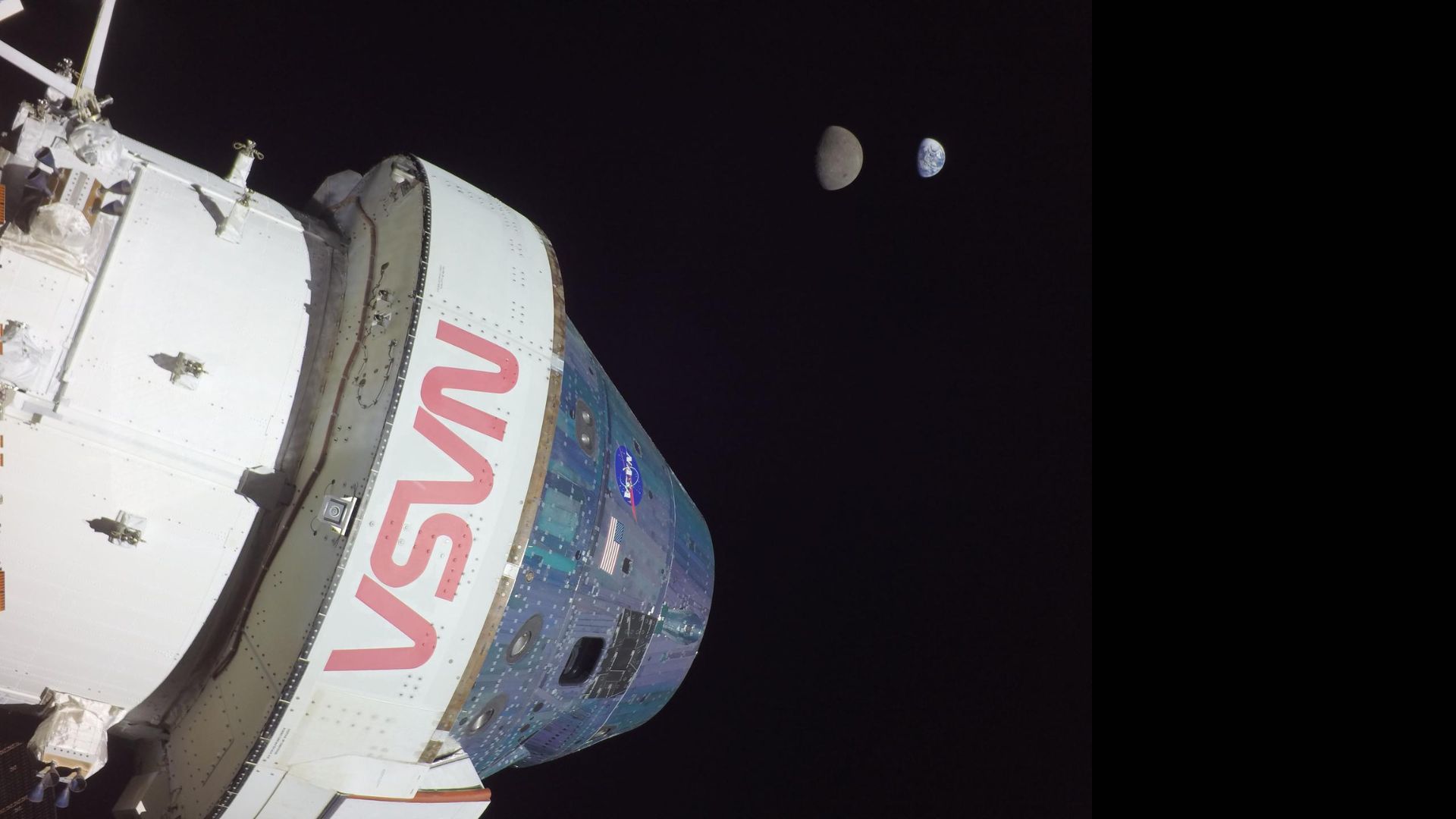
Artemis 2 will take astronauts beyond Earth’s natural shield
When NASA’s Artemis 2 crew leaves low Earth orbit, the four astronauts will no longer have the full protection of Earth’s atmosphere and magnetic field. That reality makes radiation one of the defining operational risks of the mission, and it is one NASA has planned around carefully.
According to Space.com, the crew will monitor radiation conditions using onboard detectors, warning systems, and personal dosimeters that measure exposure to radiation such as X-rays and gamma rays. Orion is described as relatively highly shielded, but shielding alone is not the entire strategy. If radiation levels spike during a solar storm, the astronauts are expected to adopt defensive procedures inside the spacecraft.
The most important of those procedures is the creation of an improvised shelter. The source says the crew would use Orion’s central stowage bays and move their contents into a known “hot spot” within the vehicle to establish a more protected area. The same report notes that, in a particularly severe event, some of the places the crew could use include storage-bay areas and the space down by the toilet.
Why solar storms are a different category of space hazard
Space radiation is not a single, constant threat. Deep-space crews face a background environment, but solar storms can produce sharp increases in exposure over much shorter periods. That means a spacecraft does not just need durable shielding. It also needs procedures, warning systems, and a defined response plan.
The Artemis 2 mission brings that challenge into public view because it will be NASA’s first crewed lunar mission of the Artemis era. The flight is not merely a demonstration of propulsion and navigation. It is also a test of how modern crews and spacecraft operate in deep-space conditions that are fundamentally harsher than those in low Earth orbit.
Orion’s design appears to reflect that mixed approach of built-in protection and operational flexibility. The shielding reduces exposure under normal conditions, while the shelter plan gives astronauts a way to concentrate available mass and materials around themselves if the radiation environment worsens suddenly.

A mission that turns procedure into capability
There is a useful lesson in NASA’s approach. Deep-space safety is not just about constructing a stronger capsule. It is about designing a spacecraft that can be actively reconfigured by its crew in response to changing conditions. Using stowed materials to create a shelter shows how mission planning treats the vehicle as something more adaptive than a sealed shell.
That adaptability may become increasingly important as NASA pushes beyond short-duration lunar missions toward more ambitious exploration. Radiation exposure remains one of the central unsolved constraints for human spaceflight outside Earth orbit. Artemis 2 will not solve that problem outright, but it will demonstrate how crews can manage it in practice.
The immediate significance is straightforward. If a powerful solar event occurs while Artemis 2 is on its way to or from the moon, the astronauts will not be relying on luck. They will be watching radiation data in real time, listening for alerts, and moving into a prepared shelter configuration inside Orion. That plan underscores a broader truth about deep-space exploration: the engineering is only part of the mission. Survival depends just as much on procedures that translate risk into something crews can act on quickly and deliberately.
This article is based on reporting by Space.com. Read the original article.
Originally published on space.com