From Stealth to Spotlight
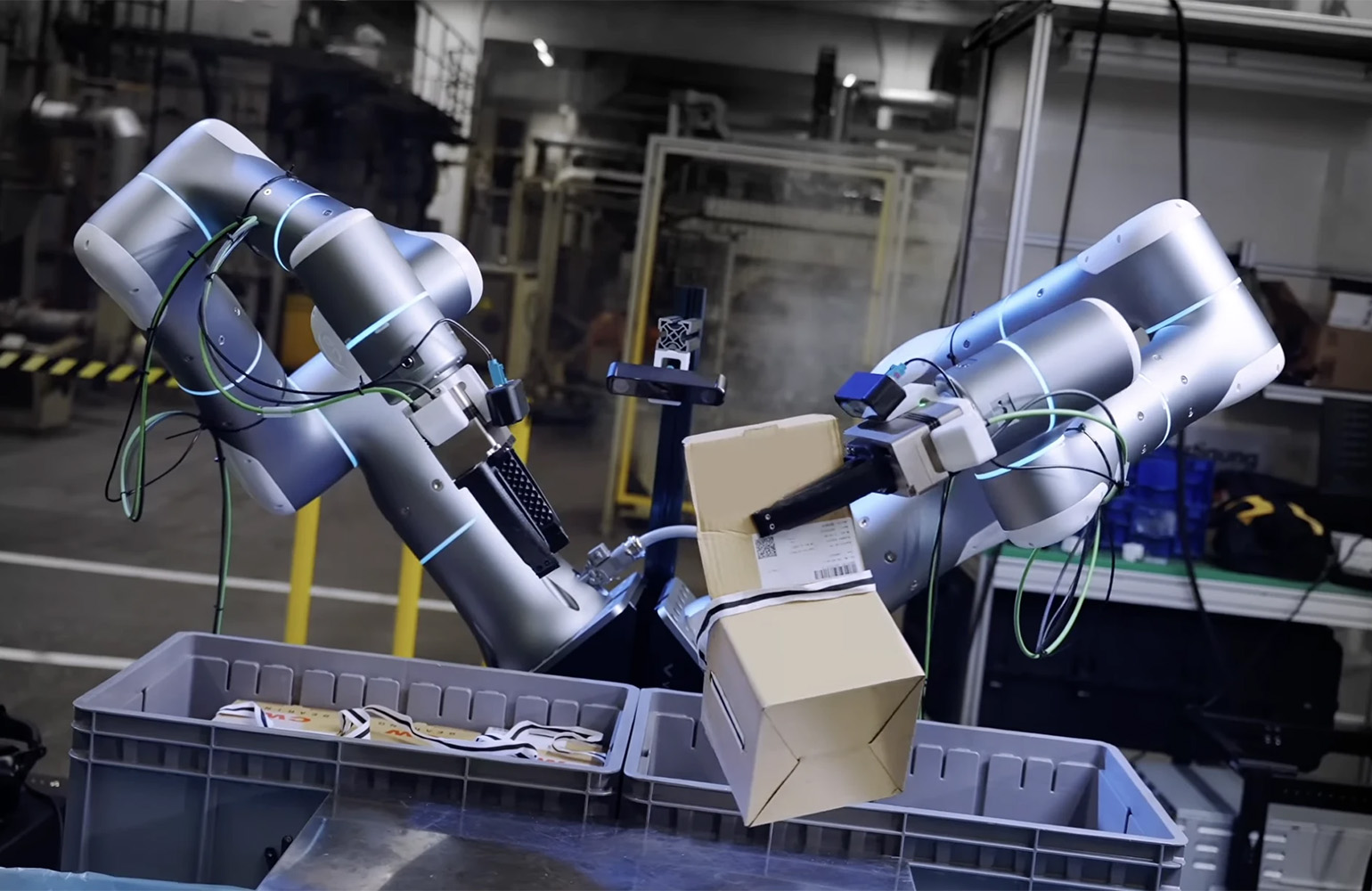
A new robotics AI company has emerged from stealth mode with one of the largest debut funding rounds in the history of the robotics industry. Rhoda AI has raised $450 million to commercialize a system that trains robots to perform complex tasks by watching video demonstrations rather than through traditional programming or manual teleoperation.
The company says its approach dramatically reduces the time and expertise required to teach robots new skills, potentially solving one of the biggest bottlenecks in robotics deployment: the programming problem. Today, getting a robot to perform a new task typically requires weeks or months of specialized engineering work. Rhoda AI claims its system can accomplish the same in hours.
Learning by Watching
The core technology behind Rhoda AI is a foundation model trained on vast amounts of video data showing humans performing physical tasks. The model learns not just what actions look like, but the underlying physics, spatial relationships, and causal chains that connect an intention to a completed task.
When a user wants to teach a Rhoda-equipped robot a new skill, they can simply show the robot a video of the task being performed, whether from a smartphone recording, an instructional video, or existing surveillance footage. The AI system analyzes the video, extracts the relevant actions and their sequence, maps them onto the robot's physical capabilities, and generates a control policy that allows the robot to replicate the task in its own environment.
This represents a fundamental shift from current approaches. Most robot training today relies on either explicit programming, where engineers manually code every movement and decision point, or reinforcement learning, where robots learn through millions of trial-and-error attempts in simulation before transferring skills to the physical world. Both approaches are time-consuming, expensive, and require specialized expertise.
Bridging the Reality Gap
One of the most significant claims Rhoda AI makes is that its system is designed to operate beyond controlled laboratory demonstrations and into real-world environments. This addresses what roboticists call the sim-to-real gap or, in this case, the video-to-real gap, the challenge of transferring skills learned from one context into the messy, unpredictable conditions of actual deployment.
Real-world environments differ from training scenarios in countless ways. Lighting changes, objects are positioned differently, surfaces have different friction properties, and unexpected obstacles appear. Systems that work perfectly in controlled settings often fail catastrophically when these conditions vary even slightly.
Rhoda AI says it addresses this through a combination of robust visual understanding and adaptive control. The foundation model has been trained on sufficiently diverse video data that it develops generalized understanding of physics and object interactions rather than memorizing specific scenarios. When deploying in a new environment, the system continuously adapts its control policies based on real-time sensory feedback.
The Funding and the Backers
The $450 million funding round is remarkable for a company emerging from stealth, reflecting the intense investor appetite for robotics AI companies. The round places Rhoda AI among the best-funded robotics startups in history, alongside companies like Figure AI and 1X Technologies that have also attracted hundreds of millions in recent funding.
The size of the round suggests that investors see Rhoda AI's approach as potentially transformative for the robotics industry, which has long struggled with the scalability problem. The global installed base of industrial robots is only around four million units, a fraction of what many analysts believe the market could support if robots were easier to program and deploy.
Applications and Target Markets
Rhoda AI is initially targeting manufacturing, logistics, and warehousing, sectors where repetitive physical tasks are well-suited to robotic automation but where the diversity of tasks and environments has limited adoption. A warehouse that handles thousands of different products, for example, would traditionally need separate programming for each item's pick-and-place requirements. Video-based learning could potentially handle this diversity with a fraction of the engineering effort.
The company is also exploring applications in food service, agriculture, and healthcare, domains where labor shortages are acute and the ability to quickly teach robots new tasks could be particularly valuable. In agriculture, for instance, different crops require different harvesting techniques, and the ability to train a robot by showing it a video of proper harvesting could make robotic agriculture far more practical.
Challenges and Skepticism
Despite the impressive funding and ambitious claims, significant challenges remain. The robotics industry has a long history of startups that demonstrated impressive capabilities in controlled settings but struggled to deliver reliable performance at commercial scale.
Video-based learning faces inherent limitations. Videos capture visual information but miss many aspects of physical tasks that are critical for robotic execution: the precise force required to grip an object, the tactile feedback that guides delicate manipulations, and the compliance needed to handle fragile items. How well Rhoda AI's system handles these non-visual aspects will likely determine its real-world viability.
The company will also need to demonstrate that its approach works across a wide range of robot hardware, not just specific platforms optimized for its software. Most commercial robotics applications require integration with existing equipment and infrastructure, and the ability to deploy across diverse hardware configurations is essential for broad adoption.
A New Paradigm for Robotics
Regardless of how Rhoda AI's specific technology performs at scale, the company's emergence signals a broader shift in how the robotics industry thinks about the programming problem. The combination of foundation models, video understanding, and adaptive control represents a fundamentally different approach from the traditional robotics pipeline, and the massive funding it has attracted suggests the industry believes a breakthrough in robot teachability may be approaching.
This article is based on reporting by The Robot Report. Read the original article.
Originally published on therobotreport.com