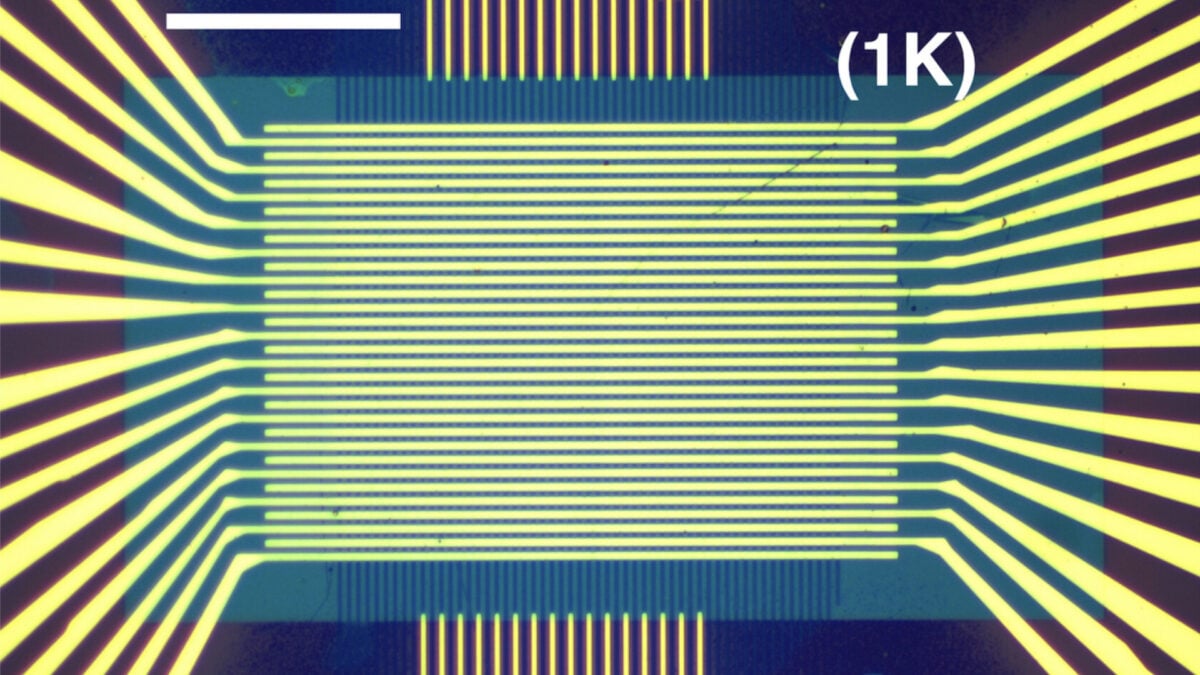
A new chip design is aimed at places where ordinary electronics fail
A prototype memory chip described in a recent Science paper has demonstrated the kind of heat tolerance that could open new possibilities for electronics in extreme environments. According to the research team, the device worked reliably at 1,300 degrees Fahrenheit, or about 700 degrees Celsius, for more than 50 hours and handled more than one billion switching cycles while operating on just 1.5 volts.
The device is a memristor, a component that can both store information and perform computing operations. What makes this version stand out is its materials stack: tungsten on top, hafnium oxide ceramic in the middle, and graphene on the bottom. The researchers say those materials are the reason the chip can keep functioning where conventional memory devices would fail. In high heat, ordinary chips can short-circuit when their layers effectively collapse into each other. Here, the chemistry and physical behavior of tungsten and graphene make that failure mode much harder to trigger.
Why the materials matter
Tungsten has the highest melting point of any metal, while graphene is a one-atom-thick sheet of carbon with unusual electrical and structural properties. In the new chip, those extremes are being used as engineering advantages rather than scientific curiosities. The team said that the surface chemistry between tungsten and graphene behaves almost like oil and water, limiting the tendency for the top and bottom layers to fuse under heat.
That explanation was supported by follow-up analysis using electron microscopy and spectroscopy, which gave the researchers an atomic-level view of how the layers interacted. In other words, the team did not only observe a working device; it also examined why the device avoided the short-circuit behavior that typically destroys high-temperature electronics.
Why this could matter for space and industry
The potential applications are broad, even if the technology remains early. Spacecraft, planetary probes, and industrial systems can all face environments that overwhelm conventional semiconductor hardware. The article explicitly points to missions dealing with extreme heat and pressure, where data retention and onboard processing become difficult just when reliable electronics are most important. A memory device that survives those conditions could expand what instruments and autonomous systems are able to do.
The Venus use case is an obvious example because the planet’s surface conditions have long made long-duration electronics especially challenging. But the same principle could matter in other aerospace contexts and in harsh terrestrial settings where sensors and control systems are pushed past the limits of standard chips. High-temperature memory is not a complete computer, as the researchers note, but it could be a foundational part of one if companion logic and supporting electronics can be developed to similar standards.
The main caveat is that a prototype is not yet a product. The team itself cautioned that practical systems would still require additional components and engineering work. Even so, this result is notable because it moves beyond vague claims of durability and delivers concrete performance at temperatures hot enough to rule out most familiar computing hardware. For extreme-environment electronics, that is a meaningful advance.
This article is based on reporting by Gizmodo. Read the original article.
Originally published on gizmodo.com