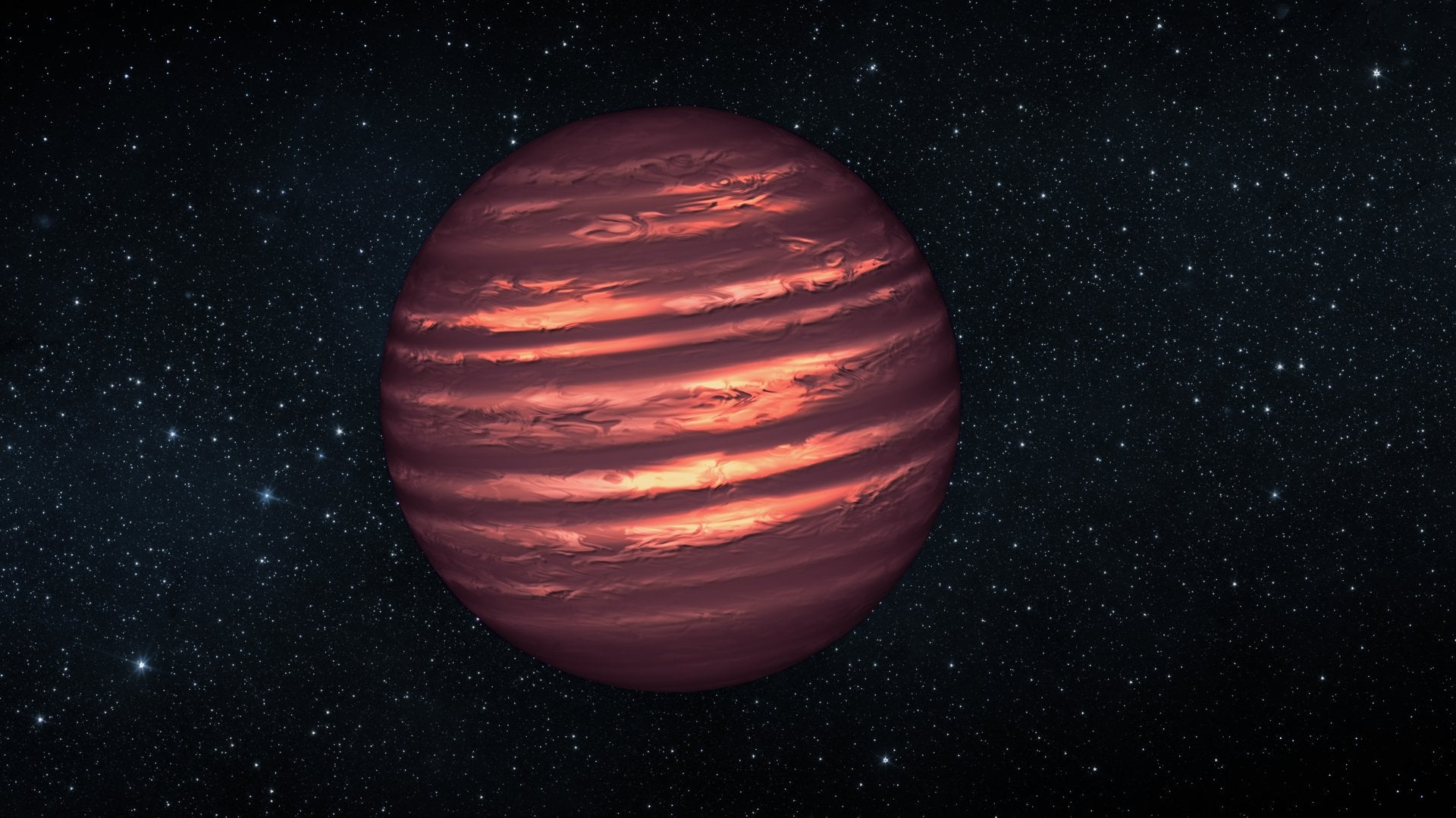
A long-standing planetary idea gets a broader test
Astronomers have assembled the largest survey yet of exoplanet and brown dwarf spin measurements, and the results support a long-held idea: rotation appears closely tied to planetary mass and formation history.
The new work used the W. M. Keck Observatory on Maunakea, Hawaii, where researchers employed the Keck Planet Imager and Characterizer, or KPIC, to study rotating worlds beyond the Solar System. By combining those observations with historical measurements, the team built curated samples spanning giant planets, stellar and substellar companions, and free-floating brown dwarfs and planetary-mass objects.
The report says the central finding is that gas giant planets spin faster than their more massive brown dwarf counterparts when mass, size, and age are taken into account. That gives observational support to a relationship astronomers have long suspected but have struggled to test across a broad enough sample.
Why spin matters
Spin is more than a simple property on a data sheet. Researchers described it as a fossil record of how a planet formed. In planetary science, rotation can preserve clues about the processes that shaped an object early in its history, including how material accumulated, how angular momentum was distributed, and whether the object formed more like a planet inside a disk or more like a star through gravitational collapse.
That question is especially important for massive worlds orbiting far from their stars. Many of the planets in the survey lie tens to hundreds of astronomical units from their host stars. Astronomers are still debating whether such distant companions formed gradually within circumstellar disks or through star-like collapse. Spin helps distinguish between those pathways because formation channels can leave different rotational signatures.
In the Solar System, the intuition behind the theory is familiar. Jupiter and Saturn both rotate rapidly, each completing a rotation in about ten hours, and together they account for a large share of the Solar System’s rotational energy. The new survey extends that line of inquiry to worlds far beyond our own system.

How the team measured distant rotation
To estimate spin, the researchers used high-resolution spectroscopy from KPIC. As a planet rotates, atmospheric features in its light become broadened. By isolating the light from these distant objects and analyzing the broadened spectral features, astronomers can infer how rapidly a planet is spinning.
The observational sample described in the report included 32 gas giants and brown dwarfs in distant star systems, including giant planets larger than Jupiter and brown dwarf companions. The team then added historical measurements to create a curated sample of 43 stellar or substellar companions and giant planets, as well as 54 free-floating brown dwarfs and planetary-mass objects.
That larger comparative framework matters because spin is difficult to interpret in isolation. Mass, radius, and age all influence how rotation evolves over time. By accounting for those factors, the researchers were better able to compare planetary objects with brown dwarfs on more meaningful terms.
A clearer dividing line between planets and brown dwarfs
The result that gas giant planets spin faster than more massive brown dwarfs, once key variables are considered, points to a meaningful physical difference between the two populations. Brown dwarfs occupy a boundary zone between planets and stars, and one of the persistent challenges in astronomy has been figuring out where formation history matters more than simple mass-based labels.
Spin may therefore become a more useful diagnostic tool. If rotational behavior systematically differs between giant planets and brown dwarfs, then future measurements could help classify ambiguous objects and sharpen theories of how planetary systems assemble.
That would be especially valuable for directly imaged worlds, which are often found at large orbital distances where formation scenarios are hardest to pin down. These are the systems where atmospheric spectroscopy and rotational measurements can reveal information that orbital data alone cannot provide.

Why this matters for exoplanet science
The exoplanet field has matured rapidly from detection to characterization. It is no longer enough to know that a world exists; astronomers increasingly want to understand its weather, chemistry, orbit, and origin. Rotation is becoming part of that toolkit.
The significance of this survey lies not only in the number of objects examined, but in the way it turns spin into a comparative population-level measurement. Rather than treating fast rotation as an anecdotal feature of a few famous planets, the study strengthens the case that angular momentum follows broader patterns tied to the way planetary and substellar objects form.
The team behind the work included researchers from Northwestern University, UC San Diego, Caltech, the W. M. Keck Observatory, the Steward Observatory, the James C. Wyant College of Optical Sciences, NASA’s Jet Propulsion Laboratory, and other institutions. The study was published in The Astronomical Journal.
What comes next
The immediate implication is that more rotational measurements are likely to become a priority. As instruments improve and samples expand, astronomers will be able to test whether the observed trend holds across a wider range of masses, orbital distances, and system ages.
If it does, spin could become one of the clearest surviving records of how giant worlds are assembled. That would make a planet’s day length more than a curiosity. It would make it evidence, preserved across millions or billions of years, of the process that built the world in the first place.
This article is based on reporting by Universe Today. Read the original article.
Originally published on universetoday.com