Introduction: The Promise of Lightsails
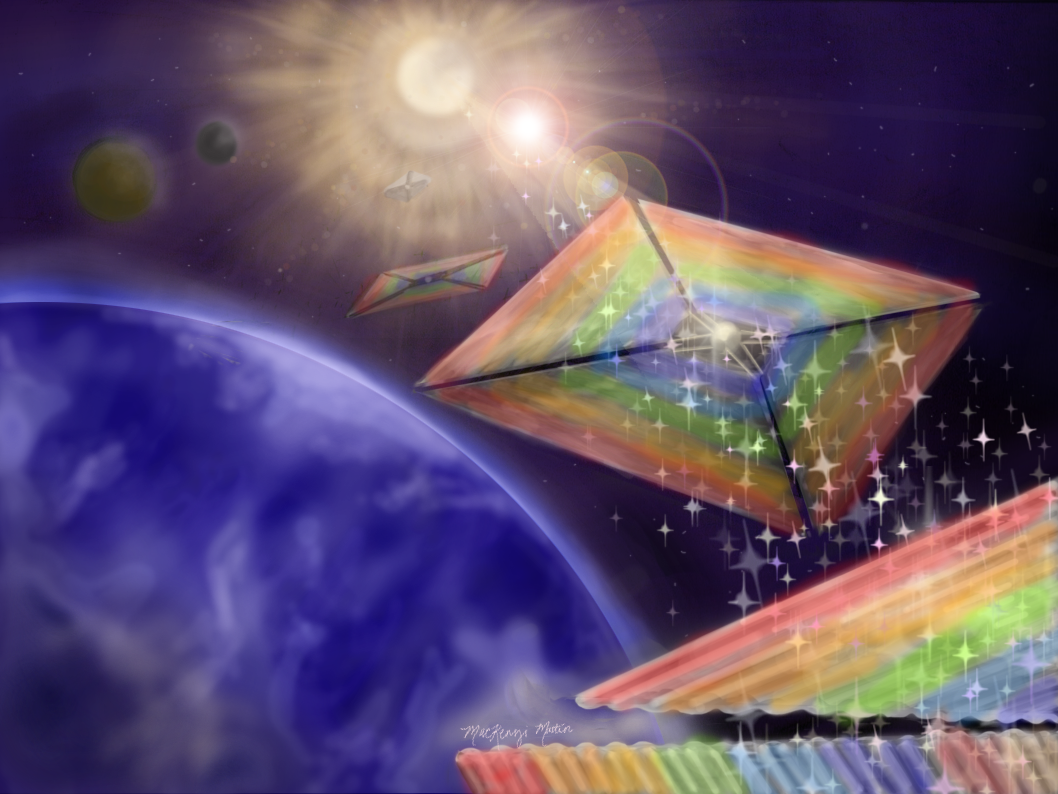
If humanity is to reach another star, chemical propulsion will not suffice within any reasonable timeframe. A different propulsion technology is needed, and one of the most promising concepts is the solar sail. These giant reflective surfaces, pushed by sunlight or powerful lasers, could accelerate spacecraft to speeds unattainable by current chemical or ion thrusters. However, a new paper from researchers at the Harbin Institute of Technology reveals that once these sails approach a significant fraction of the speed of light, they encounter an unexpected obstacle: drag from the very photons that propel them.
The Three Forces from Photons
The paper, authored by Chao Shen and Jiaze Li and available on arXiv, breaks down the forces that photons impart to a lightsail. In order of decreasing efficiency, these are: incident light (the raw momentum of photons striking the sail), specular reflection (momentum from photons that bounce off perfectly), and diffuse scattering (momentum from photons absorbed and then reemitted in random directions). At low speeds, these forces combine to provide net thrust. But as the sail accelerates to relativistic velocities, complications arise.

The Doppler Effect at Relativistic Speeds
As the lightsail speeds away from its light source, it experiences a severe relativistic Doppler effect. The frequency of the incoming light drops, reducing the energy and momentum transferred to the sail. This causes the thrust generated by all three components to decrease rapidly, making further acceleration increasingly difficult. The faster the sail goes, the harder it becomes to push it even faster.
Light Aberration and Drag Beyond 75% of Light Speed
The situation worsens when the lightsail reaches 75% of the speed of light. At this threshold, a phenomenon called relativistic light aberration takes effect. From the perspective of a stationary observer on Earth, the diffusely scattered light is directed forward, in the direction of the sail's motion. Because every action has an equal and opposite reaction, this forward-directed scattering creates a drag force on the sail. Although diffuse scattering is the weakest of the three forces, it becomes an active resistance beyond 75% of light speed. The net thrust from the pushing laser remains positive at that point, but the efficiency drop-off is significant.

Implications for Interstellar Missions
These findings have direct implications for proposed interstellar missions like Breakthrough Starshot, which aims to send tiny lightsail-driven probes to Alpha Centauri. The paper suggests that achieving the target speeds of 20% of light speed may be feasible, but pushing beyond that introduces severe efficiency losses. Mission designers must account for these relativistic effects when planning acceleration profiles and laser power requirements.
Limitations of the Study
The paper focuses exclusively on radiative dynamics and does not consider non-radiative factors such as drag from interstellar gas or dust, nor does it address thermal limitations of sail materials, such as potential melting under high-power lasers. The analysis treats the lightsail as an idealized mirror. In practice, aerospace engineers are exploring advanced metamaterials and photonic crystals tuned to specific laser wavelengths to improve performance. Future studies will need to integrate these real-world constraints.

Conclusion: Navigating the Light-Drag Barrier
Interstellar lightsails remain a promising avenue for reaching other stars, but the hidden physics of relativistic light drag must be overcome. Understanding the interplay of Doppler shift and light aberration is crucial for designing sails that can maintain efficiency at high speeds. With continued research into materials and laser systems, humanity may yet find a way to navigate this photon-induced drag barrier and sail to the stars.
This article is based on reporting by Universe Today. Read the original article.
Originally published on universetoday.com