A Historic Roll to the Pad
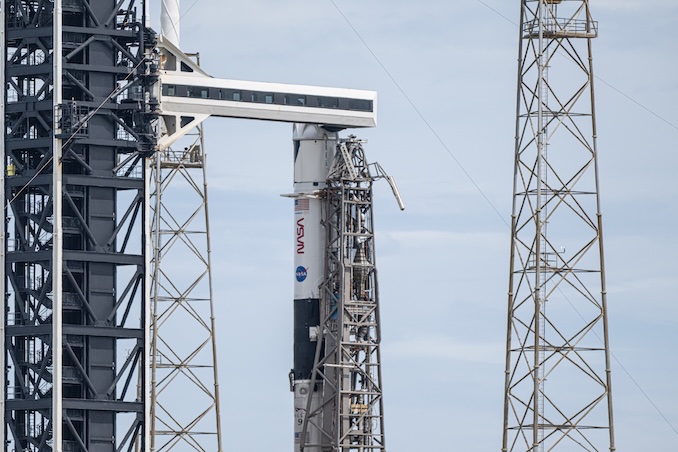
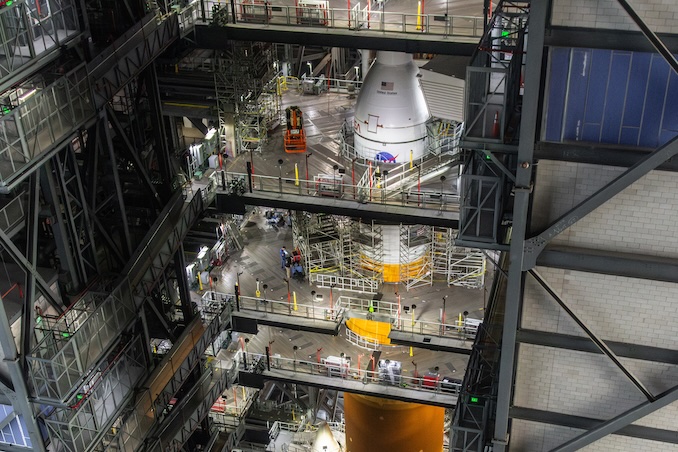
Early in the morning at Kennedy Space Center, the crawler-transporter moved at its characteristic glacial pace — roughly one mile per hour — carrying what may be the most significant payload NASA has transported to a launch pad in half a century. The Space Launch System rocket configured for the Artemis 2 mission, topped by the Orion capsule that will carry four astronauts on a free-return trajectory around the Moon, completed the approximately four-mile journey from the Vehicle Assembly Building to Launch Complex 39B. With that move complete, NASA has entered the final countdown phase for the first crewed lunar mission since December 1972.
The crew — NASA astronauts Reid Wiseman, Victor Glover, and Christina Koch, along with Canadian Space Agency astronaut Jeremy Hansen — will not land on the Moon. Artemis 2 is a crewed flight test of the Orion capsule and the SLS rocket in the lunar environment, designed to validate life support systems, deep-space communication links, and the capsule's ability to perform a precisely shaped trajectory around the Moon before returning to Earth for a Pacific Ocean splashdown. If successful, it will clear the path for Artemis 3, which aims to land the first woman and first person of color on the lunar surface.
Getting to the Pad: A Long Road
The rollout to the launch pad marks the culmination of years of delays, budget overruns, and technical setbacks that have tested NASA's Artemis program. The original Artemis 2 launch target was 2024. It slipped to late 2024, then to 2025, and now to April 2026, driven primarily by issues with the Orion capsule's heat shield — the same component that showed unexpected charring patterns during the uncrewed Artemis 1 mission in 2022. Engineers spent more than a year investigating the heat shield anomaly, ultimately tracing it to ablative material shedding behavior under specific pressure conditions. A new heat shield design was implemented, tested, and validated before the program could proceed.
Secondary issues included battery management systems in the service module, software updates to the abort detection system, and logistical delays in processing the massive SLS core stage. The SLS is currently the most powerful operational rocket in the world, capable of producing 8.8 million pounds of thrust at liftoff through its RS-25 engines — heritage Space Shuttle main engines — and twin solid rocket boosters.

What the Mission Will Accomplish
Artemis 2 will fly a hybrid free-return trajectory: after liftoff from Kennedy Space Center, the SLS upper stage will inject Orion onto a translunar trajectory. The capsule will pass within approximately 4,600 miles of the lunar surface on a slingshot path that will carry it roughly 230,000 miles from Earth — farther than any human crew has traveled since Apollo 17 — before returning to Earth on a high-speed reentry.
The roughly ten-day mission will test Orion's environmental control and life support systems under actual deep-space radiation conditions, validate the communication and navigation infrastructure of NASA's Deep Space Network as extended for lunar operations, and provide the crew with hands-on experience operating the spacecraft in the cis-lunar environment. One specific test involves the crew manually taking control of Orion using hand controllers and running through proximity operations — the kind of manual flying that might be needed in an emergency docking scenario or if automated systems fail at a critical moment.
Eyes on April — and Beyond
NASA's current target for the Artemis 2 launch is April 2026, pending final systems checks during the pad stay. The scrub risk is considered moderate: the Florida Space Coast's spring weather window is relatively benign, but upper-level winds, range safety constraints, and the need for favorable lighting conditions at the lunar flyby create a fairly narrow launch window of approximately two hours per day for the first two weeks of April.
Should the mission succeed, Artemis 3 — the landing mission — is targeted for no earlier than late 2027. That schedule depends not only on Artemis 2's success but on the readiness of SpaceX's Starship Human Landing System, which was selected by NASA in 2021 to ferry astronauts from Orion to the lunar surface and back. Starship is progressing through its own development and test campaign, having achieved successful ocean landings and early orbit flights, but has not yet demonstrated the cryogenic propellant transfer technology that the lunar landing mission requires.
For now, the sight of an SLS rocket standing on Pad 39B is itself a milestone. It means NASA is closer to returning humans to the Moon than at any point since the Space Shuttle era ended in 2011 — and for the four people who will climb aboard, it is the beginning of the most significant journey any human crew has undertaken in living memory.
This article is based on reporting by Spaceflight Now. Read the original article.

Originally published on spaceflightnow.com