A Dying Star's Final Act
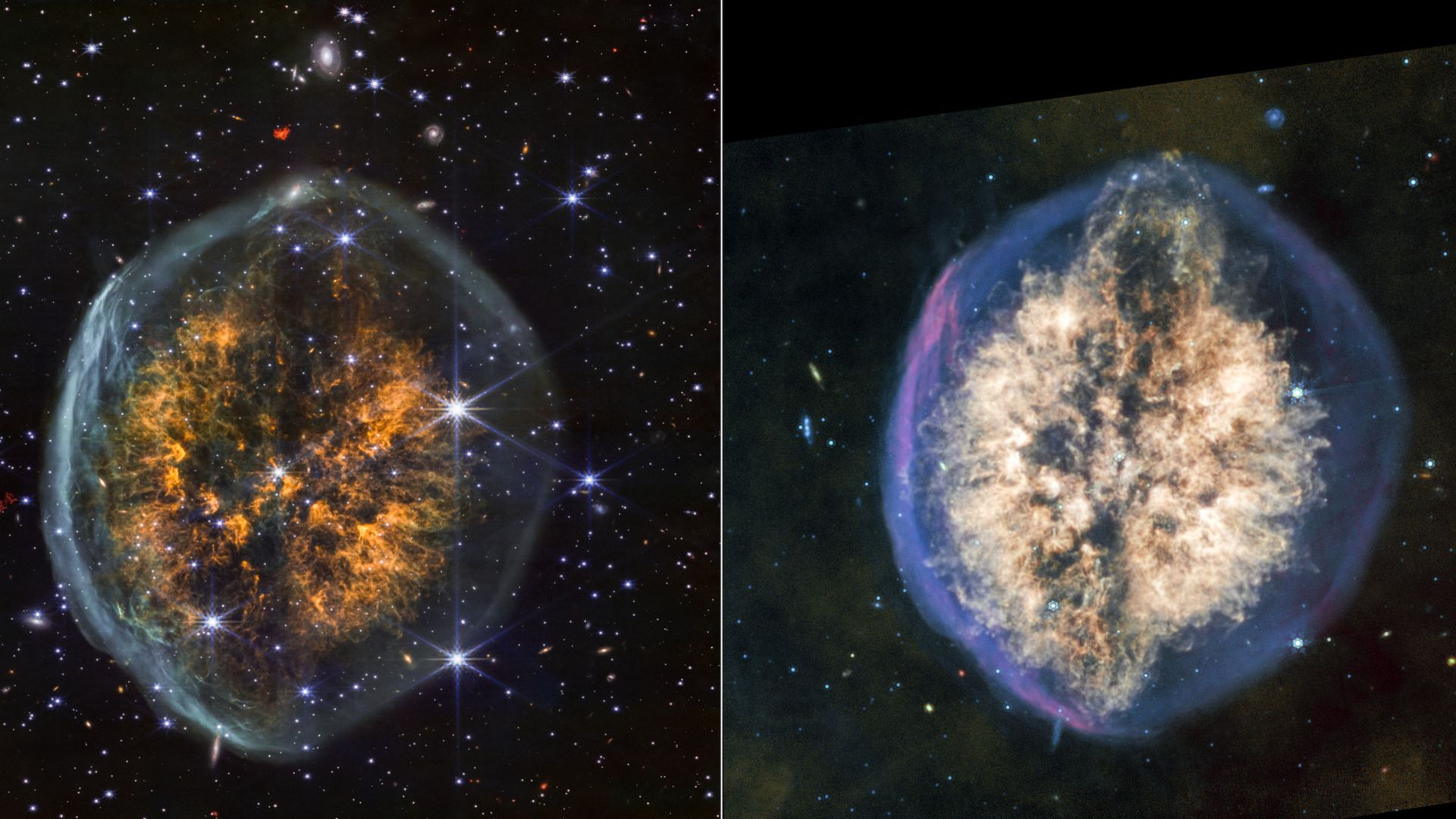
NASA's James Webb Space Telescope has turned its infrared instruments toward one of the most visually striking objects in the cosmos — a planetary nebula nicknamed the Exposed Cranium for its eerie resemblance to the folds and convolutions of a human brain. The new images reveal intricate structural details invisible to previous telescopes, providing scientists with an unprecedented view of the violent processes that occur during the final stages of stellar death.
Planetary nebulae, despite their name, have nothing to do with planets. They are the glowing shells of gas expelled by dying stars similar in mass to our Sun. When such a star exhausts its nuclear fuel, it sheds its outer layers in a series of eruptions, creating expanding shells and jets of gas that are illuminated by the hot stellar core left behind. The resulting structures can be spectacularly beautiful and scientifically revealing — each one a snapshot of stellar physics frozen in expanding gas.
What Webb Sees That Others Cannot
Previous observations of the Exposed Cranium nebula using ground-based telescopes and the Hubble Space Telescope captured the object in visible light, revealing its overall brain-like morphology but leaving many structural details obscured. Visible-light observations are limited by dust within and around the nebula that absorbs and scatters shorter wavelengths, hiding the innermost regions where the most energetic processes occur.
Webb's infrared instruments penetrate this dusty veil. The telescope's Near-Infrared Camera and Mid-Infrared Instrument captured the nebula at wavelengths ranging from 1 to 25 micrometers, revealing structures that are completely invisible in optical images. The infrared data show complex layering within the nebula's shells, fine-scale filaments threaded through the expanding gas, and a previously hidden inner cavity surrounding the central star.
The images reveal that the nebula's brain-like appearance is not merely a surface feature but extends deep into the structure. Multiple concentric shells of expelled material, each representing a distinct mass-loss episode from the dying star, are nested within each other like the layers of an onion. The infrared observations show these shells in sharp relief, with brightness variations indicating differences in gas density, temperature, and chemical composition.

The Physics of Stellar Death
The Exposed Cranium nebula provides a particularly valuable laboratory for studying stellar death because it appears to be in a relatively early stage of its evolution as a planetary nebula. The expelled gas shells are still relatively compact and have not yet expanded enough for their structures to be blurred by interaction with the interstellar medium. This early stage means that the fine structural details visible in Webb's images are closely related to the mass-loss processes that created them.
Stars in the final stages of their lives on the asymptotic giant branch undergo thermal pulses — periodic surges in nuclear burning that cause the star to swell and contract. Each pulse can expel a shell of material, and the interaction between successive shells creates the layered structures visible in the new images. The timing, intensity, and geometry of these pulses encode information about the star's internal structure during its final millennia of nuclear burning.
Webb's spectroscopic capabilities add another dimension to the data. By analyzing the specific wavelengths of infrared light emitted by different molecules and ions within the nebula, astronomers can determine the chemical composition of the expelled gas. This information reveals what nuclear reactions occurred inside the star and how the products of those reactions were mixed and expelled — providing a chemical fingerprint of stellar evolution.
Unexpected Structures
Several features in the new images surprised the research team. The innermost cavity surrounding the central star shows evidence of bipolar outflows — narrow jets of material streaming from the star's poles at high velocity. These jets are creating bullet-like condensations where they slam into the slower-moving expelled shells, generating shockwaves visible as bright infrared emission knots.
The origin of these jets is debated. In single-star models, fast stellar winds from the exposed core interact with the previously expelled slow wind to create the observed structures. However, many astronomers now believe that the most dramatic jet features in planetary nebulae require a binary companion — a second star whose gravitational influence shapes the outflowing material into the observed bipolar geometry.
Webb's images of the Exposed Cranium nebula may help resolve this debate. The morphology and velocity structure of the jets, combined with the geometry of the concentric shells, provide constraints on the physical mechanism responsible. If a binary companion exists, its gravitational influence should produce specific asymmetries in the shell structure that are now detectable in Webb's high-resolution infrared images.
Dust Production and Cosmic Recycling
The mid-infrared observations are particularly valuable for studying dust production in the nebula. Dying stars are major producers of cosmic dust — the microscopic solid particles that fill interstellar space and provide the raw material for future generations of stars and planets. The Earth itself was built largely from dust produced by previous generations of dying stars.
Webb's mid-infrared data show the thermal emission from warm dust grains within the nebula, revealing where dust is being produced and how it is distributed relative to the gas shells. The spatial relationship between dust and gas provides clues about the physical conditions required for dust grain formation — temperatures, densities, and chemical compositions that allow atoms to condense into solid particles.
Understanding dust production in planetary nebulae is important beyond stellar physics. The total amount of dust produced by dying stars contributes to models of galaxy evolution, cosmic chemistry, and the conditions in molecular clouds where new star systems form. Each planetary nebula observation by Webb adds data points to these models, gradually improving our understanding of the cosmic recycling process that connects stellar death to stellar birth.
A Preview of Our Sun's Fate
The Exposed Cranium nebula offers more than scientific data — it provides a preview of our own solar system's distant future. In approximately five billion years, the Sun will exhaust its hydrogen fuel, swell into a red giant, and eventually shed its outer layers to form a planetary nebula much like the one Webb has now imaged in such detail. The Earth will likely not survive this process, but the elements that currently constitute our planet and its inhabitants will be recycled into the interstellar medium, potentially contributing to future generations of stars and worlds.
Webb's observations transform these cosmic processes from abstract concepts into vivid, detailed imagery. The telescope's ability to peer through dust, resolve fine structural details, and analyze chemical compositions makes it uniquely suited to studying planetary nebulae — and the Exposed Cranium nebula's new infrared portrait joins a growing gallery of stellar death scenes that are reshaping astronomers' understanding of how stars end their lives and contribute their substance back to the cosmos.
This article is based on reporting by Live Science. Read the original article.
Originally published on livescience.com