Ancient Water Channels in Stone
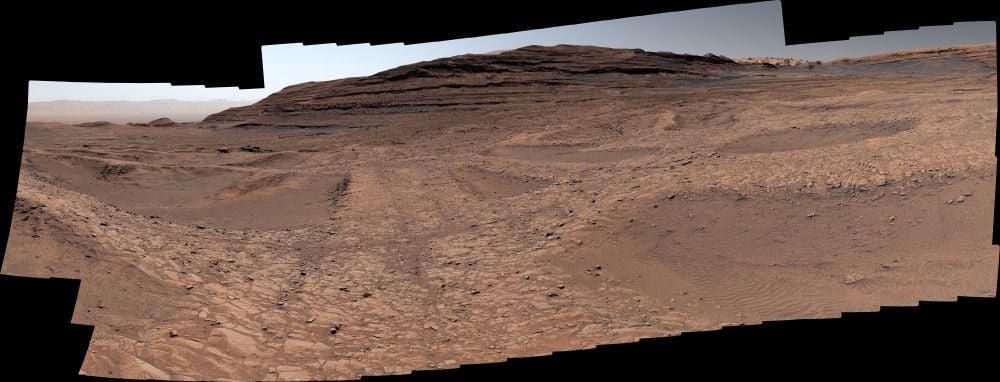
NASA's Mars Science Laboratory Curiosity has reached a milestone in its exploration of Gale Crater, gathering its fourth rock sample from the distinctive boxwork ridge formations that have long been one of the mission's primary scientific targets. These low ridges, standing roughly one to two meters tall, were formed billions of years ago when water flowed through a network of underground fissures, depositing minerals that hardened into resistant rock while the surrounding material eroded away over geological time.
The boxwork formations were first identified from orbit by the Mars Reconnaissance Orbiter in 2006, and their presence in Gale Crater was one of the key reasons NASA selected the site for Curiosity's landing in 2012. Now, more than 13 years into its mission, the rover has finally reached these formations in the lower foothills of Mount Sharp, providing humanity's first close-up examination of structures that may hold clues to whether Mars was once capable of supporting life.
What the Rocks Can Tell Us
Boxwork formations are significant because they represent the remnants of hydrothermal systems — environments where warm, mineral-rich water circulated through cracks in the rock. On Earth, hydrothermal systems are among the most biologically productive environments, hosting thriving ecosystems of microorganisms that derive energy from chemical reactions rather than sunlight. If similar conditions existed on ancient Mars, these formations would be among the most promising places to look for evidence of past microbial life.
Previous samples collected from the boxwork region have shown what scientists describe as tantalizing evidence that may be consistent with ancient biological activity. However, the scientific community remains appropriately cautious about drawing conclusions. As the researchers emphasize, the extraordinary claim that Mars was once inhabited requires extraordinary evidence — and they are still waiting for data that could definitively distinguish biological signatures from purely geological processes.
The fourth sample adds another data point to a growing body of evidence. Curiosity's onboard laboratory, the Sample Analysis at Mars (SAM) instrument, can analyze the chemical composition of rock samples in detail, identifying organic molecules, mineral phases, and isotopic signatures that might provide clues about past environmental conditions and any biological processes that may have occurred.

The Long Road to This Moment
Curiosity's journey to the boxwork formations represents one of the most patient scientific campaigns in space exploration history. The rover landed on the floor of Gale Crater in August 2012 and has been systematically driving toward Mount Sharp — a layered mountain of sedimentary rock that rises 5.5 kilometers from the crater floor — while stopping to investigate promising geological features along the way.
Each layer of Mount Sharp represents a different chapter in Mars's environmental history, from the warm, wet conditions that may have prevailed billions of years ago to the cold, dry planet we see today. By climbing through these layers, Curiosity is essentially reading a geological history book one chapter at a time, with the boxwork formations representing a particularly intriguing page about Mars's hydrothermal past.
Mars Sample Return: The Bigger Picture
Curiosity's findings in the boxwork region take on additional significance in the context of NASA's Mars Sample Return campaign. While Curiosity can perform sophisticated analyses on the surface, the definitive search for evidence of past life ultimately requires returning Martian rock samples to laboratories on Earth, where they can be examined with instruments far more sensitive and versatile than anything that can be sent to Mars.
NASA's Perseverance rover, operating in Jezero Crater roughly 3,700 kilometers from Curiosity, has been collecting and caching rock samples specifically for eventual return to Earth. The Mars Sample Return mission has faced budget challenges and timeline uncertainty, but remains one of NASA's highest priority scientific goals. The insights from Curiosity's boxwork samples inform the broader scientific strategy by helping researchers understand which types of Martian rock are most likely to preserve biosignatures if they exist.

What Comes Next
With the fourth boxwork sample in hand, Curiosity's science team will spend weeks analyzing the data returned by the rover's instruments. The results will be compared against previous samples and evaluated in the context of the broader mineralogical and chemical environment of the boxwork region. Any anomalies that might suggest biological activity will be subjected to intense scrutiny and alternative explanations before any conclusions are drawn.
Meanwhile, the rover continues its climb up Mount Sharp, with more geological formations and scientific targets ahead. After more than a decade on Mars, Curiosity's mission has evolved from an initial two-year primary mission to an open-ended exploration campaign that continues to produce some of the most scientifically valuable data ever collected from another planet. The boxwork formations represent not an endpoint but another chapter in one of humanity's most remarkable scientific journeys.
This article is based on reporting by Universe Today. Read the original article.
Originally published on universetoday.com