
Chang’e-7 reaches Wenchang ahead of a pivotal lunar mission
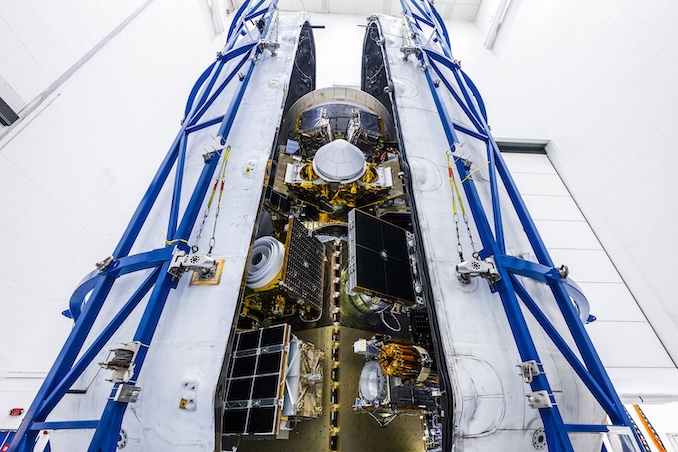
China’s Chang’e-7 spacecraft has arrived at Wenchang Satellite Launch Center, moving the country’s next major lunar mission from planning into visible launch preparation. According to the reported details, the multi-element spacecraft was transported from Beijing to Haikou on Hainan island aboard an Antonov An-124 aircraft on April 9, with China’s human spaceflight agency, CMSEO, confirming its arrival at the coastal launch site.
The mission is scheduled for the second half of 2026, with earlier reports pointing to a possible August launch on a Long March 5 rocket. The spacecraft is not a single-purpose lander. It is a more elaborate exploration package made up of an orbiter, a lander, a rover, and a hopping probe built to investigate one of the most strategically important targets in current lunar exploration: the south pole.
That architecture makes Chang’e-7 more than another robotic lunar visit. It is a systems mission aimed at prospecting, mapping, surface operations, and targeted sampling in terrain that could shape the next stage of human and robotic activity on the moon.
Why the lunar south pole matters
The south pole has become one of the most contested and closely watched regions in lunar exploration because permanently shadowed craters there may contain volatiles, including water-ice. Chang’e-7 is designed specifically to search for evidence of that resource. The mission is expected to target a landing area in the vicinity of the south pole, with sites around Shackleton crater previously identified as leading candidates.
Site selection in that region is unusually demanding. The reported process balances two competing requirements: access to areas with favorable illumination and proximity to permanently shadowed regions that may preserve water-ice. Those conditions make the south pole both scientifically valuable and operationally difficult. A site that is easier to power and communicate with may be less ideal for direct ice prospecting, while a site closer to the coldest traps may be harsher to reach and work within.
That tension explains why the mission carries multiple elements. An orbiter can provide broader context, a lander and rover can investigate the surface more conventionally, and the hopping probe can try to extend reach into terrain that is harder to access. The structure of the mission reflects the complexity of the target.
The hopping probe is the headline payload
The most distinctive part of Chang’e-7 is its hopping spacecraft, also described as a mini-flying probe. Rather than relying only on rolling mobility, China is sending a vehicle intended to work in darkness and intense cold near permanently shadowed areas. That makes it one of the mission’s defining technologies.
The probe carries the Lunar Soil Water Molecule Analyzer, or LUWA. According to the supplied report, the system will drill for samples, seal and heat them, and then analyze them using a mass spectrometer. In practical terms, this means China is not merely planning to image the terrain or infer composition from a distance. It is preparing to directly process material in search of water-related evidence.
That distinction is important. Remote sensing can identify promising sites, but in-situ analysis is what begins to turn prospecting into actionable knowledge. If Chang’e-7 can confirm water-ice or other relevant volatiles in these environments, it would sharpen the strategic value of the lunar south pole for future exploration campaigns.
The source material is also clear about why such a finding would matter. Water-ice could support drinking water and oxygen production for astronauts, and it could potentially be split into hydrogen and oxygen for rocket propellant. That makes the search scientific, operational, and geopolitical at the same time. A resource that supports life support and in-space transportation changes what sustained lunar presence could look like.
A step in China’s longer moon strategy
Chang’e-7 is described as a key step in China’s roadmap toward a sustained robotic and eventual crewed presence on the moon. That wording puts the mission in a larger national sequence rather than treating it as a standalone research project. The spacecraft’s arrival at Wenchang therefore has significance beyond logistics. It signals that China’s lunar program is continuing to move through the milestones needed to connect robotic prospecting with later human capability.
That broader context is visible elsewhere in the report. China is working to integrate its crewed and robotic lunar programs, and earlier this year it conducted an in-flight abort test of the new Mengzhou crew spacecraft. A full orbital flight using the new Long March 10A rocket could take place later in 2026. Taken together, those efforts show a program aligning hardware development, safety milestones, and robotic exploration around a longer-term lunar objective.
The timing is also notable because the mission preparations are unfolding amid a wider surge in lunar activity. The report places Chang’e-7’s arrival at Wenchang one day before NASA’s scheduled Artemis 2 return to Earth on April 10, marking the first crewed circumlunar mission in more than half a century. The juxtaposition is not accidental. Lunar exploration has become a field of overlapping national programs, each trying to convert technical progress into durable presence and strategic leverage.

What success would mean
Chang’e-7 carries 18 science payloads in total, including three aboard the supporting Queqiao-2 relay spacecraft. That breadth suggests a mission intended to do more than answer a single binary question about ice. But the water-ice search will dominate how the mission is understood internationally, because it is so tightly linked to the future economics and logistics of moon activity.
If the mission produces strong evidence of accessible water-bearing material near the south pole, it would strengthen the case for infrastructure, follow-on missions, and more ambitious surface operations in the region. If conditions prove harsher or the resource more difficult to verify than expected, that would still be consequential. Either outcome helps define the practical map for the next decade of lunar plans.
For now, the key development is simpler and more immediate. Chang’e-7 is no longer an abstract program milestone. It is at the launch site, entering final preparation for a mission that blends prospecting, mobility innovation, and strategic intent. In the emerging contest to understand and use the moon’s south pole, that is a meaningful step forward.
This article is based on reporting by SpaceNews. Read the original article.
Originally published on spacenews.com