New imagery adds detail to a still-unfolding mission
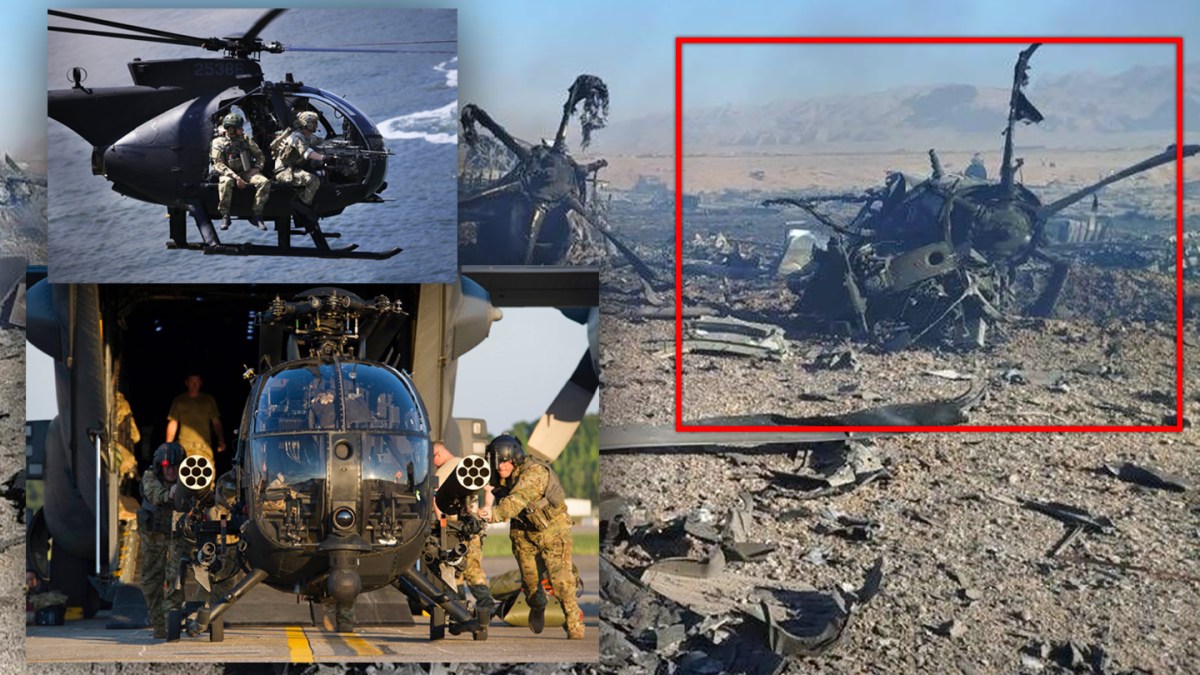
New images emerging from an improvised airfield in Iran appear to show destroyed AH-6 or MH-6 Little Bird helicopters associated with the U.S. Army’s 160th Special Operations Aviation Regiment, the Night Stalkers. The site reportedly served as a forward hub and arming and refueling point during the rescue mission for a downed F-15E weapons systems officer.
The imagery, as described in the report, includes at least one burned-out H-6 airframe visible near the wreckage of a C-130. A second destroyed helicopter may also be present. If the images are authentic, they offer one of the clearest indications yet that the operation involved not only fixed-wing special operations aircraft but also rotary-wing assets positioned to protect the force on the ground.
The report stresses that the images appeared authentic after a cursory examination, while also noting that this assessment could change as more verification emerges. That caution matters. Early wartime or crisis imagery often carries uncertainty, and the exact sequence of events at the landing site remains only partially established.
Why Little Birds would matter at a site like this
The H-6 family is closely associated with special operations missions that require small, agile aircraft able to insert teams, move in and out of austere locations, and, in attack configuration, provide close support. In this case, the report says any AH-6 helicopters at the site were likely there for force protection and close air support for the larger rescue element.
That would fit the reported function of the airfield. The location was described as a forward operating site supporting the extraction effort. A remote and exposed landing strip used in such a mission would face obvious risks, including attack, surveillance, or pressure from approaching forces. Light helicopters could help cover those vulnerabilities, especially in the narrow window when troops and aircraft are on the ground.
The appearance of destroyed Little Birds also suggests the rescue operation may have been more logistically costly than early summaries indicated. Even when a mission succeeds in recovering personnel, the loss of specialized aircraft at a forward site can materially change how the operation is judged inside military planning circles.
Wider losses at the improvised airfield
The same report says two MC-130J Commando II aircraft at the site were reportedly demolished in place because they were incapable of departing. It adds that three more aircraft later arrived and extracted the special operations force. If accurate, that sequence points to a mission that ended with at least some assets intentionally destroyed to prevent them from being left intact at the scene.
That detail is important because it signals both the vulnerability and the value of the equipment involved. An MC-130J is not a disposable platform, and neither is a Night Stalker helicopter. Losing such aircraft in a rescue scenario underscores the degree of risk accepted when personnel recovery must be executed in contested territory.
The debris field shown in the images was described as extensive. Even without full independent confirmation, the overall picture is one of a temporary special operations node that was pushed beyond the point where all of its aircraft could be recovered cleanly.
Conflicting reports around combat on the ground
The tactical picture at the site remains unsettled. The report says there may not have been a major firefight on the ground, despite earlier accounts suggesting heavier direct engagement. At the same time, it notes reports that Iranian forces approaching the base were fired upon from the air.
A video said to show one of those engagements reportedly appears consistent with fire from an AH-6-type aircraft. That does not resolve exactly what happened, but it does reinforce the logic behind deploying armed Little Birds to such a location in the first place. Even if ground fighting at the strip itself was limited, rotary-wing fire support may still have been used to shape the perimeter and keep approaching forces at a distance.
The distinction matters operationally. A prolonged firefight would imply one kind of breakdown. Aircraft firing on approaching threats while a rescue force consolidates and departs suggests another: a mission that encountered acute danger, but managed to avoid becoming a static ground battle.
What the imagery changes
Special operations missions are often understood first through fragments: a statement, a satellite image, a blurry video, an after-action leak. This latest imagery does not answer every question, but it sharpens the outline of the event. It points to a larger aviation footprint at the Iranian landing site than some observers may have assumed and indicates that elite, high-value aircraft were committed and then lost there.
That in itself is strategically revealing. Recovering downed aircrew remains one of the most politically and militarily sensitive missions any force can undertake. The apparent loss of Little Birds and MC-130Js suggests that the operation was not a marginal action at the edge of the conflict. It was a high-priority mission executed under severe pressure.
More confirmation will be needed before the full episode can be reconstructed with confidence. But if the images continue to hold up, they will stand as evidence of both the reach and the cost of that rescue effort.
This article is based on reporting by twz.com. Read the original article.
Originally published on twz.com